

Between Tides and Time
In a city known for its ever-evolving skyline and bold creative energy, Hotel Indigo Dubai Downtown continues to affirm its place at the intersection of art, culture, and community. This summer, the boutique lifestyle hotel partners with Double J Art Gallery to unveil “Anemones in Volcanic Rock”, a solo exhibition by celebrated Portuguese textile artist Marita Setas Ferro. The exhibition invites visitors into a world where marine life and geological textures are reimagined through tactile threads and sculptural forms.
Known for her innovative use of crochet and knitting, Setas Ferro’s work explores the fluid boundaries between tradition and transformation. At the heart of the exhibition is a striking hexagram-shaped installation that channels the four classical elements; earth, fire, water, and air through richly layered color and texture. With its emphasis on sustainability, craftsmanship, and symbolic form, the show offers an immersive reflection on nature’s complexity and the stories woven into every stitch. As the artist herself notes, “Anemones in Volcanic Rock” is not merely a textile piece but a dialogue between tradition and imagination.
This latest collaboration is a natural fit for Hotel Indigo Dubai Downtown, where art is far more than ornament. It is the very fabric of the space. Featuring over 200 original works by UAE-based artists and storytellers, the hotel’s interiors act as a living gallery that celebrates local culture and creative dialogue. With initiatives like its in-house Art Tour and immersive mobile app, the hotel continues to push the boundaries of what it means to live, stay, and experience art in the heart of Dubai. The exhibition remains on view through September 2025, offering guests and visitors a rich cultural encounter all summer long.
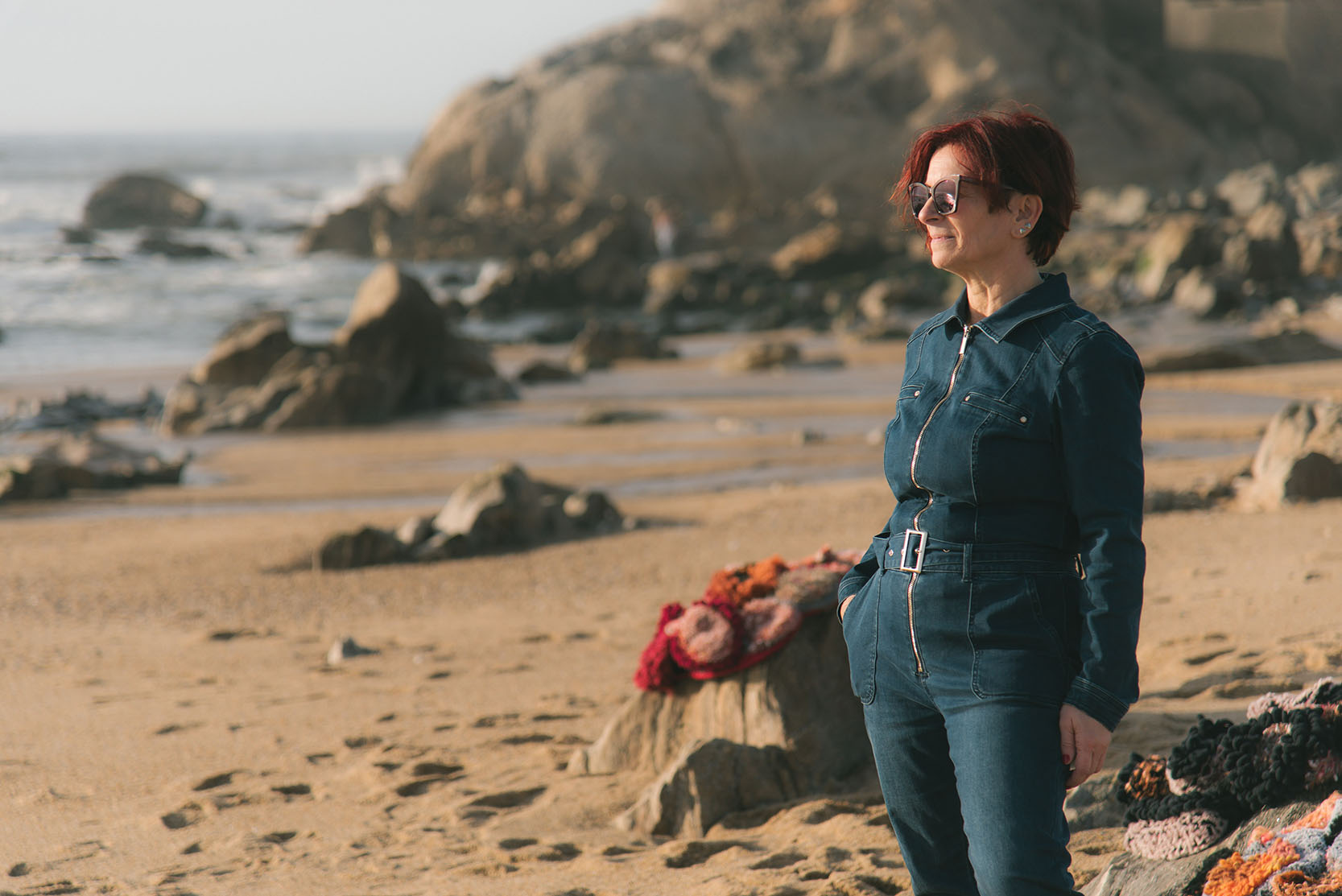
Your solo exhibition “Anemones in Volcanic Rock” is about to debut at Hotel Indigo Dubai Downtown. Can you tell us what inspired this body of work?
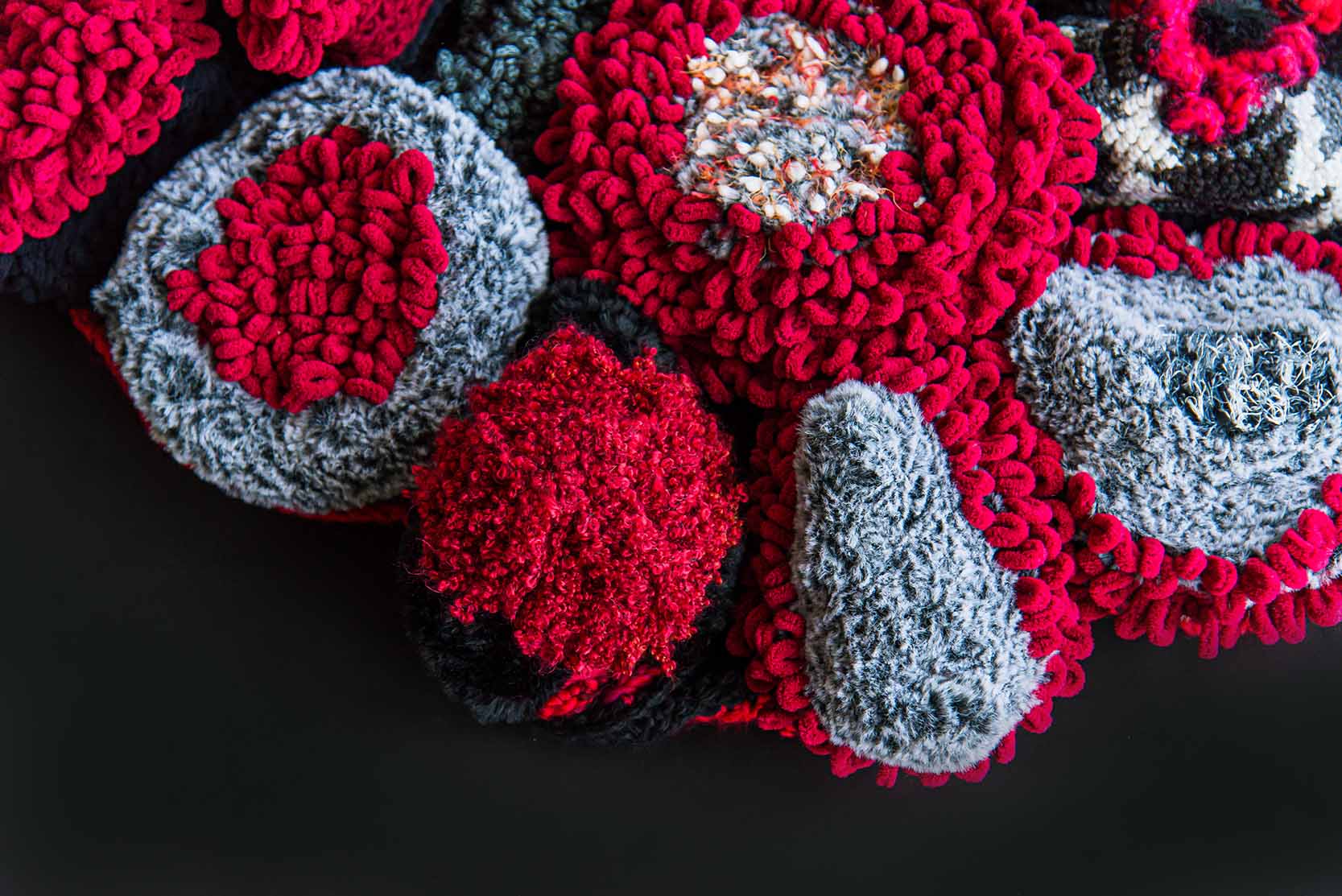
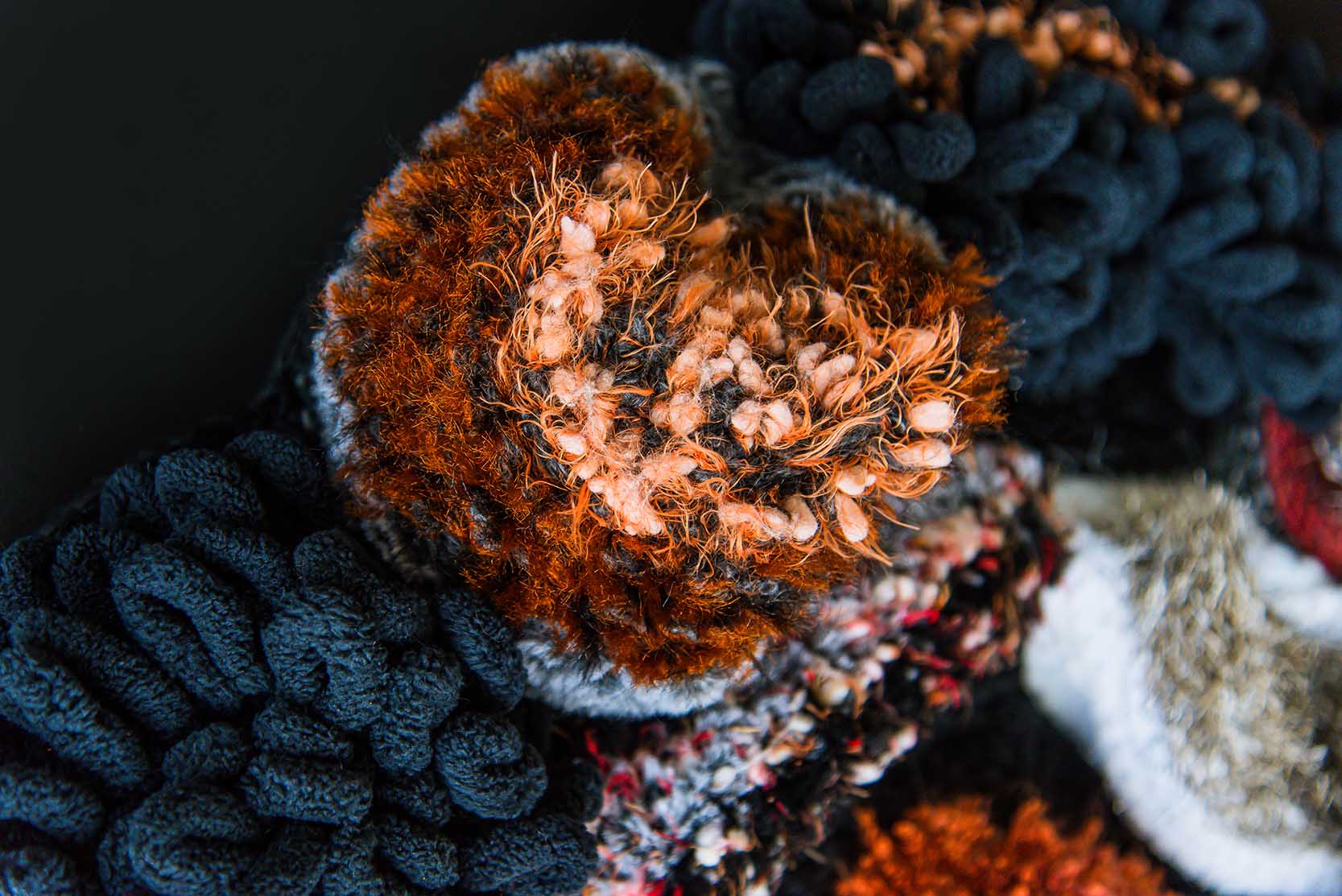
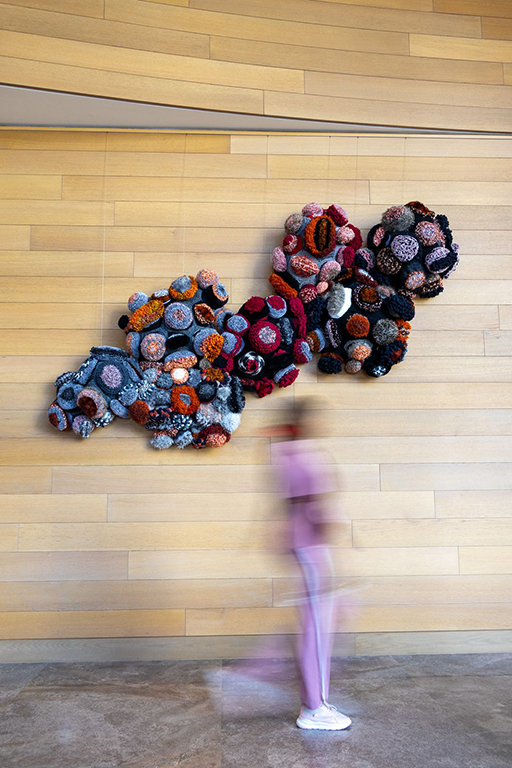
The textile sculpture “Anemones in Volcanic Rock” is a visual homage to the delicacy and strength of natural elements from both sea and land. This work was born from a desire to magnify and reimagine organic forms – corals, anemones, starfish, and shells through the tactile language of textile techniques like knitting and crochet. As if seen through an imaginary magnifying lens, these marine creatures are transformed into soft sculptures that blur the line between the familiar and the fantastical.
From the outset, I envisioned this piece as a wall installation, allowing its sculptural volumes to extend outward and engage the space through bold contrasts of colour, rich texture, and scale. The initial form began as a vibrant, multi-coloured centrepiece, full of texture and movement, where a multitude of marine-inspired shapes converged, brought to life through crochet.
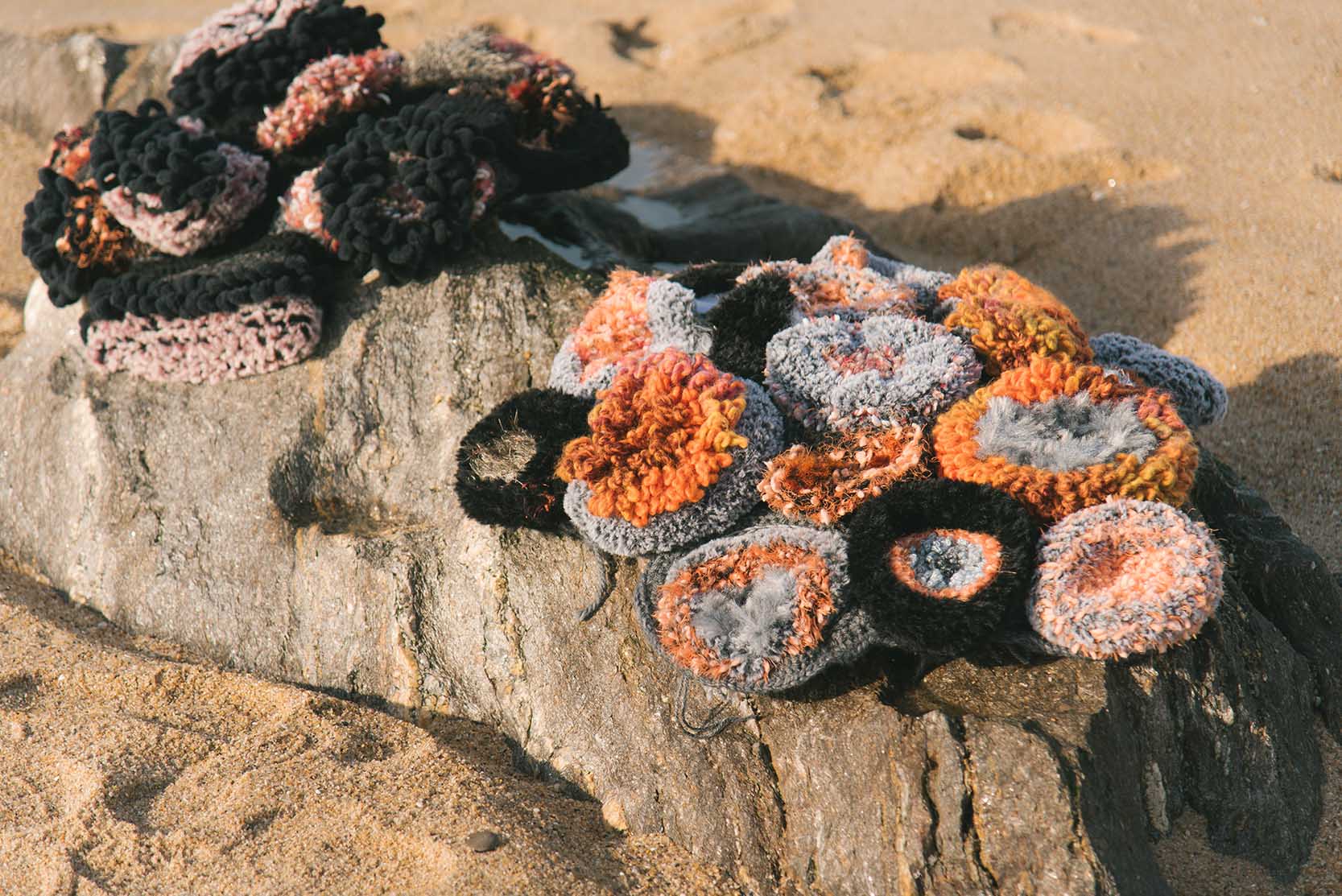
As the work evolved, it grew organically in dimension, intensity, and chromatic complexity. What started as a single central piece expanded into a composition of seven parts: the original core, now surrounded by six additional elements, each with its own unique colour palette and emotional atmosphere. Together, they form a textile archipelago that invites viewers to dive in, to lose themselves in its forms, and to reconnect with the quiet poetry of the natural world.
It belongs to the series “Things from Nature”, a general theme that connects my textiles sculptures since 2016.
The centrepiece of the exhibition is a hexagram-shaped installation symbolizing the four elements. How did this symbolic form emerge in your creative process?
The sculpture “Anemones in Volcanic Rock”, composed of seven pieces arranged in an irregular hexagram and inspired by the ancient symbolism of the Seal of Solomon, brings together the four elements—fire, water, earth, and air, both metaphorically and through color. The volcanic rock evokes the raw forces of fire and earth, serving as fertile ground where anemones take root, thriving between tides, suspended in the eternal dance between water and air. In this way, the sculpture aspires to embody the elemental unity of the universe—a harmonious whole where all forces converge.
The number seven holds profound symbolic resonance for me. It is rooted not only in my own cultural background, but echoes across many traditions, spiritual systems, and fields of knowledge. It represents the seven days of the week (six for creation and one for rest), the seven classical planets, the seven stages of perfection, the seven circuits around the Kaaba in Mecca. Seven also encompasses the planetary and angelic hierarchies, the fullness of celestial realms and moral order. For the ancient Egyptians, it symbolized eternal life—a complete cycle, mirroring the phases of the moon, each lasting seven days.
The Seal of Solomon, represented by two interlocking equilateral triangles, captures this cosmic duality: fire in balance with water, air in contrast to earth. Together, they form a sacred geometry—a symbol of totality across space and time. In Hermetic traditions, the seal expresses the union of opposites, the synthesis of complexity into oneness. It also aligns with the seven base metals of alchemical tradition, with gold at the center—symbol of the sun and the six outer points corresponding to silver (moon), iron (Mars), tin (Jupiter), lead (Saturn), mercury (Mercury), and copper (Venus).
Through this sculptural composition, I aim to evoke not only the delicate forms of marine life, but also the deeper, invisible forces that shape and bind the natural world inviting the viewer into a moment of reflection, connection, and wonder.
You often work with crochet and knitting — techniques deeply rooted in tradition. How do you strike a balance between honoring heritage and pushing the boundaries of contemporary textile art?
Although crochet and knitting are rooted in deep tradition, the way I apply these techniques invites a kind of gentle disruption – a moment of surprise where heritage meets innovation. It’s in this encounter, where the familiarity of the method clashes with unexpected forms, vibrant colors, and rich textures, that a dialogue begins. A silent conversation between the piece and the viewer, the hand and the fiber, the memory and the present.
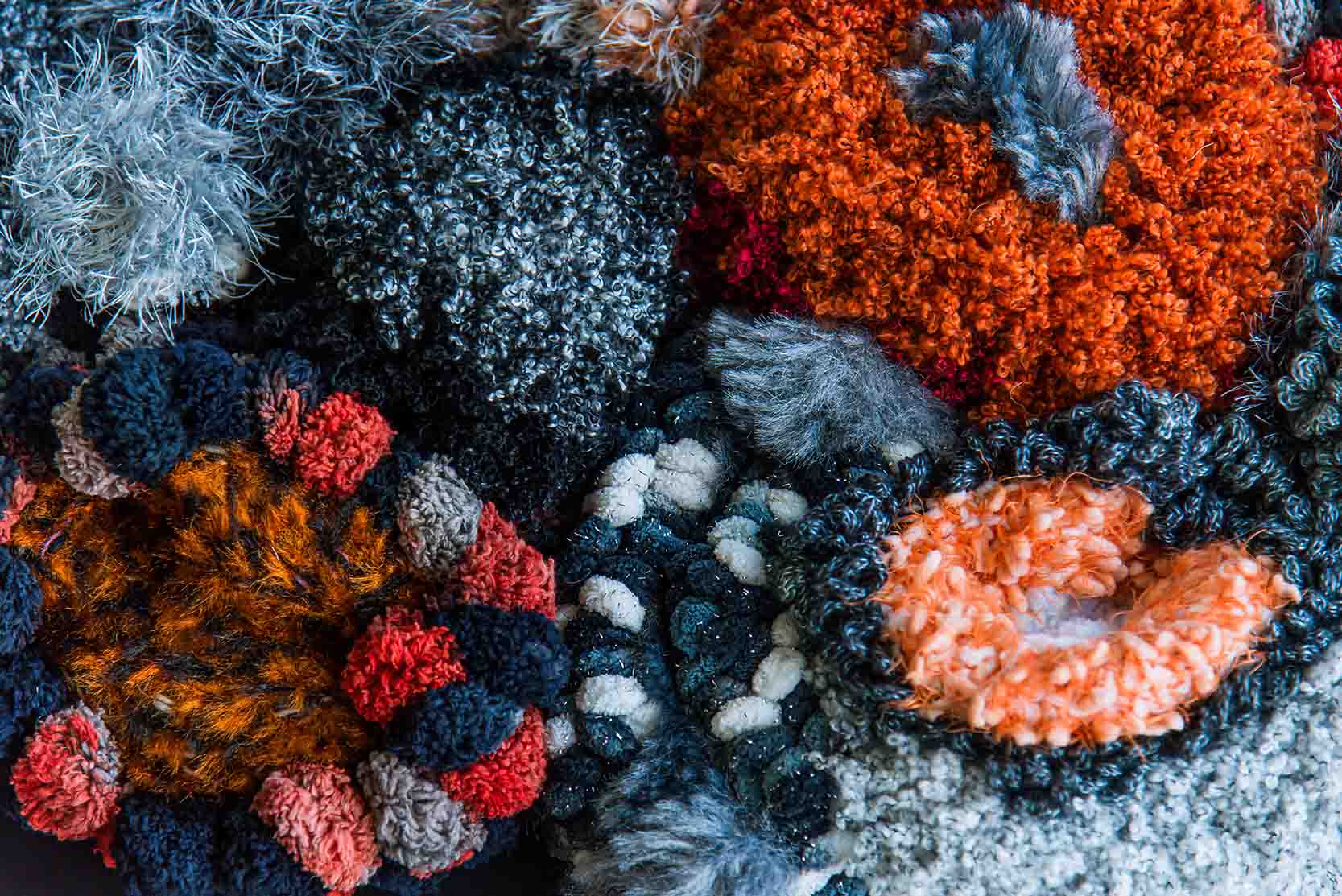
The yarns I use are not chosen at random—they are discovered, collected like treasures from old shops, remnants of long-forgotten collections, or from places that marked my travels. Each carries a story, a texture, a tone. I blend them carefully, playing with contrast or subtle harmony—tone on tone—always guided by the forms and rhythms of nature that inspire me.
These threads become my drawing tools, like pencil or ink in space. Through the slow, meditative practice of crochet and knitting, I “write” in three dimensions. The more complex the thread—with loose fibers or irregular textures—the more time and patience it demands, as I gently untwist it with each loop to achieve the perfect visual and volumetric effect.
The final composition emerges from a radial rhythm—starting at the center and expanding outward—each element joined by a crochet loop. This method allows me to sculpt with fiber, layering textures that echo the tactile richness of natural surfaces. It is a sensory experience designed to invite pleasure—especially through sight and touch.
Ultimately, this process is pure joy for me: to transform something as humble and linear as a thread into organic forms that feel alive. To draw in space with needle and yarn is to shape softness into structure, stillness into movement, and tradition into contemporary expression.
Sustainability is a strong thread in your practice. How does this value manifest in your materials, techniques, or overall artistic vision, especially in this exhibition?
The value of sustainability lies in how each of us takes responsibility for making this world a better place. This responsibility has many layers—and for me, sustainability is deeply interwoven with my creative and professional practice.
It is present in the work I do as the founder and designer of a sustainable brand I created; in the intensive collaborations I undertake with artisans to preserve cultural heritage and improve the quality of their handmade products; and in my mentorship of young designers, where the principles of eco-design are developed and put into practice—blending traditional craft techniques with cultural heritage as the foundation for new creations.
Above all, as a visual artist, I use the textile sculptures in the series “Things from Nature” as a form of awareness—a way to draw attention to the urgent need to preserve nature, to encourage mindful use of resources, and to highlight the vital role coral reefs play in maintaining the balance of marine ecosystems.
The materials I use—yarns—are always sourced from local shops. Often, I find them in abandoned stockpiles, destined for landfill. By using these materials, I address two concerns: I give new life to forgotten resources, and I support small local businesses by purchasing their deadstock.
In this particular piece, I used yarns collected from various places I’ve passed through—Porto, Madrid, Dubai, Venice, Paris, London—each incorporated into the smaller sculptural forms, like a woven record of my travels. In doing so, I integrate fragments of these places into the very fabric of my work.
“Anemones in Volcanic Rock” evokes marine life and geological formations. Why do these natural elements continue to play such a central role in your work?
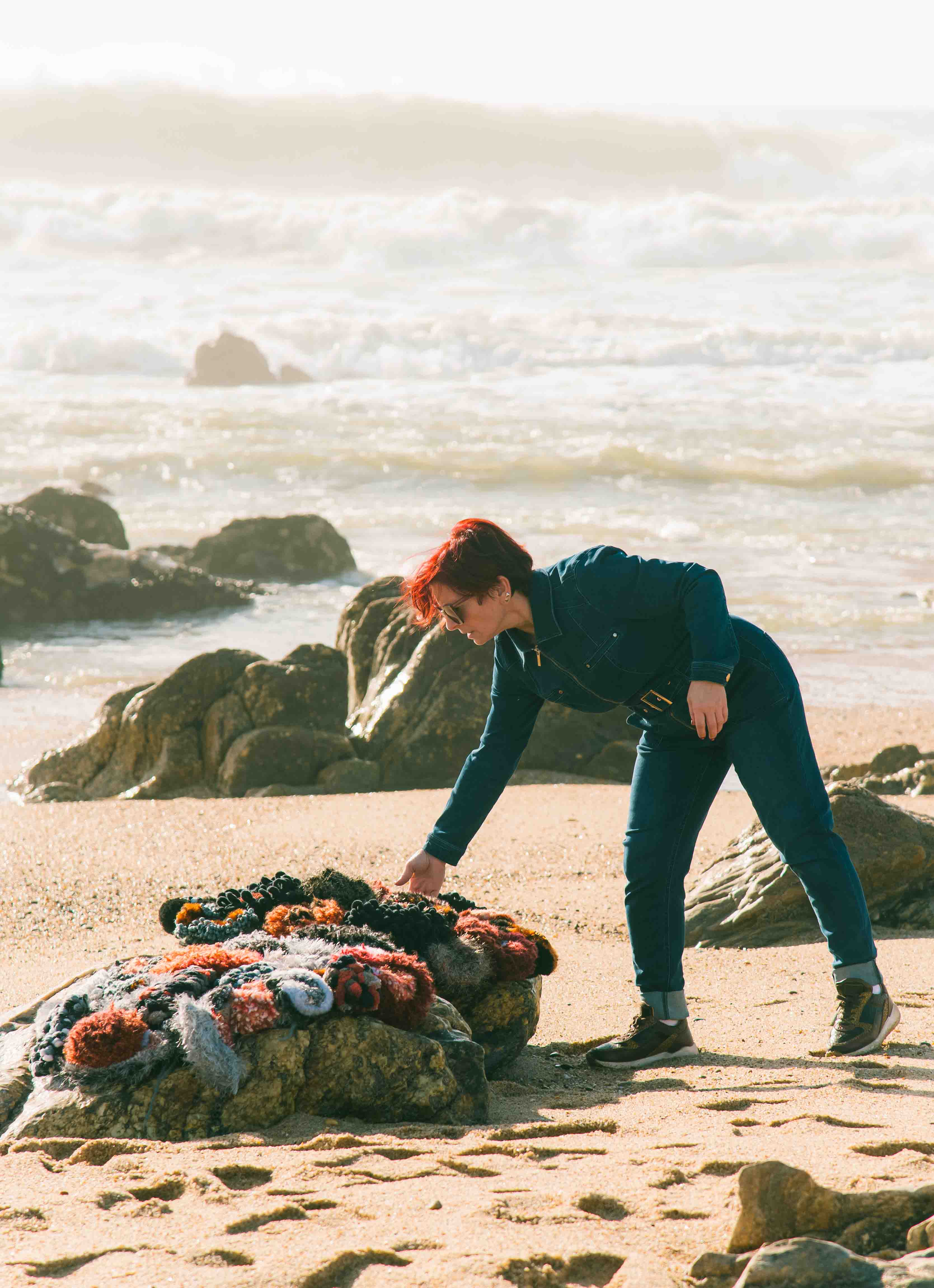
I have always carried the sea within me. Born in Beira, Mozambique, I spent my early years with the Indian Ocean as a constant backdrop—running barefoot on the sand, watching the tides shift, collecting shells, and feeling the pulse of nature all around me. That deep sensory connection to the marine world left a lasting imprint, shaping the way I see, feel, and create.
When I moved to Porto as a child, the landscape changed, but the ocean remained. Porto, a city of stone and mist, lives where the Douro River meets the Atlantic—a meeting point of strength and flow, history and nature. Since 2000, I’ve lived in Miramar, a quiet coastal town where the sea is again part of my daily rhythm, just a short walk from my home.
The Atlantic’s wild energy, the foam of its waves, the creatures that live in the tide pools—barnacles, seaweed, anemones—continue to fascinate me. These forms, textures, and natural movements find their way into my textile sculptures. My work often draws directly from this marine universe, not only visually but emotionally, expressing a lifelong relationship with water, transformation, and resilience.
For me, the sea is more than a theme—it is a memory, a home, and a metaphor. It moves through my practice like a thread, connecting who I am with what I create.
Your art is now being showcased in Dubai, a region with its own rich craft heritage. How do you see the Middle Eastern art scene evolving, particularly in the realm of textile and sculptural art?
Europe, known as the old continent, is often very focused on itself—it holds an immense and extraordinary cultural and artistic heritage. Because of this, it can sometimes struggle to fully understand or embrace other cultures that are equally rich but vastly different from its own reality.
For us Portuguese, positioned at the far western edge of Europe with Spain as our only land connection to the rest of the continent, there is often a sense of being a small and somewhat displaced country. And yet, we have always been remarkably open and integrative when it comes to other cultures. Perhaps it is this openness that allowed me to quickly develop a strong empathy with Arab culture, as well as a deep curiosity about the cultural and artistic heritage of the Emirates.
It was very much in the spirit of adventure—a trait that has characterized the Portuguese people since the Age of Discoveries—that I felt compelled to bring my artistic practice to the Gulf region.
Over these past two years, from 2023 to 2025, I’ve noticed a steadily growing interest in what we call “Fine Craft”—artistic objects created by the hands of the artists themselves using traditional craft techniques. I believe this reflects a broader search for cultural roots, for that which connects us to our communities, and for expressions of identity through handmade art. This movement fosters a strong, empathetic connection between the artist and the viewer—something both intimate and profoundly human.
Has your time in the Middle East, or specifically in Dubai, influenced your creative direction or future themes in any way?
It was through the kind invitation of Jonathan Silva and Jorge Pinto, founders of Double J Collective Gallery, to exhibit my work at World Art Dubai in 2023 that I first had the opportunity to present my art in Dubai. The reception exceeded all expectations—warm, enthusiastic, and deeply encouraging—and I quickly realized there was a genuine and growing interest in contemporary textile art.
Buoyed by this success, I made the conscious decision to invest more deeply in this vibrant market, focusing my practice on textile sculpture. In 2024, I applied to Collect and was honored to be accepted. The piece I created for this opportunity, now exhibited at Hotel Indigo Dubai Downtown, marked a pivotal moment in my artistic journey.
This work enabled me to expand my vision, allowing me to create larger-scale wall sculptures that offer a richer exploration of volume and color. It was a transformative step, one that opened new avenues for expression and deepened the dialogue between form, texture, and space within my practice.
What does it mean to you to be represented by Double J Art Gallery, and how has this partnership helped shape this exhibition?
Being represented by Double J Collective Gallery in the Gulf region is an absolute honor. I’ve known Jorge Pinto for over two decades and Jonathan Silva for more than ten years—both dear friends whose deep commitment and integrity have inspired unwavering confidence in the project they’ve brought to life.
It fills me with pride to be showcased alongside some of the finest Fine Craft artists from Europe, the Gulf, and now, the American continent.
Jonathan Silva, the director of Double J Collective Gallery, is a consummate professional—meticulous, thoughtful, and genuinely devoted to the well-being of the artists he represents. His dedication shines through in every detail.
My participation in this exhibition was made possible through a wonderful partnership between Double J Collective and Hotel Indigo Dubai. This collaboration has already given voice to a variety of artists and themes, and I’m delighted to be part of this evolving and vibrant creative journey.
The opening night takes place at Open Sesame’s Jewellery Box — a very distinctive space inside Hotel Indigo Dubai Downtown. What drew you to this venue, and how does the hotel’s artistic ethos complement your work?
Hotel Indigo Downtown Dubai is, without a doubt, the art hotel of Dubai.
Its identity is deeply rooted in a commitment to creativity and culture. The art collection on display is not only impressive in scale and quality—it’s curated with intention, care, and vision. Having a dedicated curator and an active artistic program in place is truly remarkable and speaks volumes about the hotel’s values.
I have great admiration for the founders of Hotel Indigo Downtown Dubai —not just for its aesthetic and ambiance, but for the thoughtful way its art collection has been developed. It invites every visitor, whether a guest or passerby, to engage with art in a meaningful way—something that remains rare in many parts of the world.
For any artist who knows the realities of exhibiting in different countries, it’s clear what a privilege it is to present work in a space like this. Hotel Indigo is unique in Dubai: a place where artistic knowledge and a genuine desire to share art come together.
To exhibit here is more than an opportunity—it’s a celebration of culture, connection, and the living role that art can play in everyday.
Hotel Indigo Dubai Downtown is known for its dedication to local art and design. How important is it for you to exhibit in spaces that blur the lines between hospitality and gallery experiences?
I often say that the grey areas are always the most interesting ones. They are the spaces that surprise us, that challenge the way we think, that push us to reflect, to question, to speak, and ultimately to arrive at new ideas and unexpected conclusions. And that, I believe, is one of the greatest gifts an artist can receive.
The care and curatorial sensitivity with which Hotel Indigo Downtown Dubai manages its collection is truly exceptional. From the thoughtful way the program is developed to the respectful and attentive treatment of the artists and creatives who exhibit there, everything is handled with impeccable integrity.
This creates a profound sense of trust and security—something invaluable for any artist. To exhibit in a space that honors both the artwork and the artist with such sincerity allows creativity to flourish in its most authentic form.
You’ve recently been part of prestigious platforms like Collect Open and Future Icons in London. What’s next for you after this Dubai exhibition? Any upcoming projects or collaborations we should look out for?
Yes, as artists, we are constantly driven by the urge to externalize our emotions and inner worlds through the creation of new work. It’s an ongoing need to give form to feeling, to translate the intangible into something that can be seen, touched, and shared.
I’m honored to have been selected to participate in the XV Florence Biennale 2025, taking place this October, and I will also be exhibiting at Context Art Miami during Miami Art Week in December 2024.
These upcoming events represent not only important milestones in my artistic journey but also opportunities to continue the dialogue between emotion, material, and audience across different cultures and contexts.
Finally, what do you hope visitors take away from “Anemones in Volcanic Rock”? Is there a particular message or feeling you hope stays with them?
Anemones in Volcanic Rock is a textile sculpture that reimagines the essence of natural elements from the sea through knitting and crochet techniques. With each soft, malleable form, I hope to invite visitors into a space of visual and tactile exploration, where the intricate textures found in nature come to life.
This sculpture was created not only to celebrate the beauty of these organic shapes but also to emphasize their fragility. My intention is for the pieces to evoke a sense of comfort and a deeper connection to the natural world. By blending the delicacy of nature with the language of textile artistry, I hope these sculptures spark reflection on the relationship between human creativity and the environment—creating an immersive experience that lingers with the viewer.