
Visual Thinker Bridging Artistic Inquiry and Social Practice
Laila Demashqieh is an Amman‑based artist, printmaker, and art‑education specialist whose work spans almost two decades and crosses boundaries between artistic inquiry and community outreach. Her distinctive practice encompassing monoprinting, etching, lithography, installation and mixed media is marked by a tactile, conceptual intensity that invites sustained critical engagement.
As an educator and curator, she has co‑founded Alolbah, an initiative that reimagines art education by offering accessible kits, workshops and collaborative exhibitions designed to decentralise traditional models of visual literacy.
Her recent exhibition, The Space Between Spaces, explored themes of erosion, fragmentation, collision and formation through black‑and‑white monoprints that challenge aesthetic conventions and encourage multisensory dialogue.
In this interview, Laila shares the conceptual roots of her latest body of work Continuum, delving into the interplay of control and chaos, form and illusion, and how her structural philosophy of art continues to evolve in both studio and community.
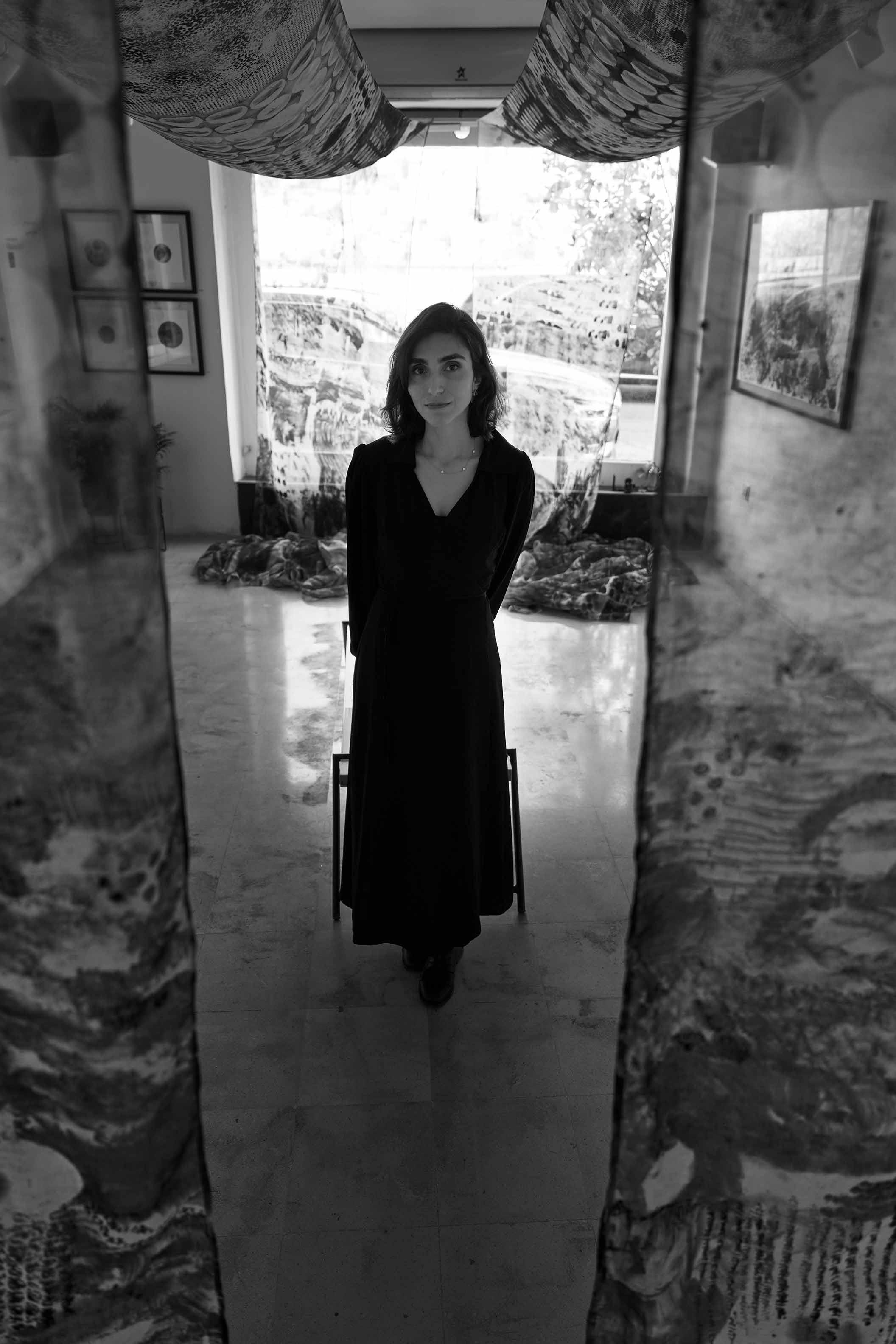
Can you introduce yourself and share how your journey into the visual arts began?
I’m an artist, educator, and community‑development practitioner in the arts. For nearly two decades I’ve worked across monoprinting, etching, and installation. I’ve exhibited in Jordan, Brazil, Germany, the UK, and Türkiye, and I co‑founded Alolbah with artist Rand Abdul Nour, an initiative that challenges conventional art‑education models and expands access to visual literacy through kits, workshops, and collaborative exhibitions.
My practice began from a sense of rupture, both personal and structural. Like many people coming of age amid inequality, political uncertainty, and cultural fragmentation, I struggled to align external realities with inner experience. Art was the first place I didn’t need to resolve those conflicts; a quiet space that felt grounding rather than isolating.
Over time, that attention became a method: less about expressing feeling than examining the frameworks that shape it. What began as instinct became inquiry, a form of embodied research, probing not just what we remember but how we forget; not only what we see but how meaning gets assigned.
Your latest body of work, Continuum, offers a powerful meditation on control and chaos. How did the concept emerge, and what personal or intellectual tensions shaped it?
Continuum didn’t begin with an idea. It began with a failure, the failure of coherence. I was watching systems I once believed in, personal, political, perceptual, begin to unravel. But what replaced them wasn’t collapse; it was repetition. Patterns resurfacing under new names, new narratives, new disguises.
That tension, between motion and stasis, clarity and illusion, became the spine of the work. I started thinking in loops, in feedback, in the architectures of false order we construct when meaning slips, the kind that comforts even as it deceives.
Where earlier work like The Space Between Spaces mourned rupture, Continuum accepts it. It doesn’t search for coherence; it interrogates what we build in the aftermath and why we trust it. The work doesn’t offer exit routes. It offers tools for seeing what we mistake for stability. Systems that don’t collapse; they replicate.
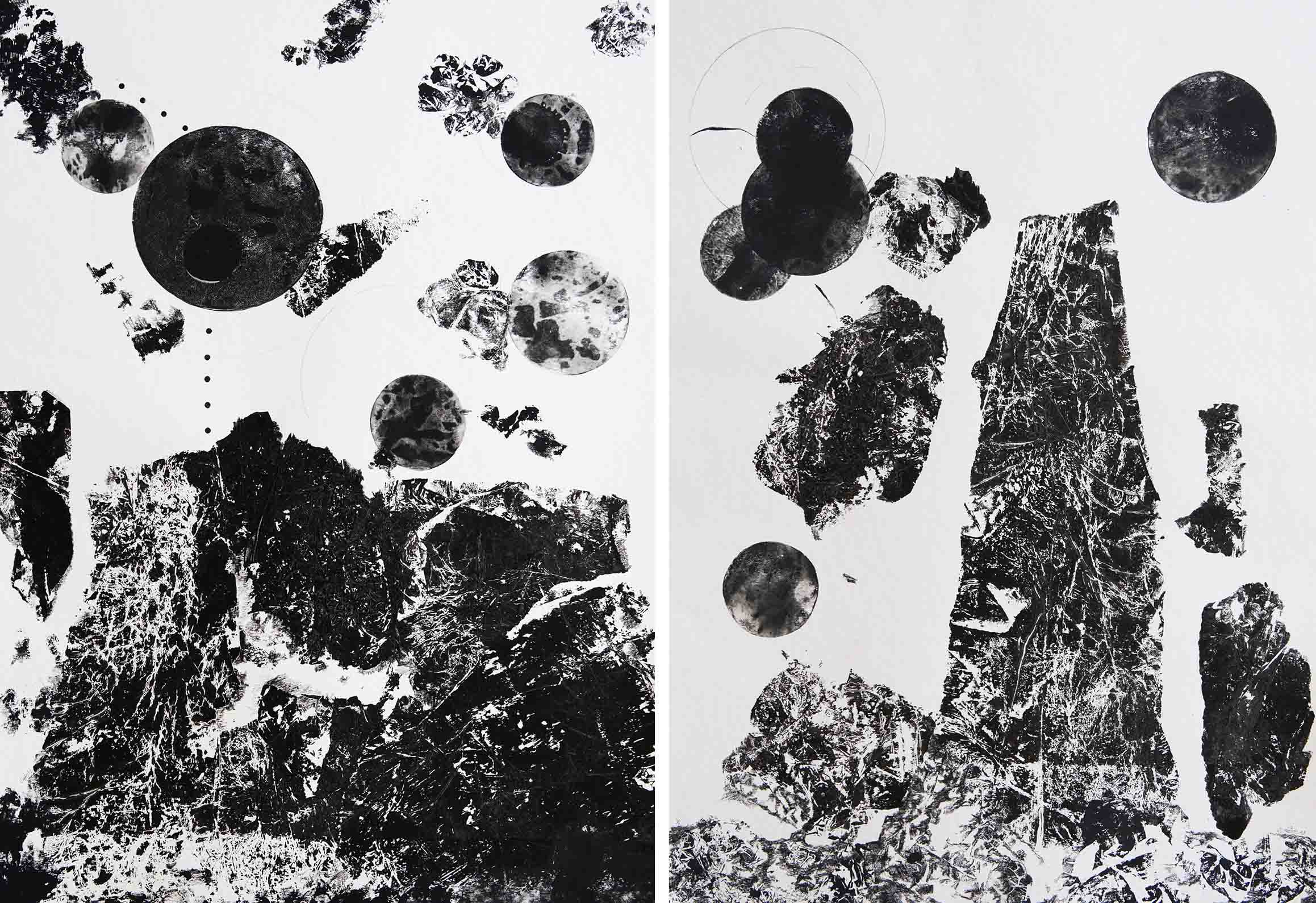
The motif of the sphere recurs throughout this series. What does it allow you to say about influence, illusion, and the desire for control?
The sphere holds a paradox. It appears neutral, symmetrical, complete, but that very coherence can become a form of containment. It suggests harmony, yet suppresses contradiction. In Continuum, I used the sphere to examine the systems we inherit and inhabit, the ones that promise order while quietly scripting repetition.
It became a recurring motif not because of its perfection, but because of its illusion, a seamless loop perceived as perfect. A form that draws you in and denies you exit. The sphere is seductive because it mimics resolution while concealing rupture.
That same tension extended into the spatial soundscape created by Odai Shawagfeh (Ghaem Jozi). The sound wasn’t background; it was structural. Built as a 3D audio field, it wrapped around the body, echoing the visual grammar of the work while destabilising it. There was no fixed point of entry, no resting place. The experience moved as you moved. The sound was mixed for a 3D audio field with no fixed focal point, so the choreography of bodies in the space became part of the piece.
In illusion, the system is never static, it adapts to your motives and impulses, even those buried under layers of denial. It mirrors you, then swallows you. That’s what makes it hard to leave: not because it demands belief, but because it offers the comfort of coherence, even when it’s false.
Your work often engages in philosophical inquiry. How do you balance conceptual rigour with material experimentation?
I rarely begin with form. I begin with a question, or rather, a tension I can’t resolve intellectually. The inquiry precedes the making, not as a set of references, but as a destabilising force that has to be metabolised through the work.
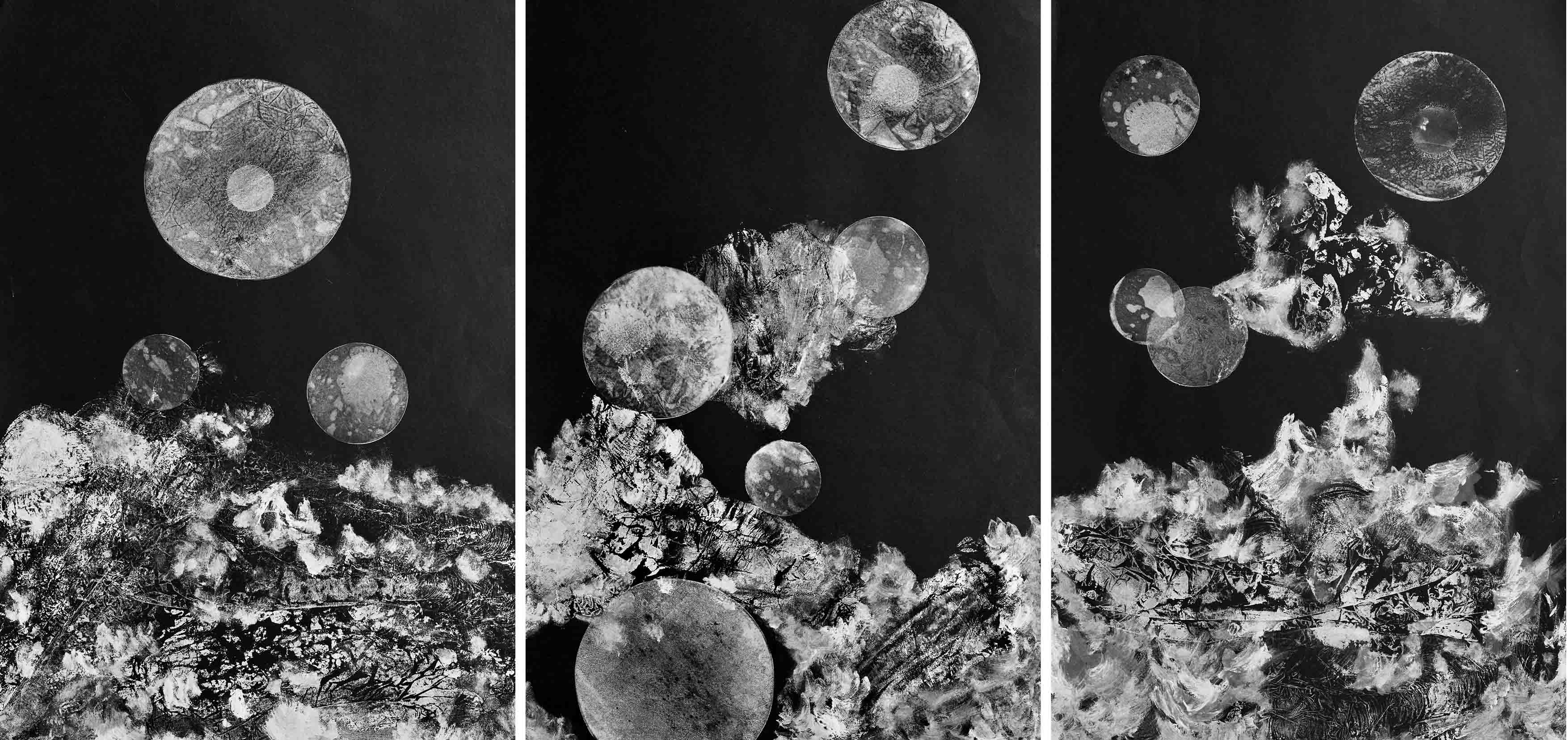
I read across disciplines, but I don’t go into the studio to explain ideas; I go to test them, through pressure, repetition, and ink. Monoprinting allows for both control and surprise. It holds the trace of intention, but also of accident. There’s no exact repeat, only echoes and variations. Most prints are unique monotypes rather than editions, so each carries the record of its own making.
That feels true to the questions I’m exploring: how we see, what we forget, the patterns we fall into. The process itself becomes a way of thinking, not just about the image, but about how we come to understand anything at all.
I treat resolution with suspicion. For me, the work only succeeds if it can both contain an idea and resist it. I’m drawn to thresholds, where the edges blur, where meaning slips, where perception begins to fray. That’s where the experience takes place, not before the work, but within it.
Between The Space Between Spaces and Continuum, your work shifts from mourning rupture to examining the illusions that follow it. How has your understanding of void, repetition, or distortion evolved?
Rupture isn’t clean. It’s preceded by distortion and followed by renewal. The Space Between Spaces was still tethered to grief. The void felt sacred. Still. In Continuum, the void loops. It recycles. It reorganises itself through ideology, language, and multiple narratives, including those projected by the viewer.
I started to notice how repetition can look like progress, even when nothing is really changing. How structure can hide the fact that we’re stuck. So instead of trying to define the emptiness, I began building forms that could hold its unpredictability without trying to control it.
There’s a tactile intensity in your prints, even digitally. How do you think about texture and embodiment in your work, especially in online contexts?
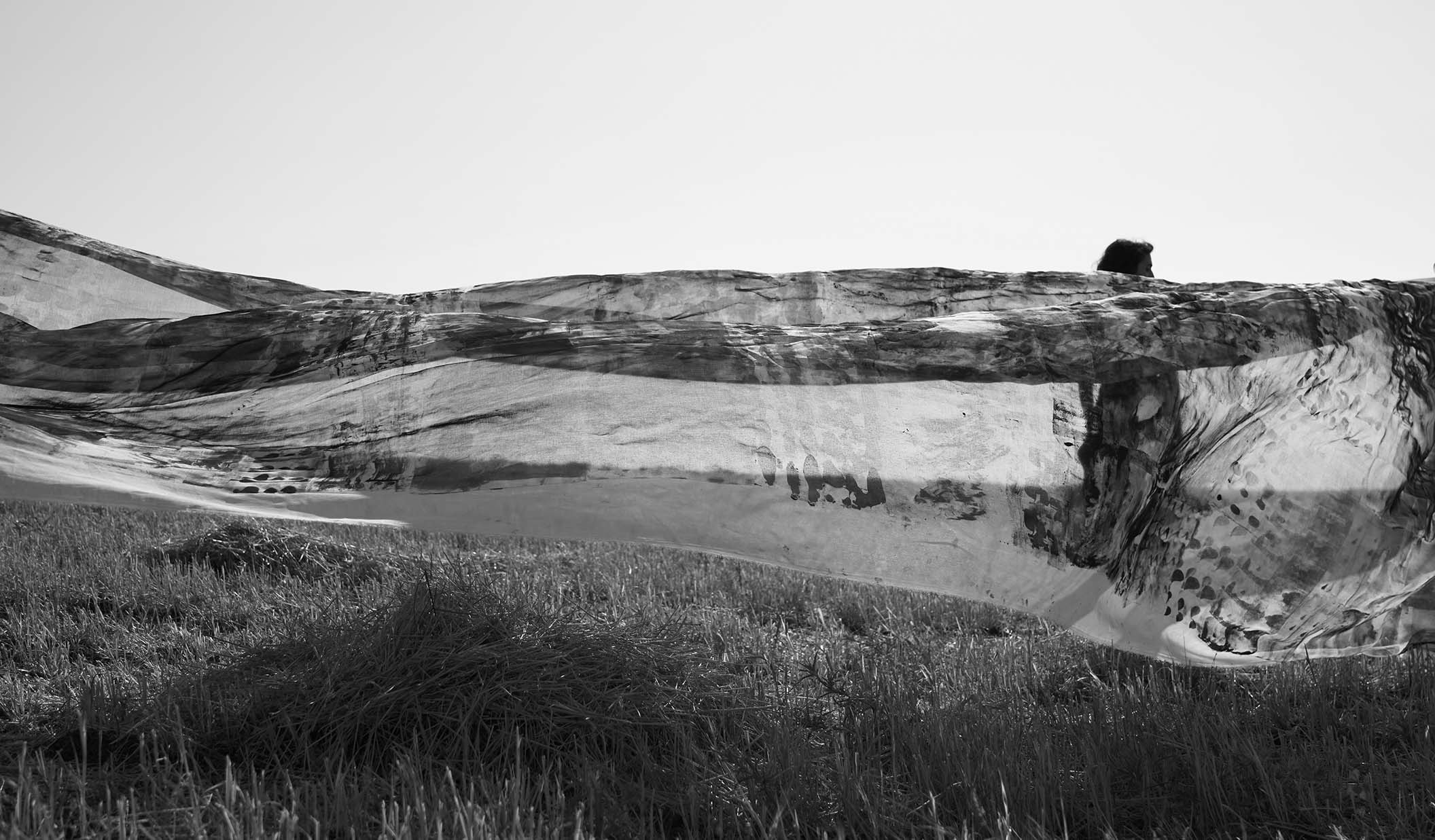
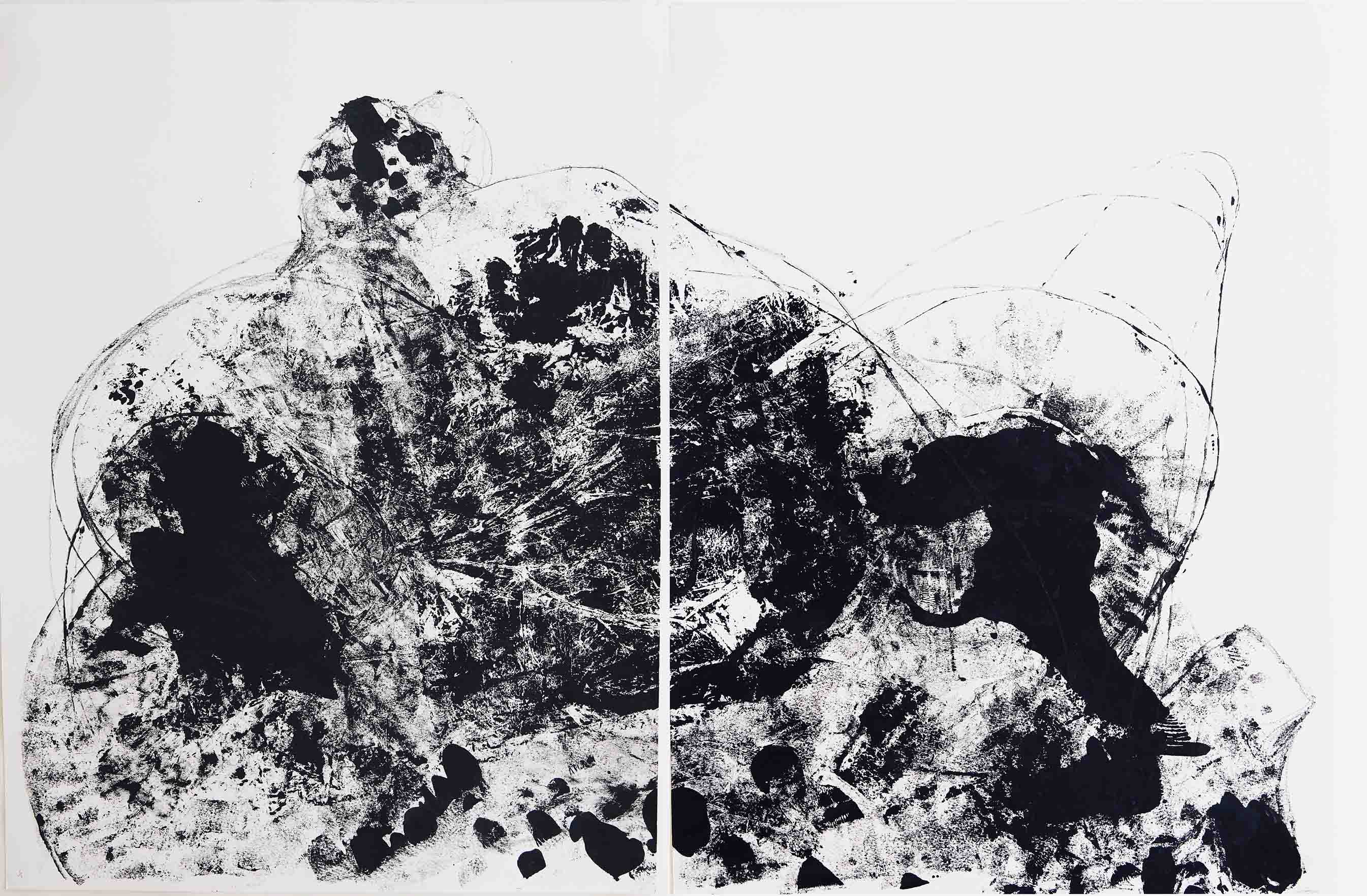
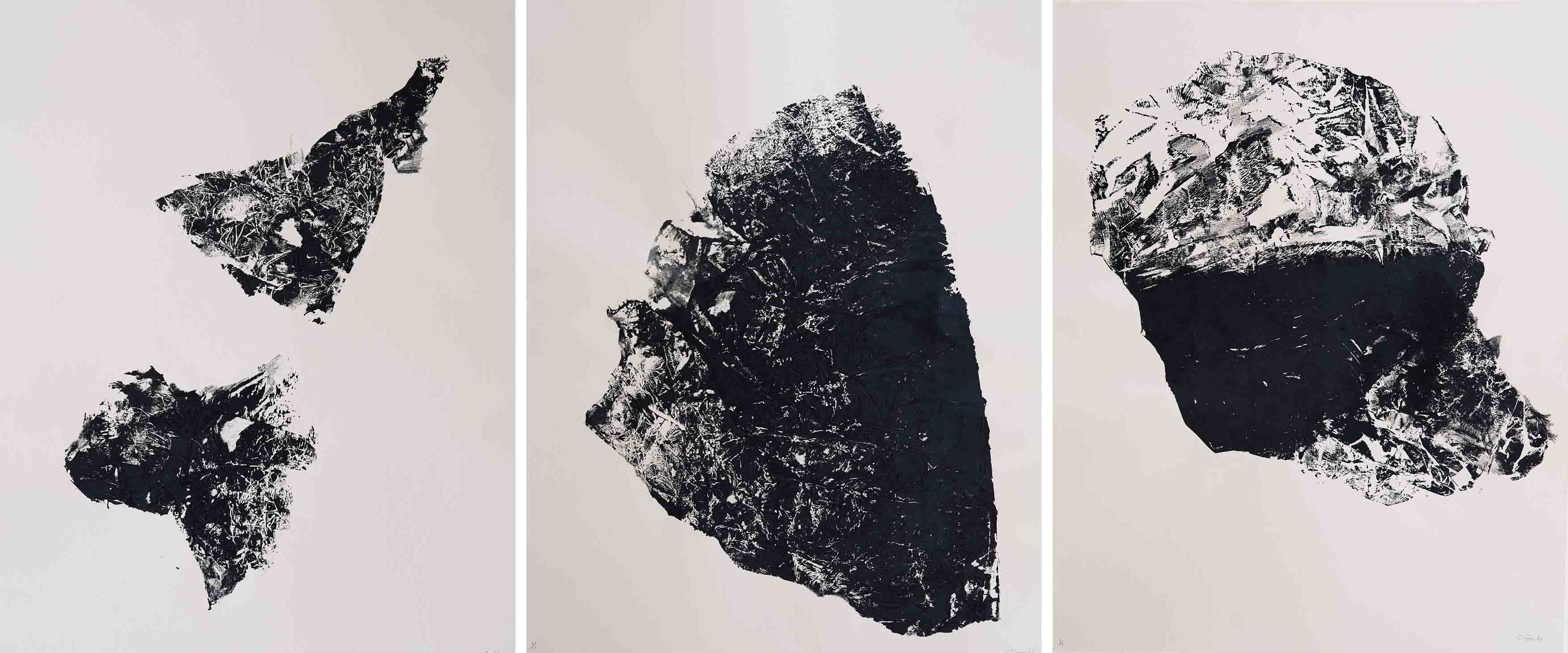
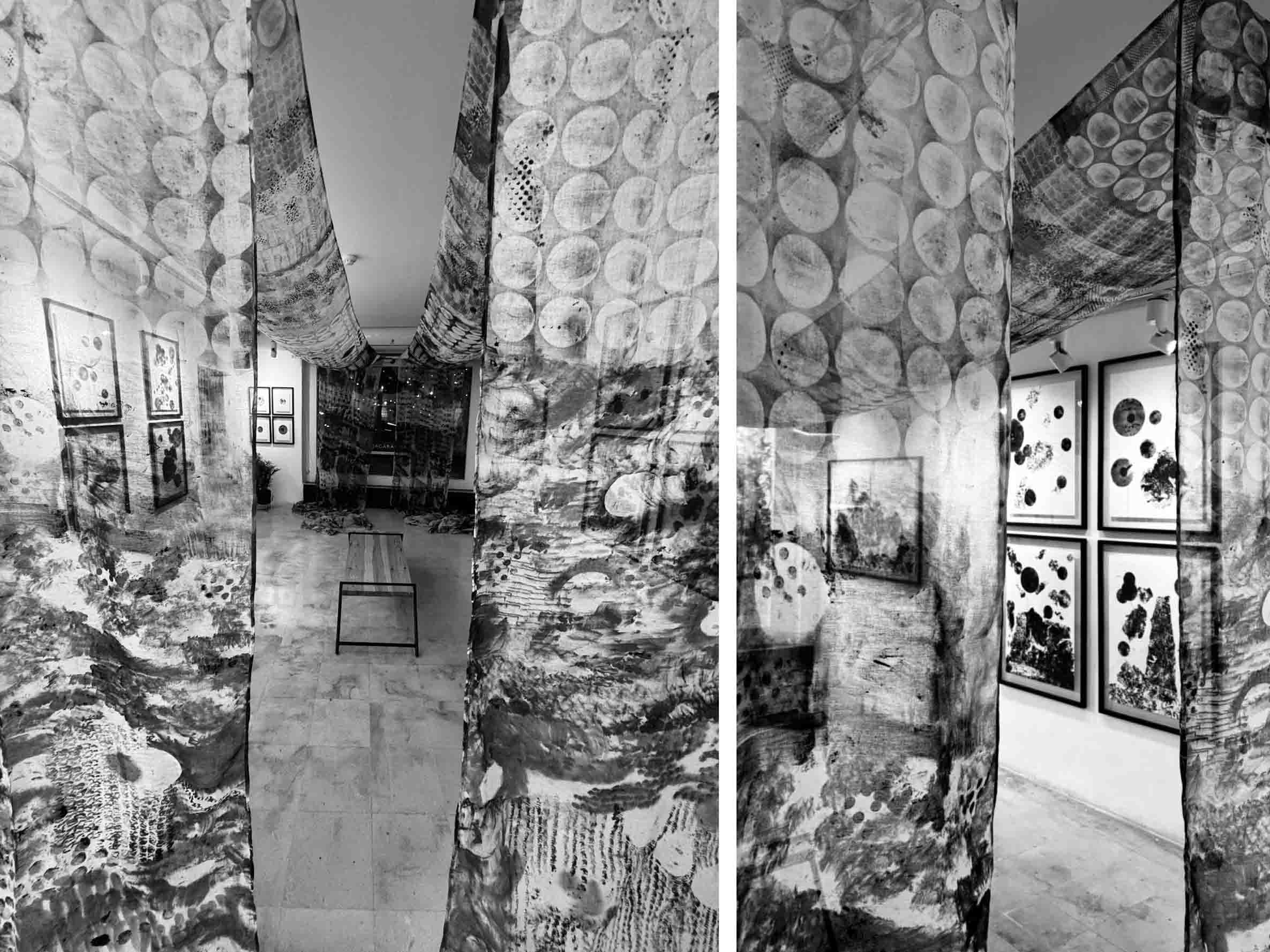
Texture is pre‑verbal. It bypasses interpretation. In my prints, I work with layering, tearing, shadow, and abrasion to create surfaces that feel like they’ve been lived through. Even online, I want the work to carry weight, to resist the seamlessness of digital culture. Recent works range from an 18‑metre hand‑printed textile to large monoprints, where surface pressure and abrasion do as much narrative work as image.
Embodiment isn’t about figuration. It’s about the nervous system. What does the viewer feel, not just emotionally but physiologically? Do they hold their breath? Shift their posture? I’m not interested in illustrating the experience. I want to create the conditions necessary for it to unfold.
Art, in your view, is structural as much as it is personal. Where does your work intervene in the regional art ecosystem, and where are the resistances?
In much of the region, access to art is shaped by inequality and by inherited systems that privilege certain voices and silence others. Institutional frameworks are often borrowed, funding is externally driven, and artistic legitimacy tends to reflect proximity to power rather than depth of practice. This creates a cycle where the same types of artists, stories, and formats are elevated, while others remain invisible.
My work intervenes at that structural level. I try to create formats, whether exhibitions, workshops, or community initiatives, that don’t just mirror these hierarchies but actively question them. I’ve learned that making art accessible isn’t just a logistical issue; it’s a political one. Who gets to express themselves? Who gets to be heard? Who decides what counts as art?
In addition to actively working to empower communities throughout the region, much of my work focuses specifically on supporting women and girls, not just by inviting them into the art world, but by reshaping what that world looks like from within. I bring together education, art, and activism because I see them as inseparable. Over the years, I’ve designed participatory projects, exhibited work that engages with sociopolitical contexts, and built long‑term platforms that centre care, agency, and access.
Resistance appears in many forms: the pressure to simplify work for legibility, to meet external expectations, or to speed up timelines in the name of scalability. I resist that by working slowly, prioritising depth, and designing spaces where fragility isn’t a flaw, it’s a method. Not everything has to be polished to be powerful. Sometimes the most important work happens before it’s ready to be seen.
You’ve co‑founded Alolbah, an art‑education initiative. How does your curatorial voice shift between the studio, the classroom, and the community space?
Alolbah was co‑founded with Rand Abdul Nour, a brilliant and multifaceted creator whose work spans production design, art education, community engagement, and a wide range of drawing and painting practices. Our partnership is not just foundational to Alolbah; it is Alolbah. Everything we’ve built has come from deep trust and constant exchange. I’m lucky to work with someone whose insight and creativity push me to grow.
From the start, we knew Alolbah couldn’t follow a top‑down model. We designed it to share authorship, not by removing it, but by spreading it. Authorship becomes a structure, not a signature. In my studio, I might hold the frame; in the classroom, I stretch it; in the community, we take it apart and rebuild together. Rand and I shift between roles, artist, facilitator, co‑learner, often holding them at once. That’s the practice: staying open, responsive, and intentional.
We’re also deeply aware that access to art isn’t evenly distributed. Who gets to become an artist, whose voice is nurtured, seen, and sustained, is shaped by systems: class, geography, gender, education. In our workshops, we try to name that clearly. Not to burden the space, but to make it more honest. Recognising privilege doesn’t mean stepping back; it means stepping in differently, with accountability and with care. That’s how art becomes more democratic: not by lowering standards, but by expanding who gets to shape them.
Many artists today feel pressure to be socially engaged, conceptually rigorous, and market‑savvy all at once. Where do you feel most free or most conflicted?
I feel most free when the work is still unformed, raw, unresolved, not yet speaking in clear terms. Just friction, not meaning. That’s where the possibilities are.
The conflict comes later, when that ambiguity has to be translated for systems that demand clarity: funding, exposure, commerce. I’ve learned to treat those systems as scaffolding, not to dilute the work, but to shield it. Sometimes the most radical gestures are housed within the very structures meant to contain them.
What’s something you’ve recently unlearnt about being an artist, an expectation or belief that no longer serves you?
That the work will speak for itself. It doesn’t, or not in the ways we want to believe. Art has never travelled on merit alone. It needs context, language, infrastructure, and care.
This hasn’t diminished the practice; it’s sharpened it. The work doesn’t end at the edge of the image. It extends into how it’s shared, framed, misunderstood, defended. You have to think systemically, not just aesthetically. I used to believe that integrity meant staying silent and letting the work “speak.” Now I understand that giving it a voice, a context, a channel, is part of the practice itself.
What do you wish interviewers would ask more often, or stop asking altogether?
I wish more questions were asked about what remains unresolved, what the work resists, rather than what it resolves; about the friction that doesn’t settle, the meanings that shift even after the work is finished.
And maybe fewer questions about “inspiration,” as if it arrives in a flash. It doesn’t. It accumulates through contradiction, attention, and pause. Sometimes it shows up as residue, sometimes as rhythm. It’s less a muse, more a method.
What are some of your other hobbies and interests?
I read across genres, and often reread what sticks. I’m drawn to films that take cinematic risks or leave room for the viewer. I try to stay physically active, even if it’s just a short walk, and I keep a few podcasts in regular rotation. When I travel, I keep a small sketchbook for quick notes on light, surfaces, and how a place feels. I don’t think of these as hobbies; they’re simple habits that keep my attention sharp, and they feed the work.
Your message for us at CP Magazine?
Thank you for asking questions that didn’t require performance For understanding that art isn’t just output but inquiry, relation, and resistance. Thank you for giving space for all three.
Artwork: © Laila Demashqieh.
Photos shot by Jafar Marwan.