
“Home exists somewhere between memory and the present”
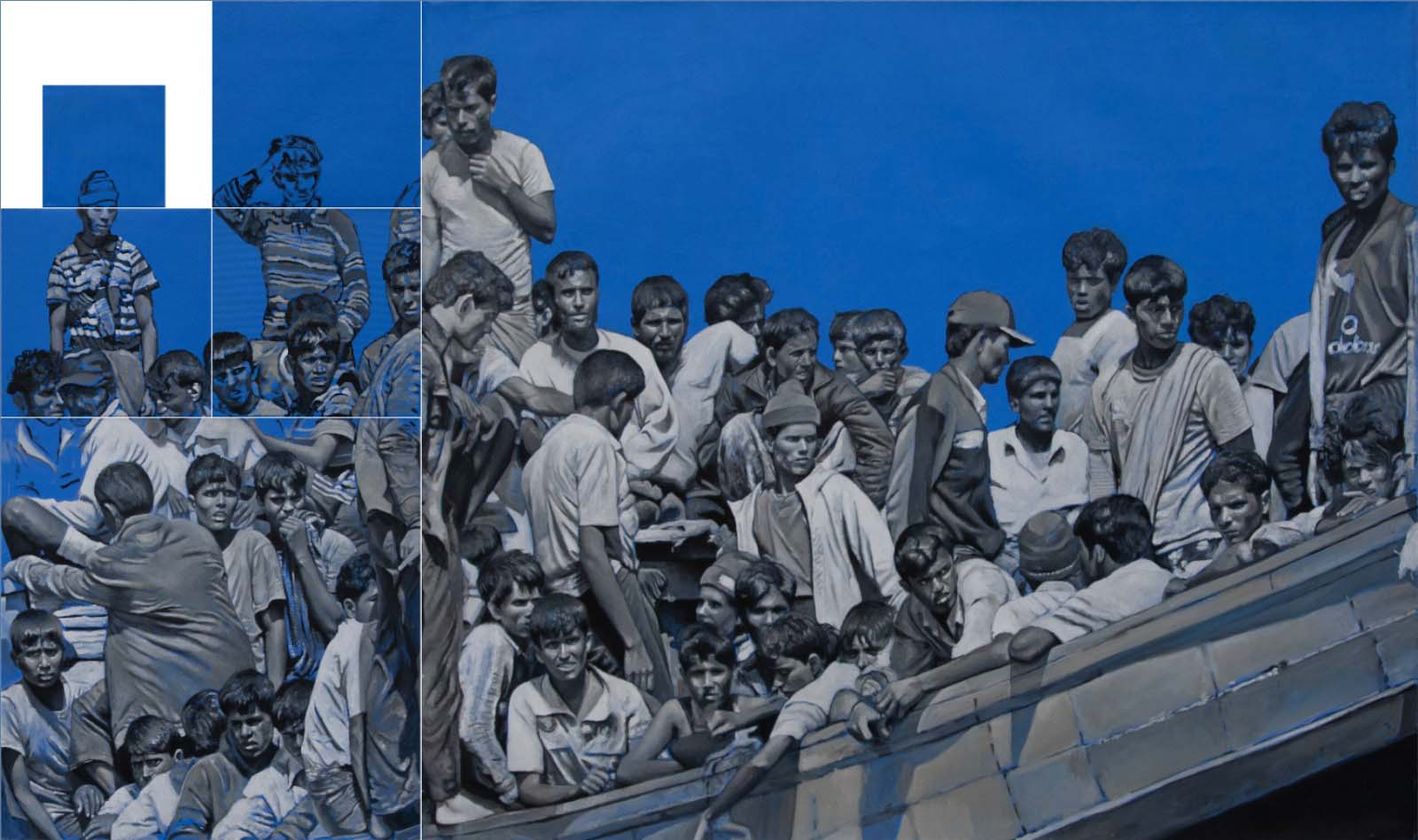
Some artists document history. Others quietly redefine how we understand it. Syrian artist Abdalla Al Omari belongs firmly to the latter. While his internationally acclaimed The Vulnerability Series first brought global attention to the human cost of conflict through striking portraits of power turned upside down, his work has since evolved into something even more profound: an exploration of what happens long after the headlines disappear. Today, his paintings ask not only what exile takes away, but how it reshapes memory, identity and our understanding of home.
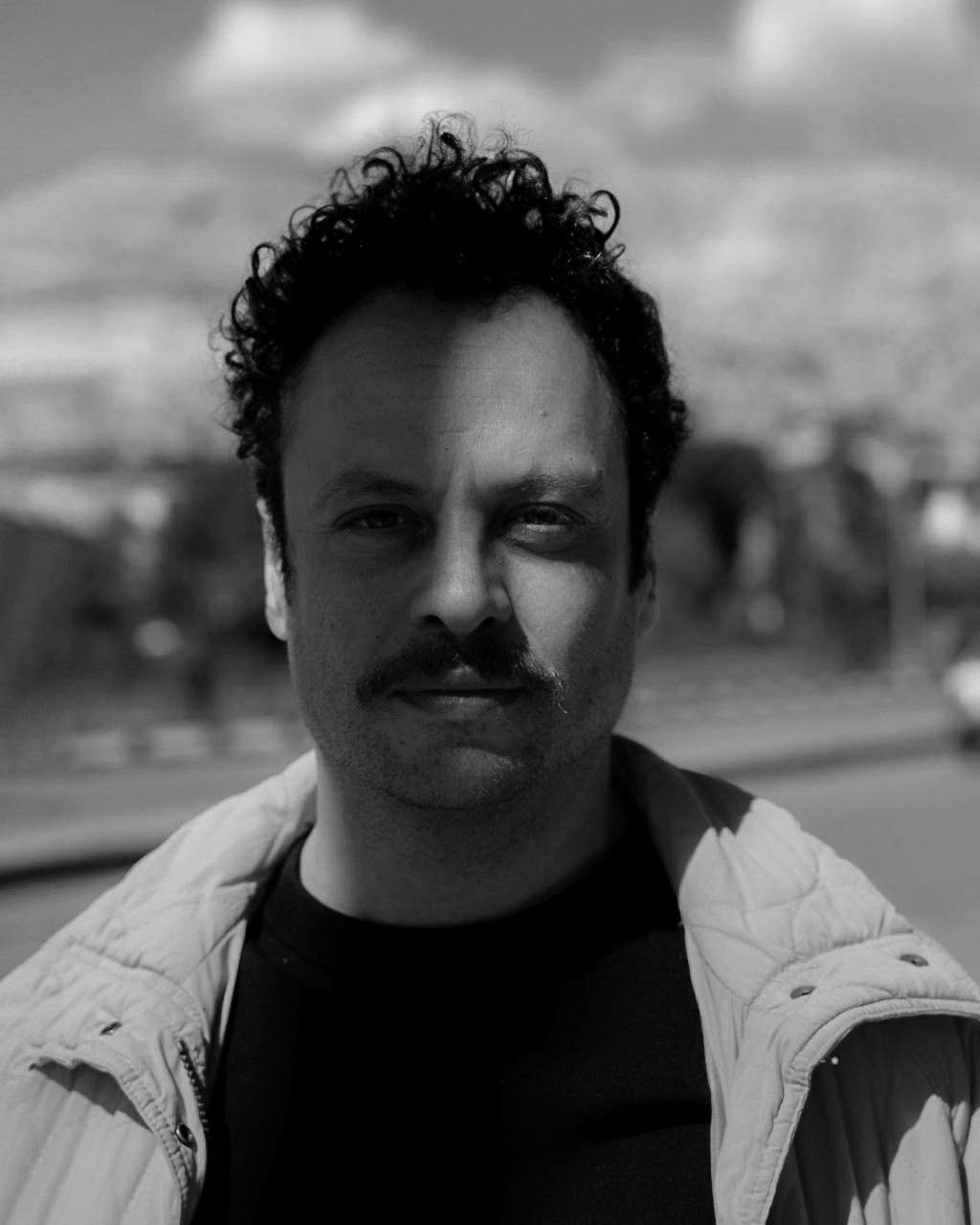
Now based in Belgium after leaving Damascus, Al Omari has built an international reputation for creating emotionally charged works that balance extraordinary technical precision with remarkable psychological depth. Rich in colour and symbolism, his paintings occupy the delicate space between realism and introspection, inviting viewers to look beyond politics and towards the universal emotions that connect us all. Beauty, in his hands, is never decorative; it is a quiet act of resistance against indifference.
For Al Omari, painting is no longer simply a means of recording loss, but of understanding transformation itself. His canvases suggest that identity is never fixed, memory is never static, and beauty can coexist with profound sorrow. It is this delicate balance between intimacy and universality that continues to captivate audiences around the world.
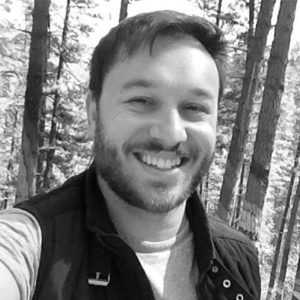
José Berrocoso, Lifestyle Editor at CityPages, speaks with Abdalla Al Omari about beauty as resistance, the fluid nature of identity, and the enduring power of art to transcend borders.
Your recent work feels less concerned with documenting exile and more with understanding what exile does to identity. Has your relationship with displacement changed over time?
In the beginning, exile was something external. It was about losing a place, a city, a familiar landscape. Over time, I realised that displacement is not only geographical. It changes the way you remember, the way you imagine yourself, even the way you relate to time. I no longer think of exile as an event that happened to me, but as a condition that continues to shape who I am. It has become less about absence and more about transformation.
People often describe your work as political, yet what strikes me most is its emotional intimacy. Do you see yourself as a political artist, or simply as someone trying to paint the human condition?
I have never started a painting with the intention of making a political statement. Politics enters the work because politics affects people’s lives. What interests me is vulnerability, dignity, fear, hope, all the emotions that exist beneath headlines. If people see the work as political, that is understandable, but I think of myself first as someone trying to understand human experience.
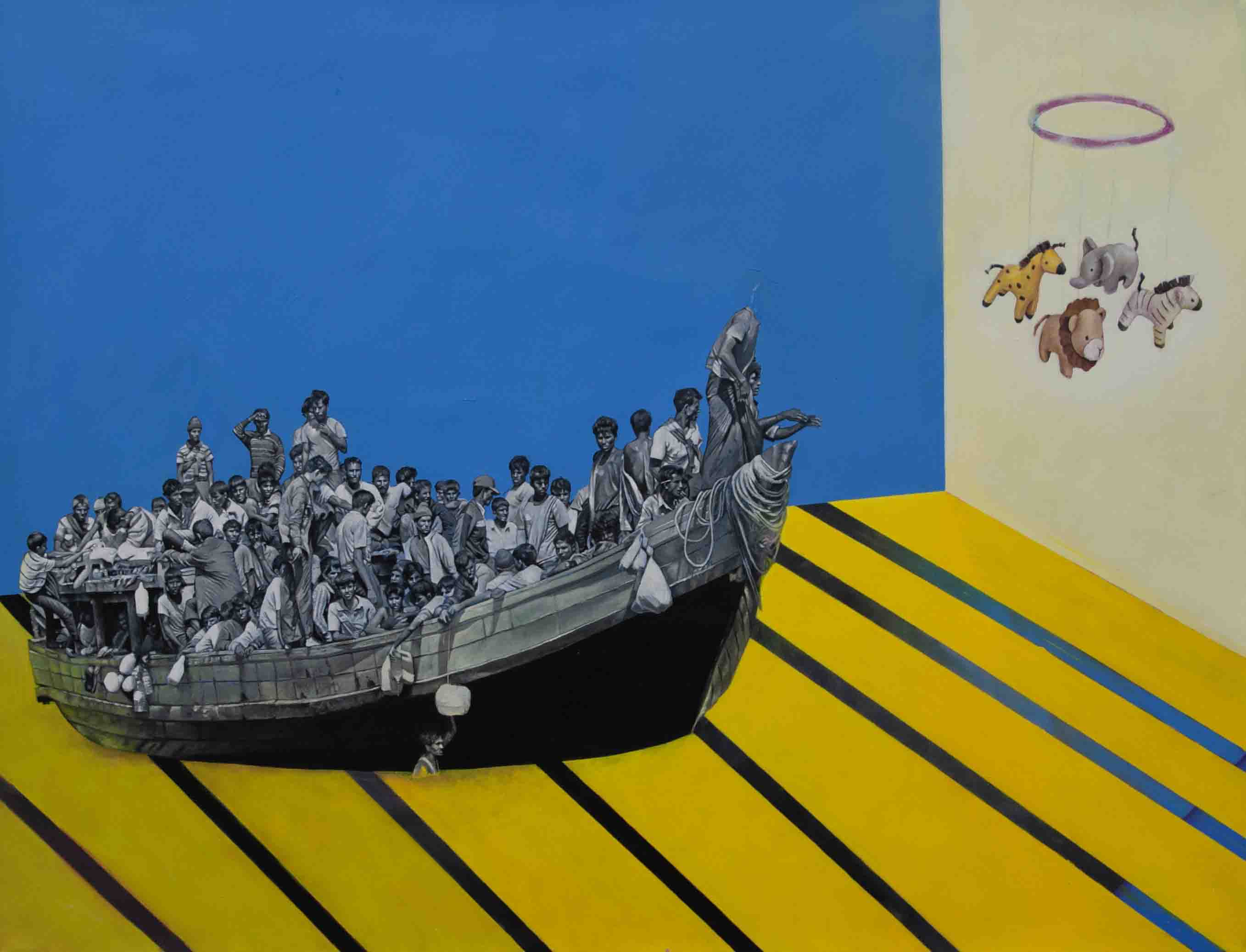
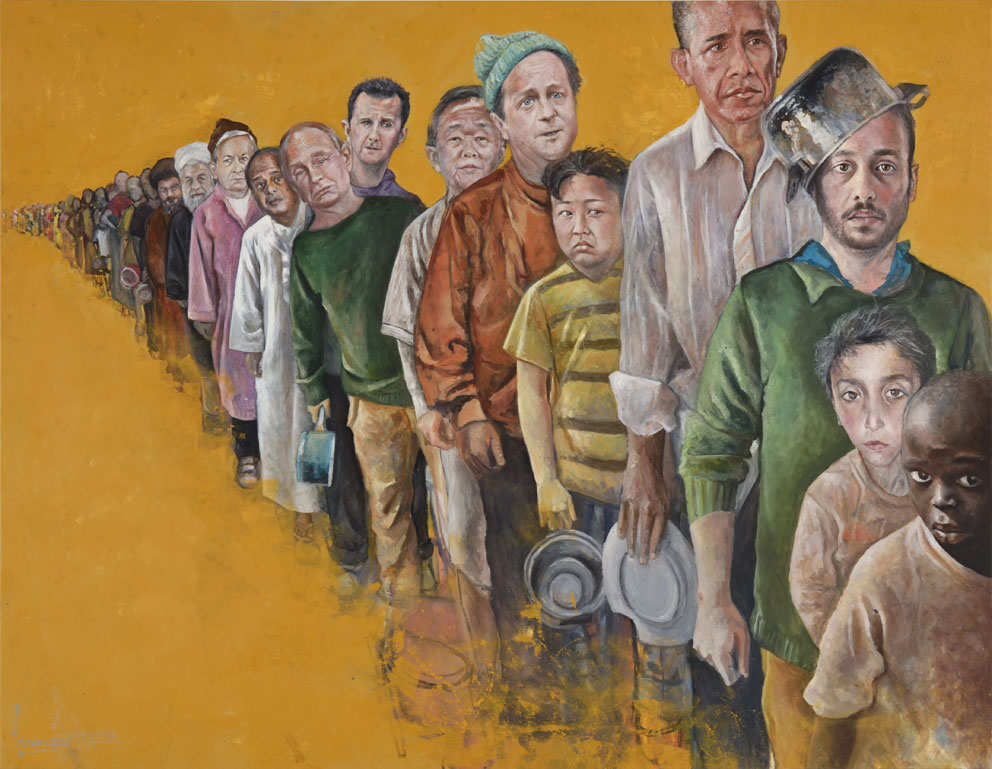
The Vulnerability Series introduced your work to an international audience almost overnight. Looking back today, do you still recognise yourself in those paintings, or do they belong to another version of Abdalla Al Omari?
I still recognise them because they came from an honest place. They belong to a particular moment in my life and in the world. At the same time, every artist changes. I would not paint them in exactly the same way today, because my questions have evolved. Rather than seeing them as something I left behind, I see them as part of an ongoing conversation with myself.
Your paintings often portray painful realities through extraordinarily beautiful compositions. Do you believe beauty can make difficult truths easier to confront, or is beauty itself a form of resistance?
Beauty has the power to invite people to stay with an image longer than they otherwise might. If beauty creates the space for empathy, then it becomes meaningful. I don’t see beauty as decoration. I see it as a form of resistance against indifference.
Memory seems to inhabit almost every canvas you paint. Is remembering, for you, an act of preservation, resilience, or simply survival?
Probably all three. Memory preserves what has been lost, but it also changes over time. It is never completely fixed. For someone who has experienced displacement, remembering is a way of maintaining continuity with the past while accepting that the past cannot be recovered exactly as it was. Painting allows me to revisit memory without trying to imprison it.
Your work explores identity as something fluid rather than fixed. Do you think we discover who we are, or do we spend our lives continuously reinventing ourselves?
I think identity is always evolving. We carry our history with us, but every experience changes us a little. Exile made that very clear to me. I am still Syrian, but I am also shaped by every place I have lived and every person I have met. Identity is not something we arrive at once and for all. It is something we continue to negotiate throughout our lives.
After so many years away from Damascus and building a new life in Belgium, what does the word home mean to you today?
Home has become more complex. It is no longer only a physical place. Of course Damascus remains deeply rooted in me, but home is also where relationships grow, where work becomes possible, where you can imagine a future. Perhaps home today exists somewhere between memory and the present rather than belonging entirely to either.
Has painting become the place where you understand yourself, rather than simply express yourself?
Yes, I think painting has always been a process of discovery. Often I don’t fully understand what I am trying to say until the work is finished. It allows me to ask questions that cannot easily be answered with words. In that sense, painting is less about illustrating ideas than about finding them.
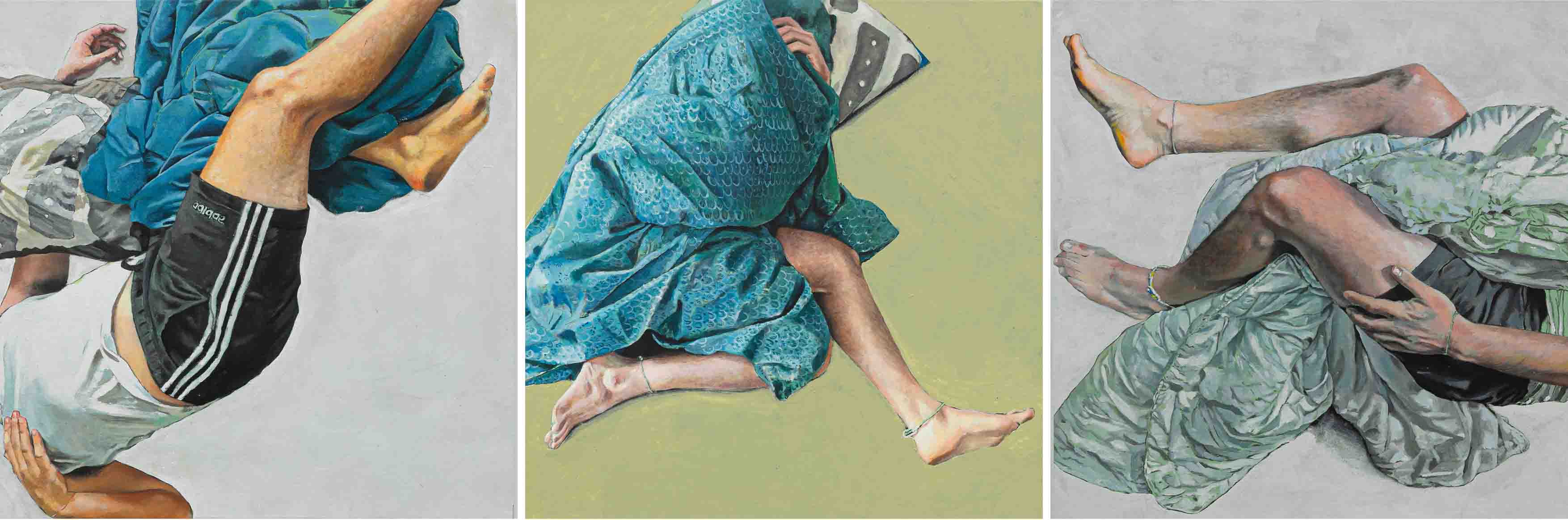
This summer you’re taking part in Tangerine Dreams at Ayyam Gallery in Dubai, an exhibition centred around the colour orange. What intrigued you most about this curatorial concept, and how did it influence the work you chose to present?
I liked the idea that a single colour could carry so many different meanings depending on context. Orange can suggest warmth and light, but it can also evoke transition, uncertainty, even longing. Rather than treating it as a purely formal element, I was interested in how colour could become part of the emotional language of the work. The exhibition offered an opportunity to explore that relationship in a focused way.
Orange is often associated with warmth, transformation, memory and shifting horizons. Within your contribution to Tangerine Dreams, what does this colour symbolise for you personally, and what do you hope viewers take away from it?
For me, orange suggests a moment between endings and beginnings, like the light just before sunset. It carries both hope and melancholy. I hope viewers do not leave with a fixed interpretation, but with a feeling that colour itself can hold emotional complexity, just as people do.
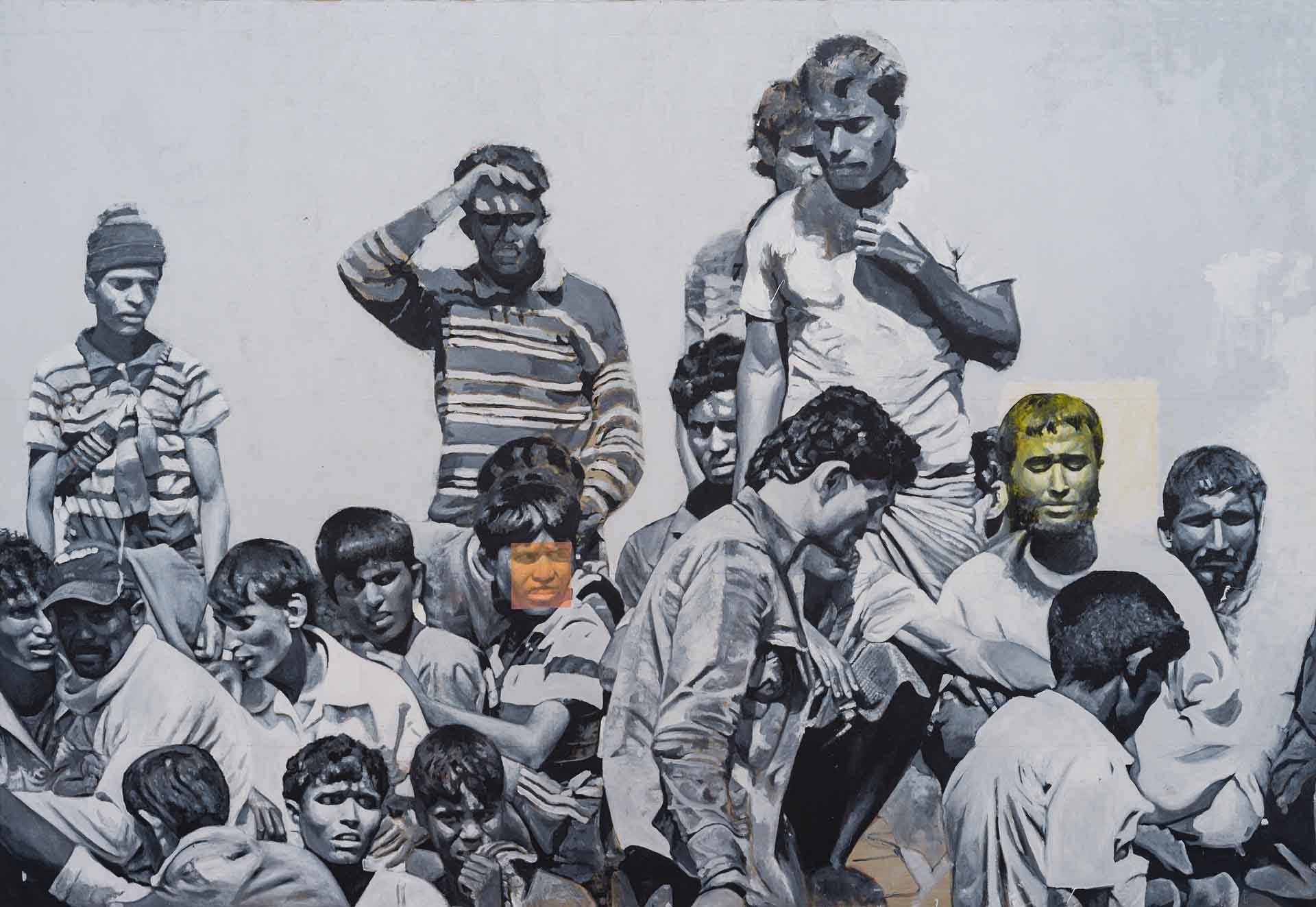
Although you’ve built your career across Europe, you continue to exhibit regularly in the Middle East. Does presenting your work in the region carry a different emotional significance for you?
It does. Audiences in the region often recognise certain cultural references instinctively, but I don’t believe the work belongs only to one audience. Human emotions travel beyond geography. Exhibiting in the Middle East feels like maintaining an ongoing dialogue with a part of myself that remains deeply connected to where I come from.
If someone who knew nothing about Syria encountered only one of your paintings, what would you hope they discovered, not about your country, but about humanity?
I would hope they recognised themselves. My paintings are not ultimately about Syria as a subject to be explained. They are about vulnerability, dignity, loss, hope and resilience. Those experiences belong to all of us. If the work reminds someone that every life contains a story worthy of empathy, then I feel the painting has done its job.