
“A rhythm of light and motion”
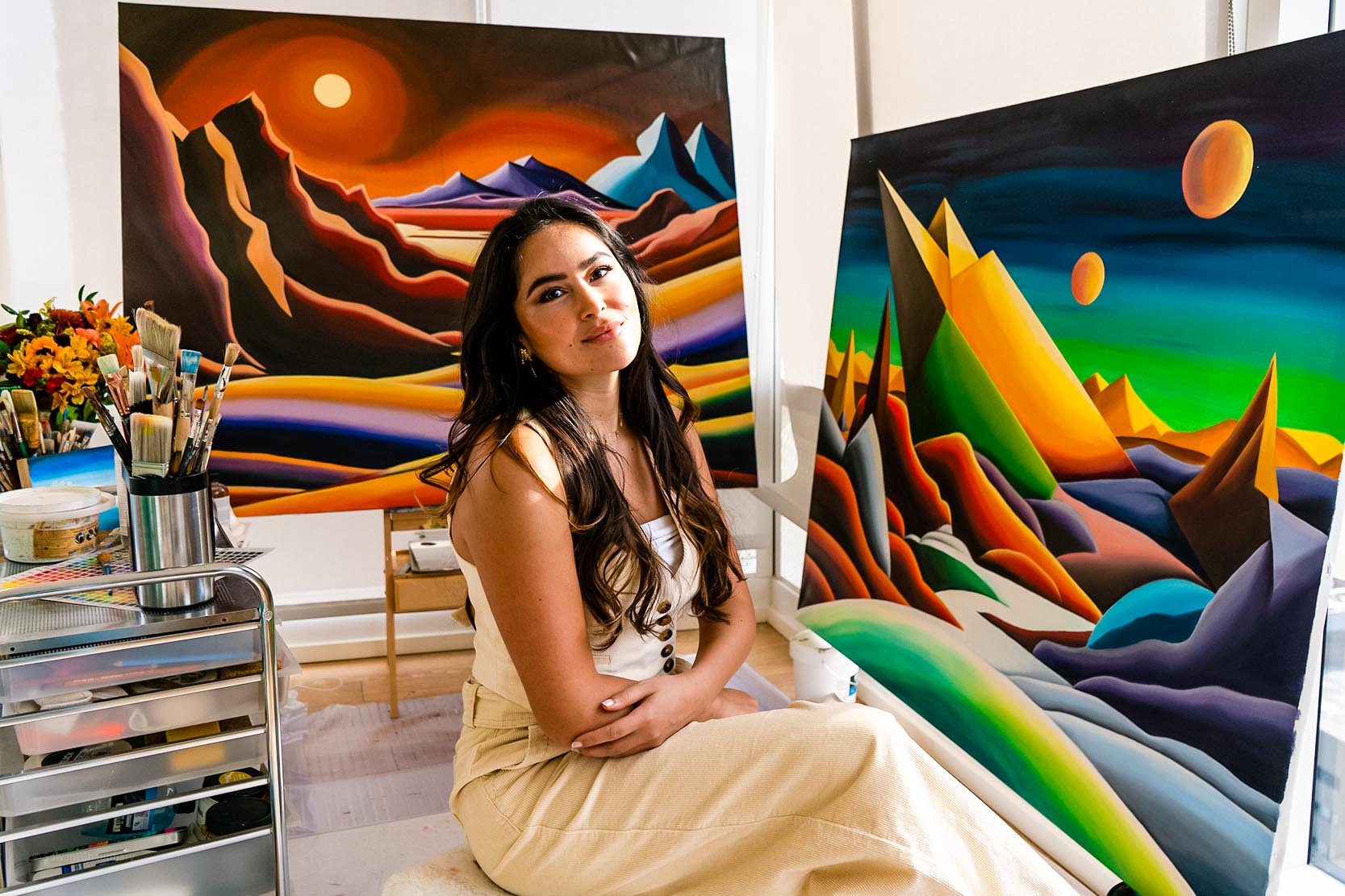
Dalya Moumina’s landscapes are more than paintings. They are deeply imaginative realms where memory, geography, and emotion converge. Born in Washington, D.C. in 1996 to a Saudi father and a Filipina mother, Moumina spent her early childhood in Saudi Arabia and the Philippines before settling in New York, where she now lives and works. Her paintings are steeped in duality: vast and intimate, grounded in place yet open to boundless interpretation. With a dreamlike palette and surreal forms, she invites viewers into atmospheric spaces where rivers flow like thoughts and mountains rise like memories.
Rooted in the terrains of her upbringing from the dry, radiant light of the Arabian Peninsula to the lush, oceanic hues of the Philippine archipelago, Moumina’s work is a meditation on identity, belonging, and the emotional texture of place. The influence of both nature and narrative is central to her process: fragmented recollections of landscapes are layered with rhythm, light, and movement, shaped by music and mythology as much as physical terrain. She draws inspiration from artists like Georgia O’Keeffe and Cy Twombly, using light as both subject and metaphor to navigate the tension between serenity and motion.
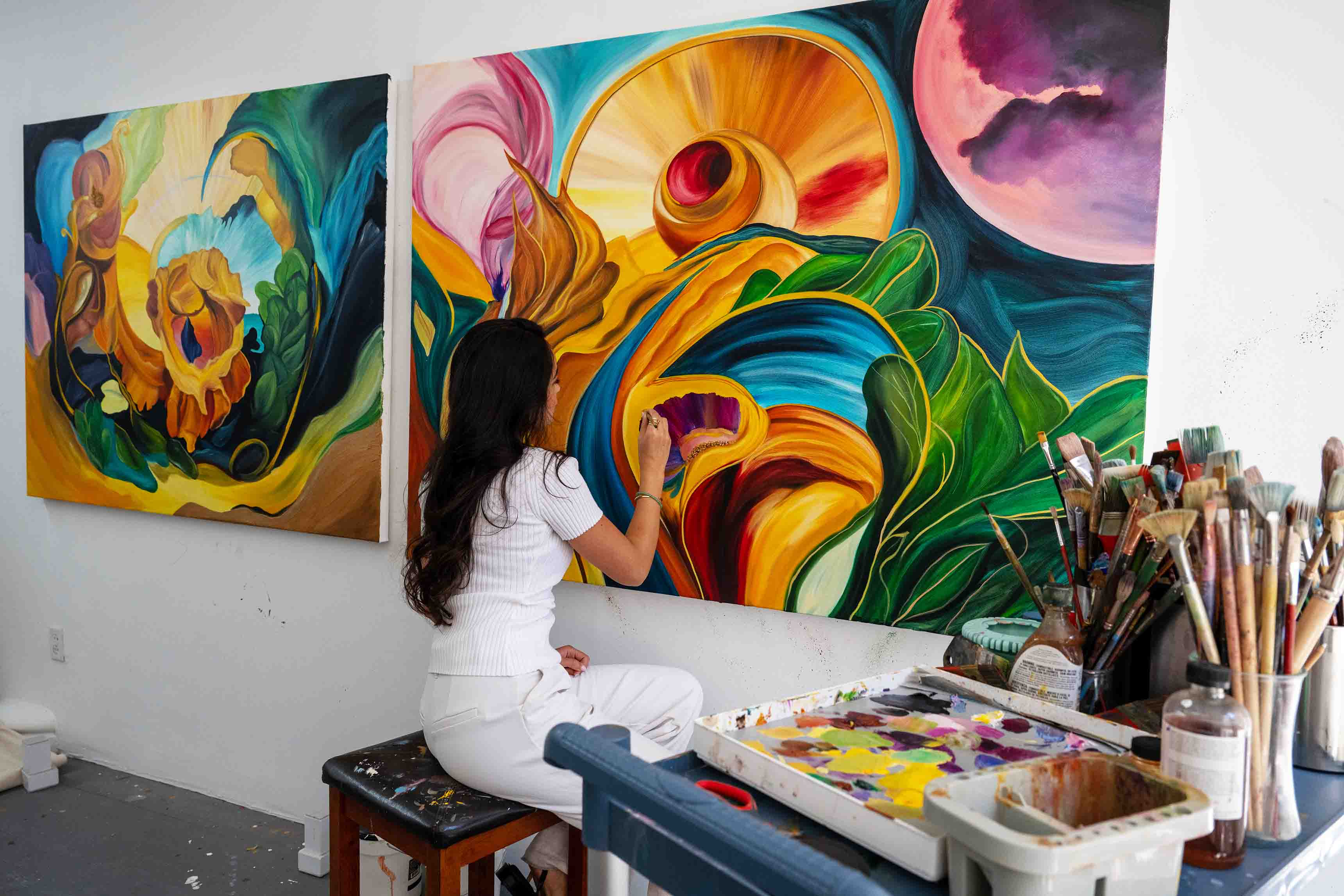
Now based in New York City, Moumina’s multicultural background fuels a bold artistic voice that feels both timeless and timely. Her paintings, often described as portals or utopian landscapes, are not escapist in nature, but rather expansive pushing the boundaries of reality while staying rooted in personal and cultural memory. In this conversation, the artist opens up about her creative process, the power of imagination, and the emotional resonance she hopes her work inspires in others.
José Berrocoso, our Lifestyle Editor, sits down with Dalya Moumina to explore the emotional landscapes, cultural memories, and imaginative worlds that shape her striking visual practice.
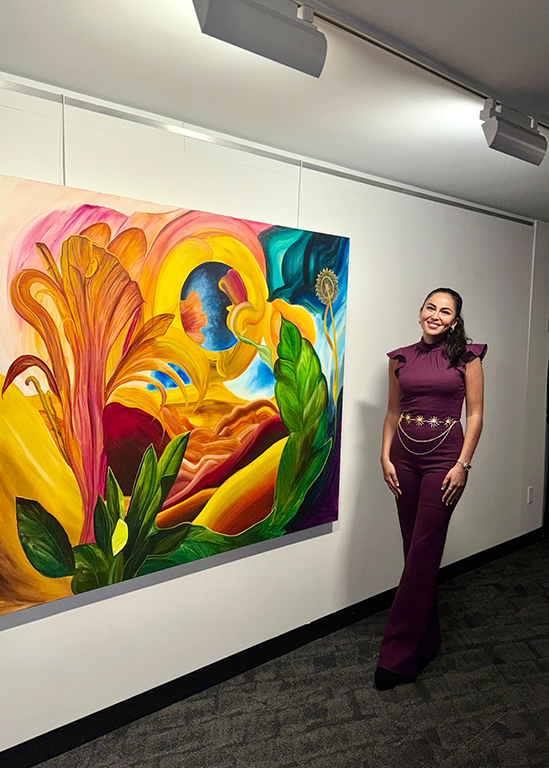
Your landscapes are deeply personal and dreamlike. When you begin a painting, do you visualize a specific place or memory, or is it more of an emotional response that guides the work?
I begin a painting by tapping into a memory and consequently immerse myself in how it makes me feel. My process it very intuitive and as I hone my practice, it’s less about visualizing a specific place and turning it into an evocative concept. Growing up between the Middle East and the Philippines, I’ve been lucky to explore the imprinting terrains of those regions and I often feel the urge to capture the essence through some medium that I can share with the world. That medium was eventually painting.
How do the contrasting landscapes of Saudi Arabia and the Philippines continue to influence the way you construct and color your imaginary worlds?
I often start with a sense of rhythm of energy, such as the fresh wind coming from the ocean, or the warmth of the sunlight breaking through clouds. Memories do play a role by they are not literal. Instead, they are fragmented and layered, much like the way I build my paintings. It’s about capturing the ethos of a place, the way it feels rather than it looks, and allowing it to unfold on the canvas.
There’s a quiet, almost sacred stillness in your compositions, yet they also feel full of motion. How do you balance that duality of calm and energy in your work?
I am happy that many viewers sense that because it was an element I was struggling to achieve in my work for a few years now. Balancing the calm and the tumultuous in my work reflects how I see the world, filled with many contrasts that coexist harmoniously. I am deeply inspired by artists such as J.M.W Turner, a British Romantic artist who captured the sublime power of nature through light and motion, and Cy Twombly, whose work evokes a multisensory experience of rhythm and energy. I aim to create a sense of movement through layered textures and vibrant colors, while grounding the composition in a quiet, almost sacred stillness. This duality mirrors the crude world, like the ocean’s waves constantly in motion yet rhythmic and serene. I also found light as a central player in my process, as it can evoke both vitality and tranquility, much like sunlight breaking through a storm. For me, it’s imperative to embrace the tension between opposites and finding beauty in their interplay.
Can you talk us through your creative process in the studio? From the moment an idea arises to when you decide a piece is finished . What does that look like for you?
From the moment I step into my studio in New York City, I forget everything outside of it and take a few moments to plan out my next pieces. I usually work on several pieces at once because they help me ignite ideas and techniques that I can borrow for other works. I don’t start with a fixed idea of what the painting looks like and instead, let my preliminary sketches guide me. I think of the textures and forms I want to create and often think about the rhythm I want the piece to have; how the waves move, how the light shifts, or how the topographies evolve over time. Music plays a big role in my process as well, as I often listen to classical composers like Einaudi while I sketch.
Once I am comfortable with the sketch, I then begin the background painting on the canvas and focus on creating a balance in color and textures. Much like Kay Sage’s surreal landscapes, where the foreground and background blur into one another, I want the viewer to feel like they are venturing into the unknown, much like exploring the unchartered ocean. I also have a canvas which I call my “experimental” canvas that I play around with, whether that is new shapes or mediums I want to test and evaluate with while I paint my main pieces.
I know a painting is finished when I stop looking at it as the maker and begin seeing it as a viewer. It’s as though the painting is telling its open story, and I can step back and let it exist on its own terms.
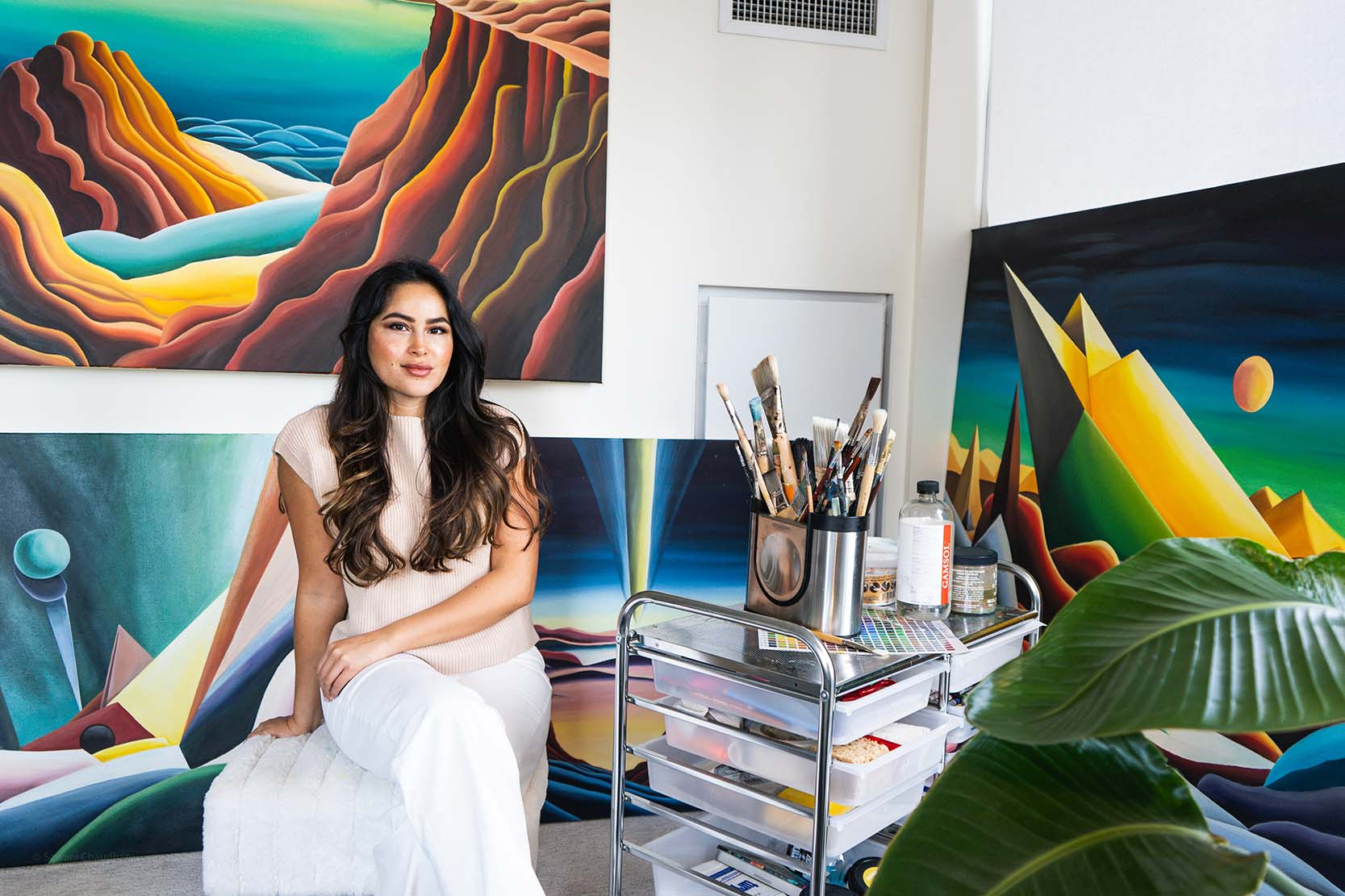
Many of your paintings feel like portals to another dimension surreal, utopian, almost spiritual. What role does imagination or escapism play in your art?
I loved reading fictional stories and mythologies growing up and helped me develop that sense of wonder and possibility. I see my paintings as portals, much like the stories I loved, inviting viewers to step into a space where the limits of reality dissolve. For me, painting is a way to explore the unknown and create spaces that feel surreal yet familiar. I’m deeply captivated by the works of artists like Giorgio de Cherico and Kay Sage as they use landscapes as metaphors for the mind and spirit. Throughout my work, I don’t use escapism per se to avoid reality but rather expand it and imagine new possibilities.
As someone who lives in New York but draws from a rich multicultural background, how do you navigate your identity within the contemporary art scene?
Living in New York, which I truly believe is the art capital of the world, has been an incredible experience. The city is a melting pot of talented artists, creative ideas, and a multitude of art events. As I continue to immerse myself in the dynamic energy of the city, it helps to have a strong sense of self for multiple reasons. New York challenges me to push boundaries, while my background keeps me grounded in the stories, memories, and landscapes that define who I am. It’s this interplay of influences that allows me to create work that feels both personal and universal, rooted in tradition yet open to the endless possibilities of contemporary art.
You mentioned Georgia O’Keeffe as a key influence. Are there other artists, movements, or cultural references past or present that inform your work in unexpected ways?
Georgia O’Keeffe has been a profound influence on my work. I first discovered her because she was once an art teacher at my undergraduate university, and her legacy left a lasting imprint on the art department. Her ability to distill the essence of nature into bold, emotive forms deeply resonates with me, and her movement has inspired me to explore the interplay of simplicity and depth in my own work.
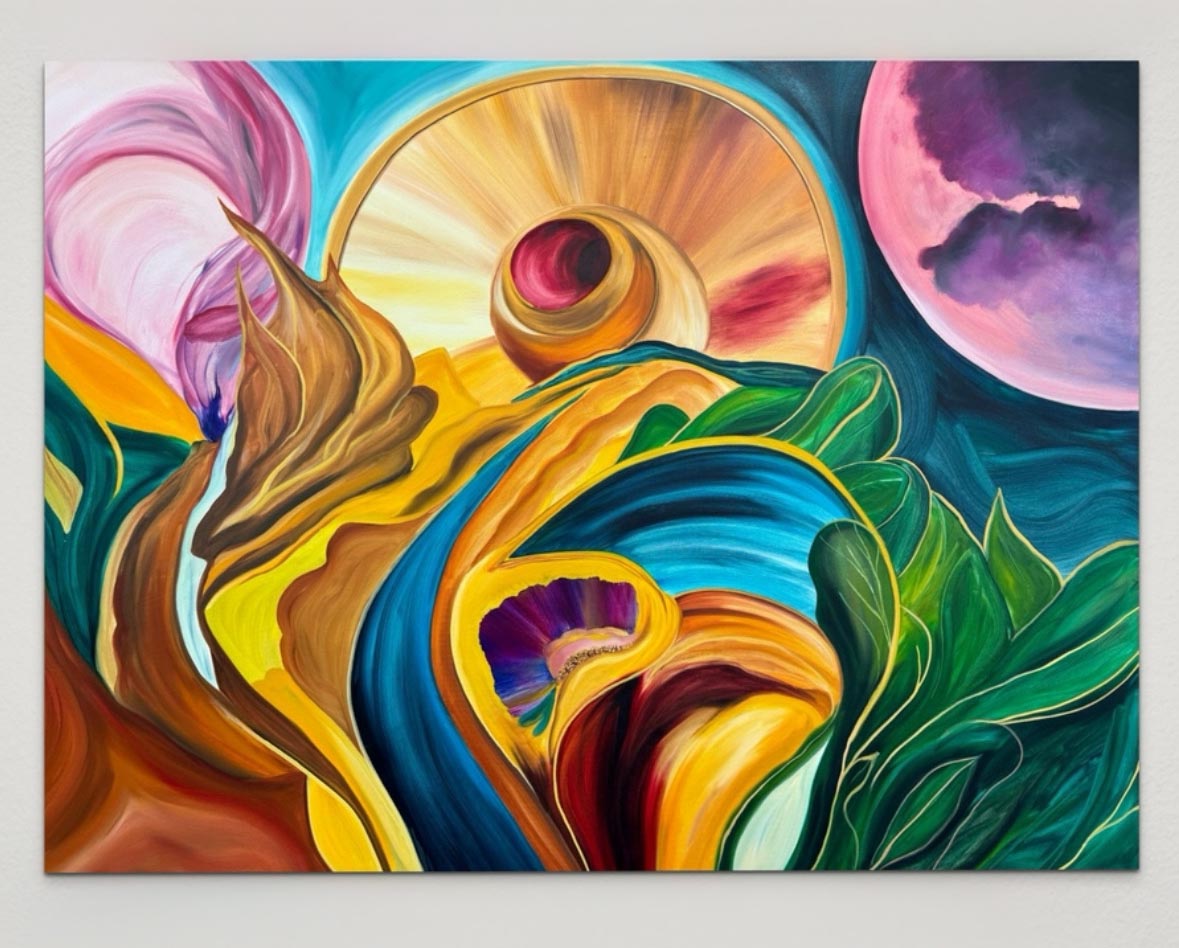
Beyond O’Keeffe, I’m also inspired by music, particularly of Einaudi. His work informs the rhythm and flow of my process. I usually incorporate endemic flora into my work, such as the date palm or desert rose from the Middle East, which are symbolic to the region. In addition, I add celestial motifs like the sun and moon, which hold deep cultural significance in both regions. For instance, the sun is a symbol of vitality and life in many Filipino traditions, and the moon phases in Islamic art symbolizes cycles and harmony.
You’ve said your work is about connection and interactivity, what do you hope people walk away with emotionally or intellectually after seeing your art?
I hope people walk away from my work feeling a sense of wonder and curiosity both about the world around them and within themselves. My art is about connection, not just between the viewer and the painting, but also between the viewer and their own emotions, memories, and thoughts. I want my work to invite vulnerability, to encourage people to pause and reflect, and maybe even see things in a new way.
Can you share anything about your upcoming projects or shows? What themes or evolutions are you currently exploring in your practice?
I am excited to share that I will be participating in an upcoming group show with Hollis Taggart Gallery in New York City on October 24 until November 26. It’s an incredible opportunity to showcase my work alongside other talented artists, and I’m excited to see how my pieces resonate within the context of the show.
In my current practice, I’m continuing to explore themes of interconnectedness and the ever-evolving nature of landscapes. I’m particularly interested in how memory, emotion, and vibration shape our perception of the world around us. Lately, I’ve been experimenting with new techniques to create even more dynamic textures and layers, inspired by the interplay of light and movement in nature. This evolution in my work feels like a natural progression, and I’m excited to see how these ideas unfold in the pieces I’ll be presenting at the show.
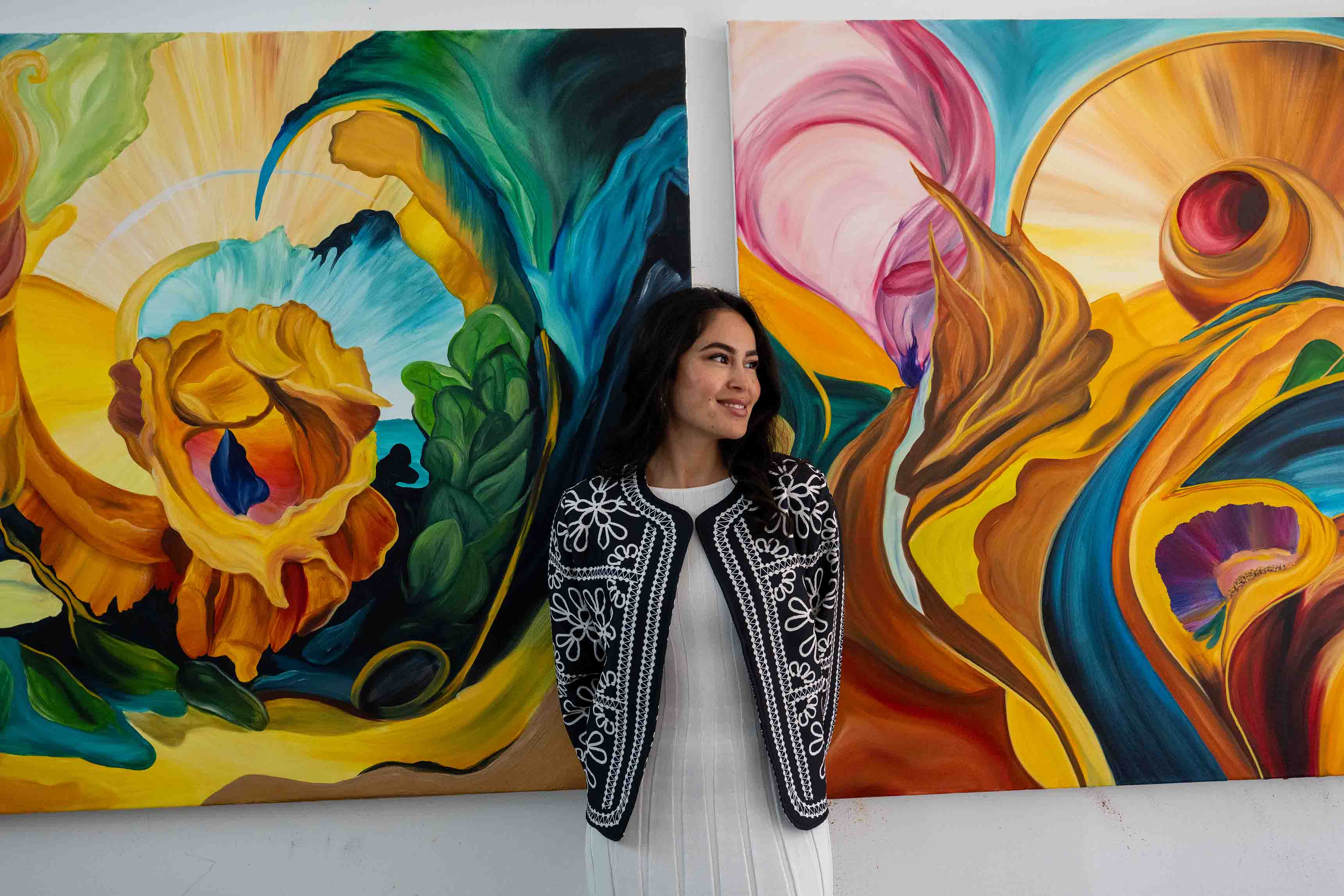
Given your roots in the Middle East, particularly Saudi Arabia, do you have plans to exhibit your work in the region? How do you see your art resonating with audiences there, and what kind of dialogue would you hope to open through those exhibitions?
Exhibiting my work in the Middle East, particularly in Saudi Arabia, is something I would love to do and am currently involved in projects that are set to take place next year. My roots in the region have profoundly shaped my perspective and artistic practice, and it would be incredibly meaningful to share my work with audiences in the Middle East. Through exhibitions in the region, I hope to open a dialogue about the ways in which art can bridge the past and present, tradition and innovation. Saudi Arabia is undergoing such an exciting cultural renaissance, with a growing appreciation for contemporary art, and I’d love to contribute to that conversation. I imagine my work sparking discussions about how we perceive and interact with the natural world, and how our shared experiences can connect us on a deeper level. It would be an honor to engage with the vibrant and evolving art scene in the region.