
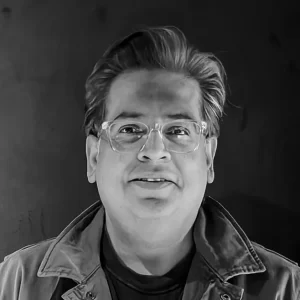
Multidisciplinary Designer Exploring Identity, Typography and Cultural Memory
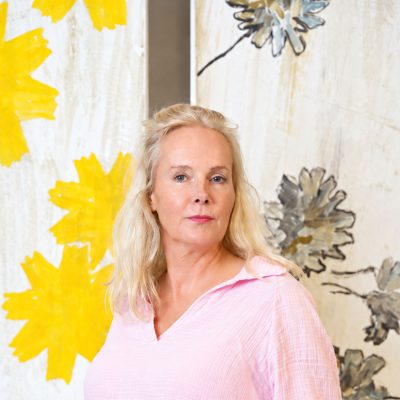
In the world of contemporary design, where cultural identity and visual storytelling increasingly intersect, Syrian-Polish multidisciplinary designer Kinda Ghannoum has emerged as a distinctive voice. With a background in architecture and a deep-rooted appreciation for art and Arabic calligraphy, Ghannoum’s journey into graphic design has evolved into a thoughtful exploration of typography, heritage and cultural memory. Today, her work sits at the crossroads of design, research and storytelling, where letterforms and visual systems become tools for preserving narratives and reinterpreting identity in modern contexts.
Growing up in an artistic family in Syria, Ghannoum developed an early fascination with patterns, language and visual culture. After initially pursuing architecture, she transitioned into graphic design as a self-taught practitioner before later completing a Master of Visual Arts at Sint Lucas Antwerpen. Her work now focuses on branding, typography and archival research, often drawing inspiration from Arabic typographic traditions while bridging Eastern and Western design influences.
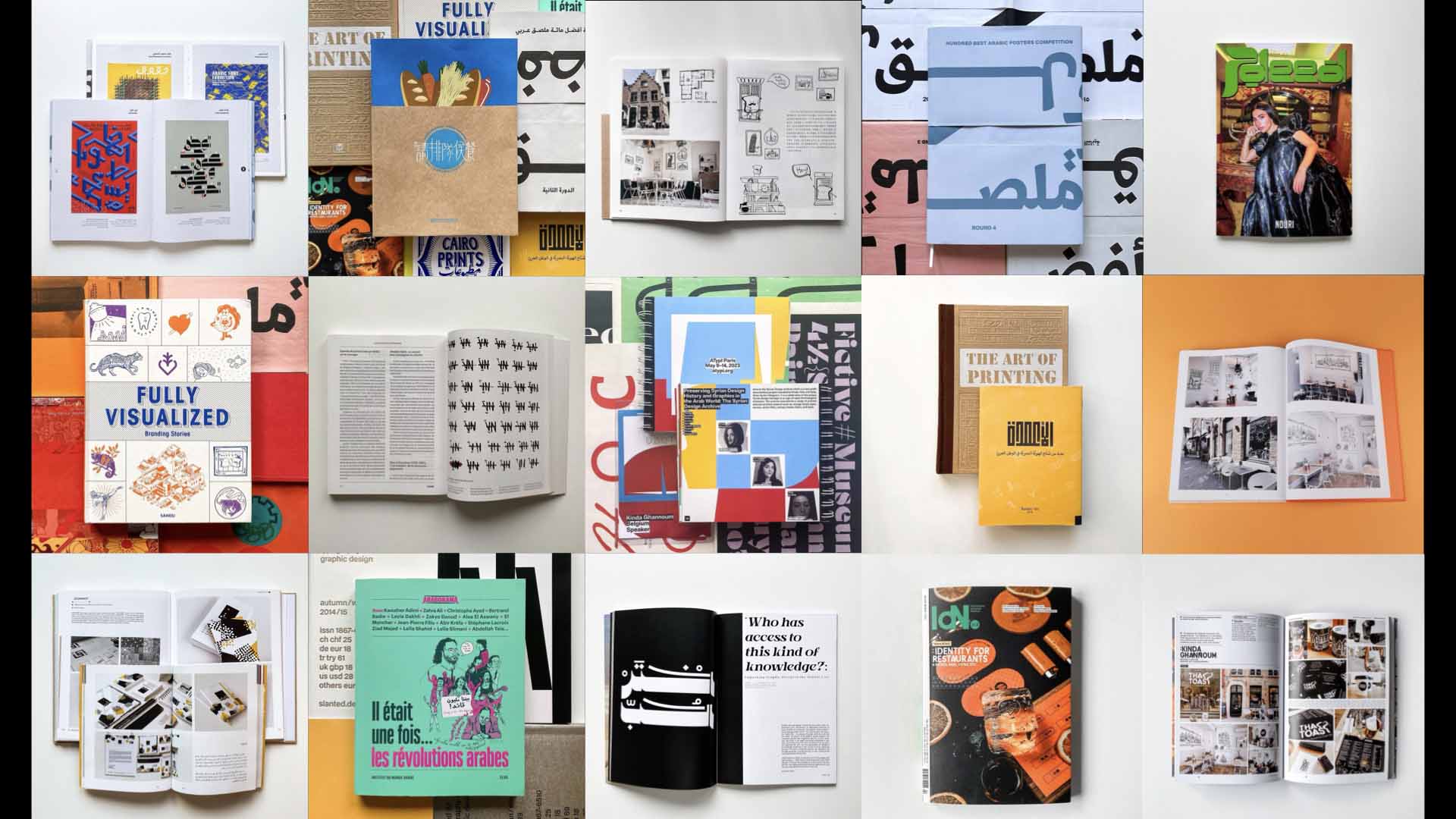
A co-founder of the Syrian Design Archive, Ghannoum is also widely recognised for her collaborations with international organisations including the Obama Foundation, Netflix, Expo Dubai 2020 and the Qatar Foundation. Her award-winning work has been honoured by global institutions and published across leading design publications and books.
In this conversation with CP Magazine, Ghannoum reflects on the cultural influences shaping her practice, the role of archives in preserving visual history and how design can become a powerful language for identity, resistance and memory.
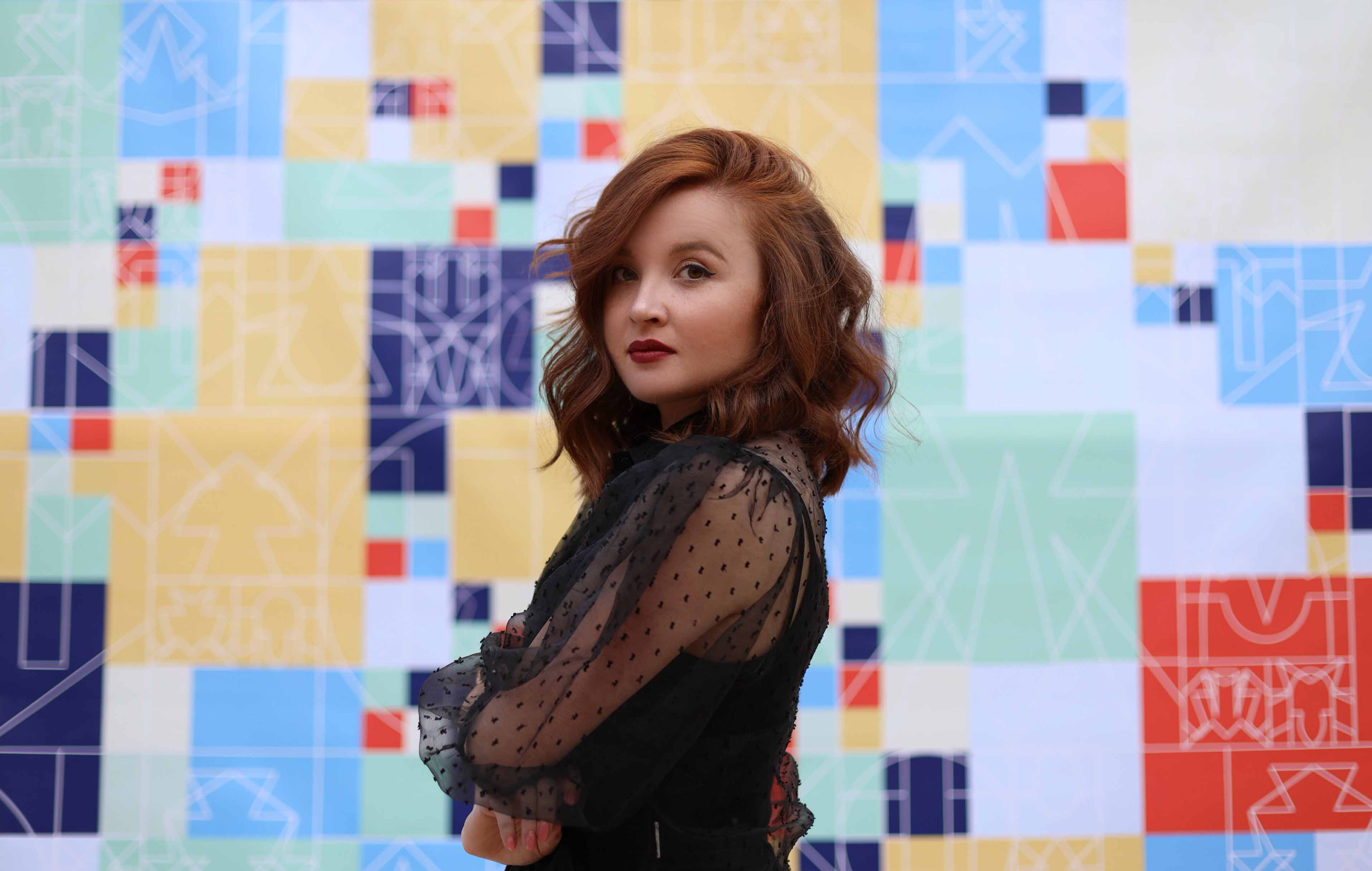
Please introduce yourself to our readers briefly.
I’m a Syrian-Polish multidisciplinary designer with a background in architecture, but my journey into design really began growing up in an artistic family in Syria, where I developed a deep appreciation for art, design and Arabic calligraphy. I later transitioned into graphic design as a self-taught designer before completing a Master of Visual Arts at Sint Lucas Antwerpen. My work focuses on branding, typography and research, often drawing inspiration from Arabic typography and cultural heritage. Through my practice, I explore typography as a storytelling tool that connects identity, memory and culture, often blending influences from both my Syrian and Polish backgrounds. I’ve had the opportunity to collaborate with a range of international organisations, and I also co-founded the Syrian Design Archive
What first drew you towards graphic design, and how did your cultural background influence that journey?
I am Syrian-Polish and grew up in Syria, surrounded by the beauty of Damascene culture. Coming from an artistic family, my love for art, patterns and Arabic calligraphy has been with me since childhood. I was always fascinated by design, art and architecture, anything that involved creating. While I originally wanted to apply to art school (that’s a long story on its own), circumstances didn’t allow it, so I chose architecture as the next closest option.
Once I started studying architecture, I enjoyed it, but I soon realised I wasn’t drawn to designing large buildings. Instead, I was more interested in smaller-scale projects, such as interiors. After graduating, finding work in Syria was challenging. By chance, I joined a team working on an event where my role was to create the project’s visual identity. The project won first prize, and the visuals were even nominated for an award. That experience made me realise my passion for graphic design and that I could turn it into a career. I started working as a designer during the day and learning in the evenings, slowly building my skills and portfolio. I was lucky to have mentors and inspiring people who guided me along the way.
Architecture gave me a strong foundation in problem-solving and design thinking. It taught me how to create solutions that balance functionality and creativity, an approach that is central to my work. Whether I’m developing an identity or a logo, I think structurally, ensuring my designs are organised, purposeful and impactful.
Graphic design became a way to research, question and reclaim visual narratives connected to the Arab world, and Syria in particular. Working with Arabic typography, archives and cultural references isn’t just an aesthetic choice for me, it’s a way of asserting presence, preserving memory and creating space for visual histories that are often overlooked. My practice sits somewhere between design, research and storytelling, shaped by this in-between cultural position and a desire to build bridges between visual worlds that rarely get to speak to each other on equal terms.
Your work bridges art and heritage. How do you define that relationship in your practice?
I don’t see heritage as something fixed or frozen in the past; for me, it’s a living, evolving set of visual languages, stories and ways of seeing the world. In my practice, art becomes a way to engage with heritage critically and creatively, rather than simply preserve or replicate it.
I’m interested in what happens when historical references, archives and traditional forms are placed in conversation with contemporary tools, contexts and questions. A big part of my work is about translating cultural memory into visual systems that can exist in the present through typography, branding, cultural projects and experimental work.
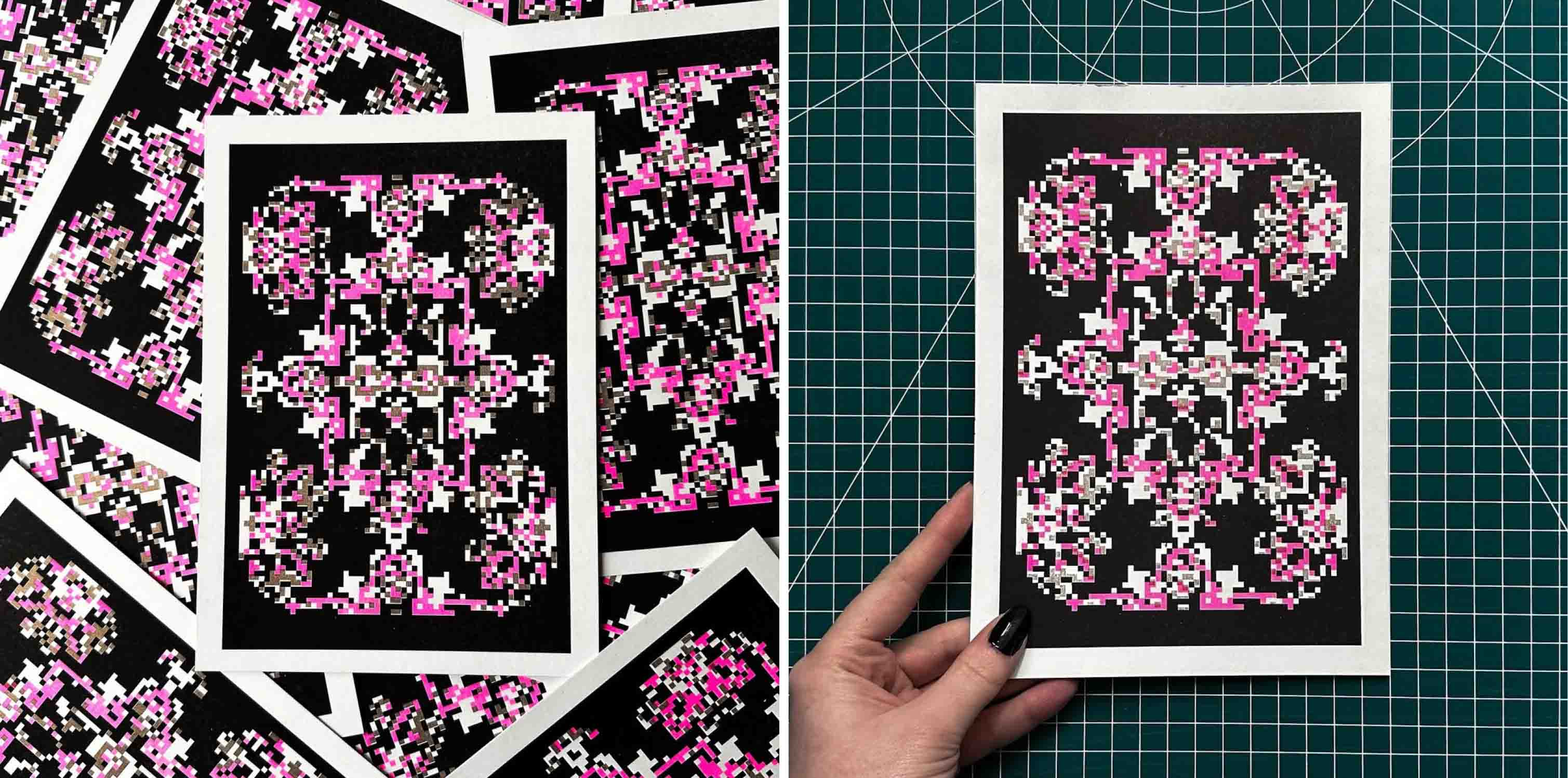
Sometimes that means working directly with archival material; other times it means reinterpreting familiar scripts, patterns or symbols to explore how identity, displacement and cultural continuity can be visually expressed today.
So the relationship between art and heritage in my practice is not nostalgic, it’s dialogic. Art becomes a space to question heritage, to activate it and to allow it to evolve. Heritage, in return, grounds my artistic and design decisions in lived experience and collective memory, giving the work depth beyond aesthetics. In that sense, I see my role less as a “preserver” of heritage and more as someone who recontextualises it, keeping it alive through contemporary visual language.
Can you share a moment when design helped you tell a story that words alone couldn’t?
There were many moments when I wanted to speak openly about Syria and Palestine, but fear always held me back. Even though I live outside Syria, I couldn’t allow myself to imagine the consequences this might have for my family. Design became a way for me to speak when words felt too risky, too heavy, or simply insufficient.
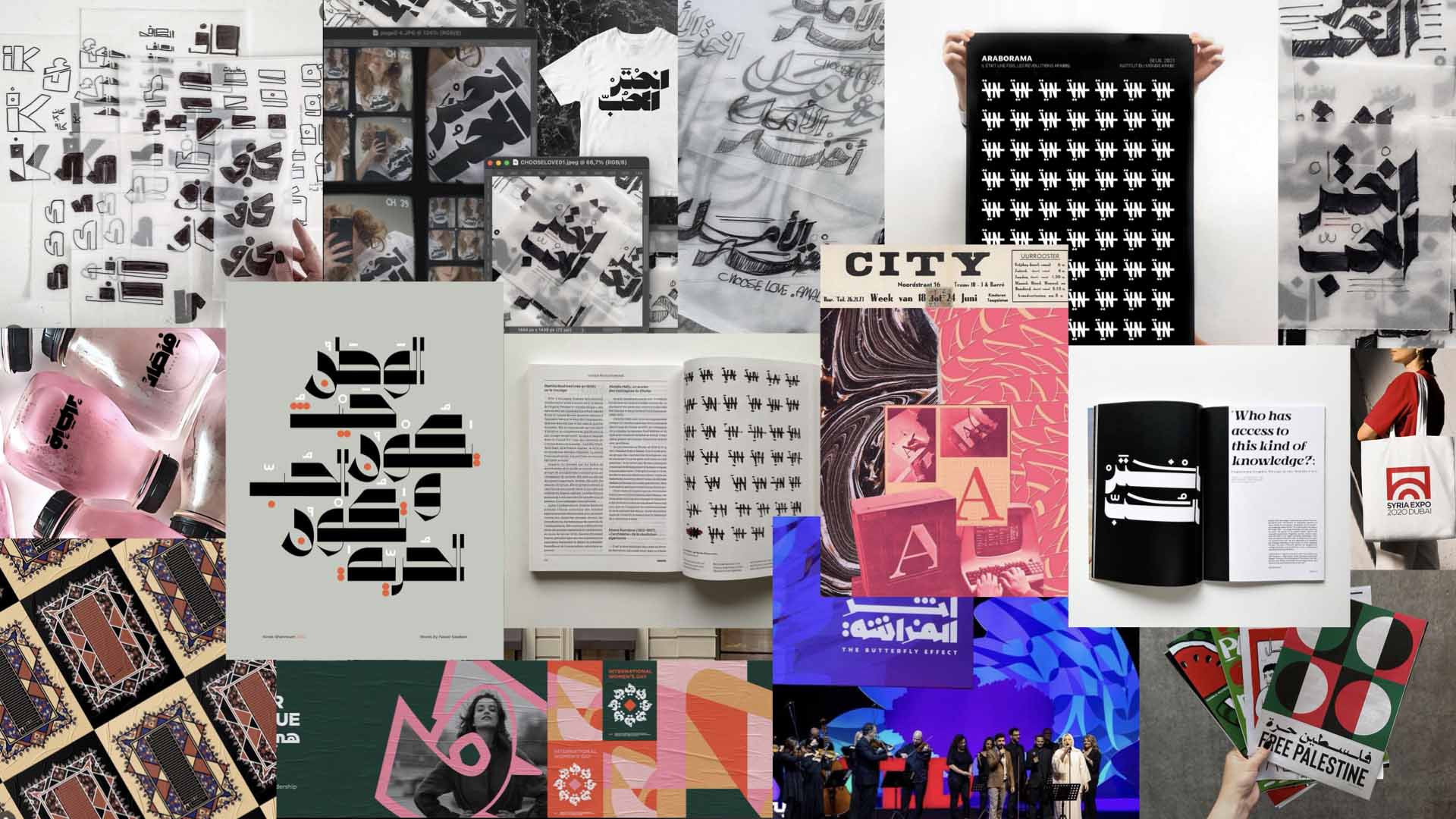
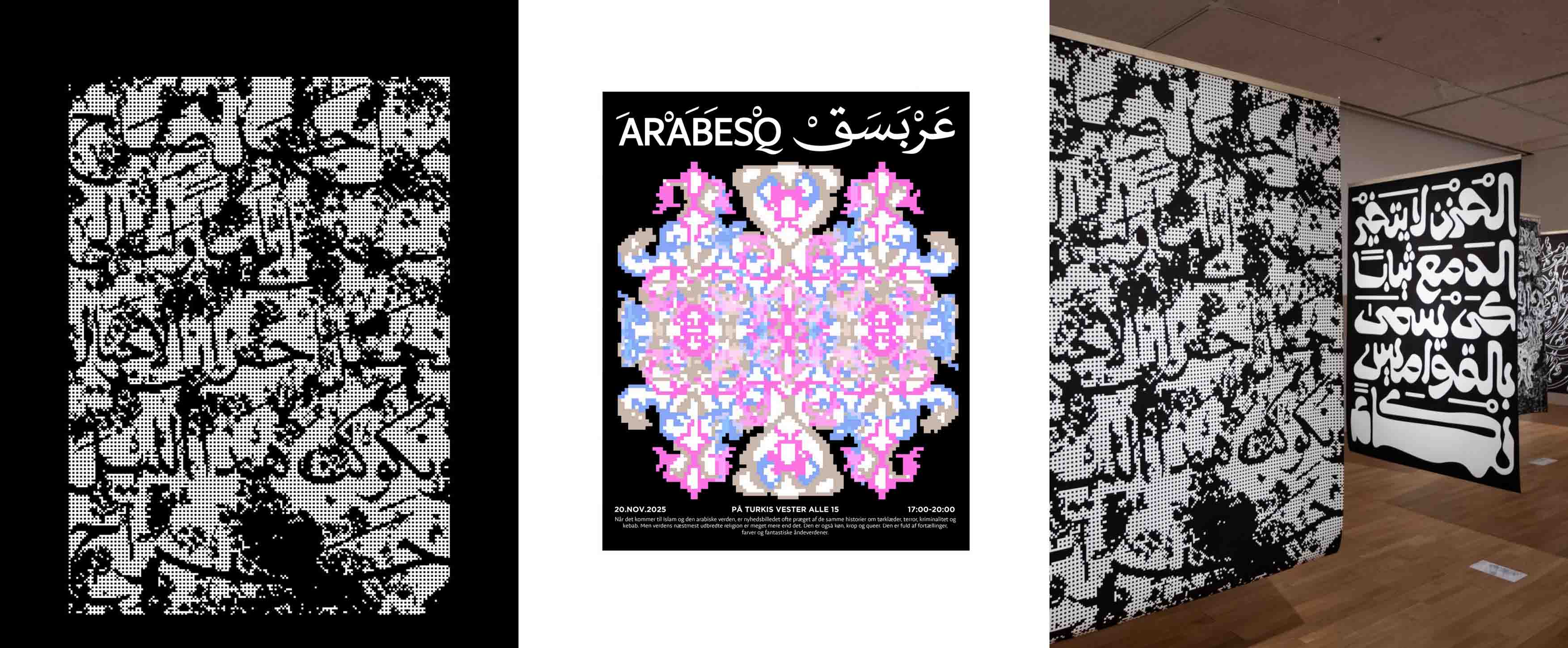
In 2021, I was invited to take part in “#ARABORAMA | Il était une fois, les révolutions arabes” at the Institut du Monde Arabe. I was asked a simple question: What do you think about the Arab Spring? For me, the answer was freedom or rather, the absence of it. People asked for their most basic rights and were met with brutal punishment: imprisonment, disappearance and death. I kept thinking about those who vanished for years while waiting to be freed, and those who never returned.
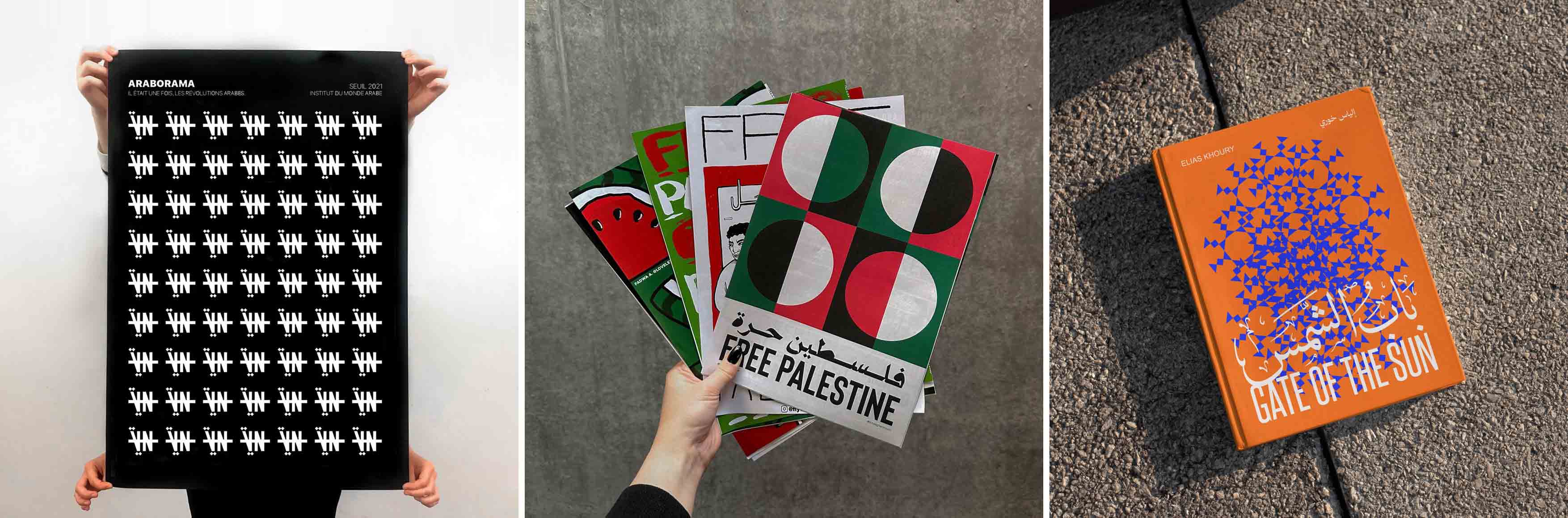
The poster I created featured the word “freedom” written in Arabic, styled like a tally of counted days, a quiet visual metaphor for time passing in detention, for freedom being postponed, slipping away, or ending tragically. I never wrote the full context behind it, but the image carried what I couldn’t say out loud.
Similarly, with my poster for Palestine, design allowed me to express grief, solidarity and resistance without relying on explicit language. Visual symbols, abstraction and typography created a space where I could communicate politically and emotionally, while also protecting myself and those close to me.
What’s the most surprising thing you’ve learned while curating the Syrian Design Archive?
One of the most surprising things I learned is how rich, intentional and conceptually strong Syrian graphic design has always been, despite how invisible it has become in global design narratives. Even I underestimated how much visual intelligence existed in everyday Syrian contexts: posters, book covers, publications, packaging, stamps and institutional graphics.
Seeing this material together made it clear that Syrian designers were not simply following trends but actively developing their own visual languages within specific political, cultural and material constraints.
Another big surprise was the sheer amount of material that existed and that we didn’t even know about. So many works had never been documented or circulated beyond their original context, and with them came the discovery of many designers whose names had completely disappeared from public memory. There were entire careers and visual contributions that no one talks about today. In many cases, the archive became the first space where these designers’ names were written back into history, which made the work feel urgent and necessary.
What also surprised me was how emotional the process became. The archive didn’t just reveal design history; it revealed personal histories. Many materials came with stories of displacement, loss or interrupted practices. Collecting and curating turned into an act of care as much as research. People reached out with a single scan, a damaged poster or a fragment of memory, and suddenly the archive became a shared space of remembering.
I was deeply moved by how much people wanted this history to exist. There’s a real hunger, especially among younger designers, for a visual lineage they can relate to and learn from. Curating the Syrian Design Archive showed me that archives aren’t just about preserving the past, they’re about restoring continuity in the present and offering a foundation for futures that don’t have to start from zero.
How do you balance historical preservation with contemporary creativity?
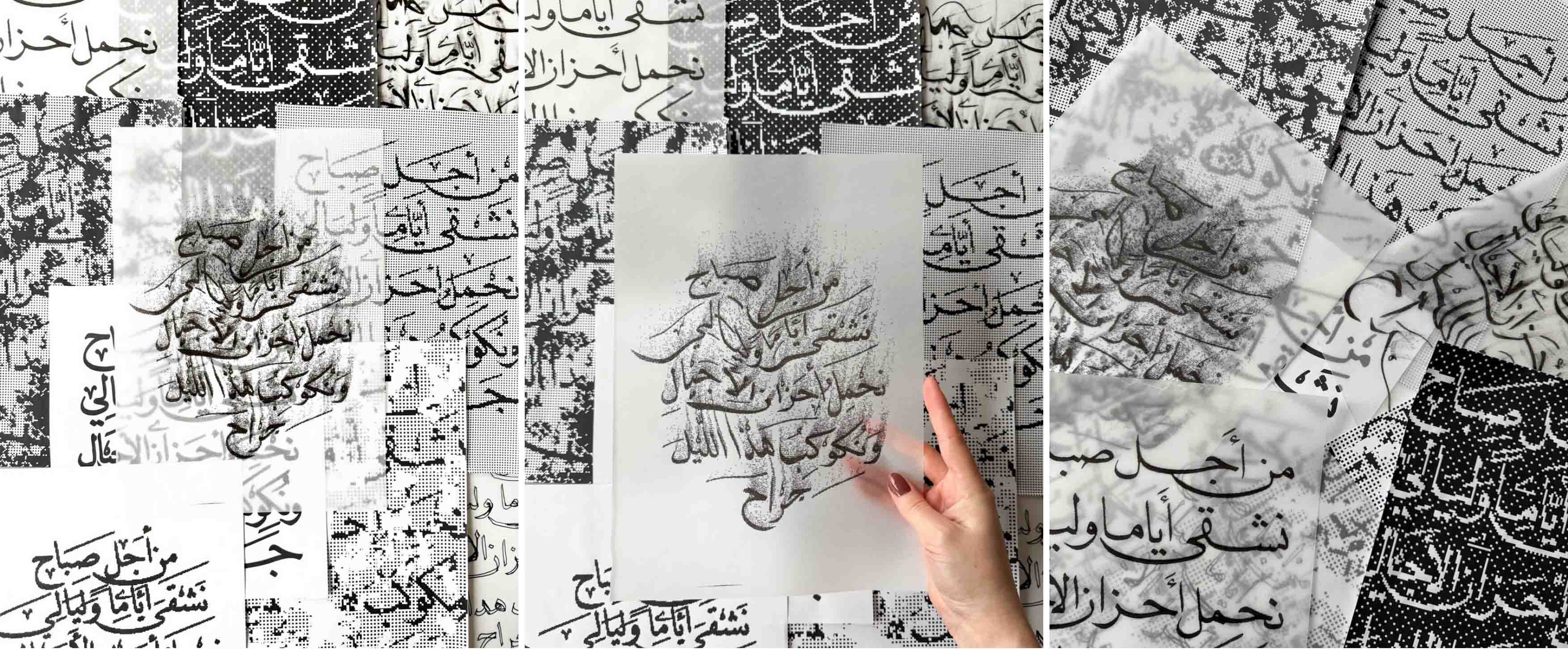
I treat historical material as a starting point and a source of inspiration, not something to replicate. It’s important for me to understand the history, the context and the “rules” behind visual languages first, because you can only break them meaningfully once you truly understand them.
Research grounds the work, but experimentation allows it to become personal and contemporary. In that sense, preservation and creativity aren’t opposites in my practice, they depend on each other.
What role do archives play in shaping collective memory in your view?
Archives play a crucial role in shaping what is remembered, what is forgotten and how histories are told. They don’t just store material; they actively shape collective memory by deciding which stories, voices and visual cultures become visible and which remain invisible. In that sense, archives are never neutral, they reflect power, access and whose narratives are considered worthy of preservation.
For me, archives are tools of resistance as much as preservation. They can challenge dominant narratives, recover overlooked histories and create space for voices that were excluded or erased. When archives are activated through design, research, exhibitions or education, they become living spaces that allow people to reconnect with their visual heritage and see themselves reflected in history.
That visibility matters because it shapes how communities understand their past, their present and their right to imagine a future.
Which project has pushed you creatively in unexpected ways?
In different ways, every project pushes me creatively each one teaches me something new, whether it’s conceptual, emotional or formal. But there are a few projects I choose to speak about not simply because they were “challenging”, but because I feel grateful to be part of them and because of the responsibility they carry.
The Syrian Design Archive has probably reshaped me the most in unexpected ways. I initially approached it as a research and preservation project, but it quickly expanded into something that affected how I think about design altogether. Working with fragmented archives, missing materials and overlooked designers pushed me to develop new ways of telling visual histories and to accept incompleteness as part of the process. It also made me more aware of my ethical responsibility when working with other people’s histories, shifting my focus from polished outcomes to care, process and creating space for multiple narratives.
Another project was a poster I created with Ranim around the anniversary of the fall of the Syrian regime. At the time, images resurfaced of torn posters and scraped-away portraits of Assad in public spaces, especially a striking image from Homs where tiles forming his face had been removed, leaving only a hollow outline. His presence remained, but emptied of authority.
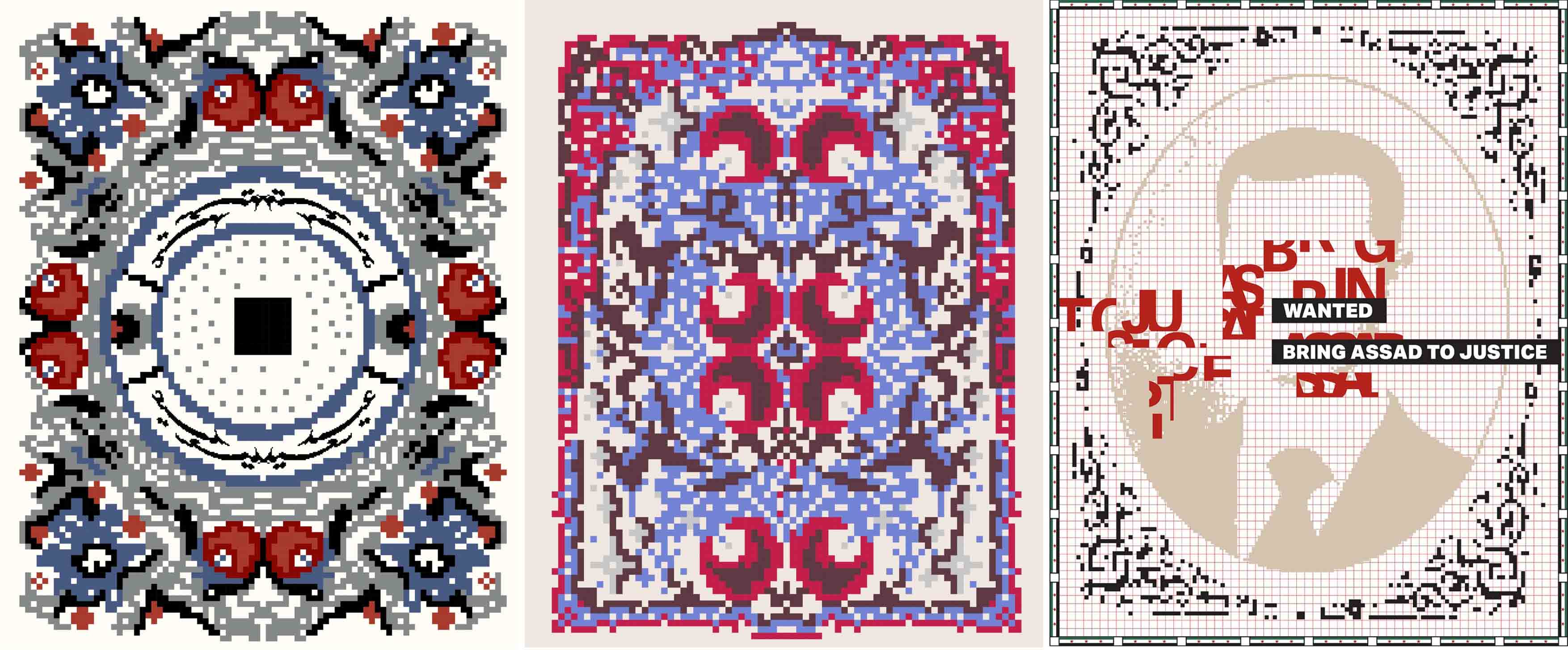
That gesture of erasure became the foundation of our poster: referencing his imprint without granting him a face. The work speaks to the regime’s unraveling and the collective desire to reclaim public space. By fragmenting his image, it reflects how deeply his likeness once saturated daily life, while also honouring the quiet resistance of those who dismantled it.
For families engaging with this work, it becomes a space to reclaim narrative and confront an image that once symbolised fear. For us, it carried the responsibility of reflecting their strength and contributing to a collective memory shaped by survivors. Absent Presence taught me how design can carry political weight without reproducing the violence of the image itself.
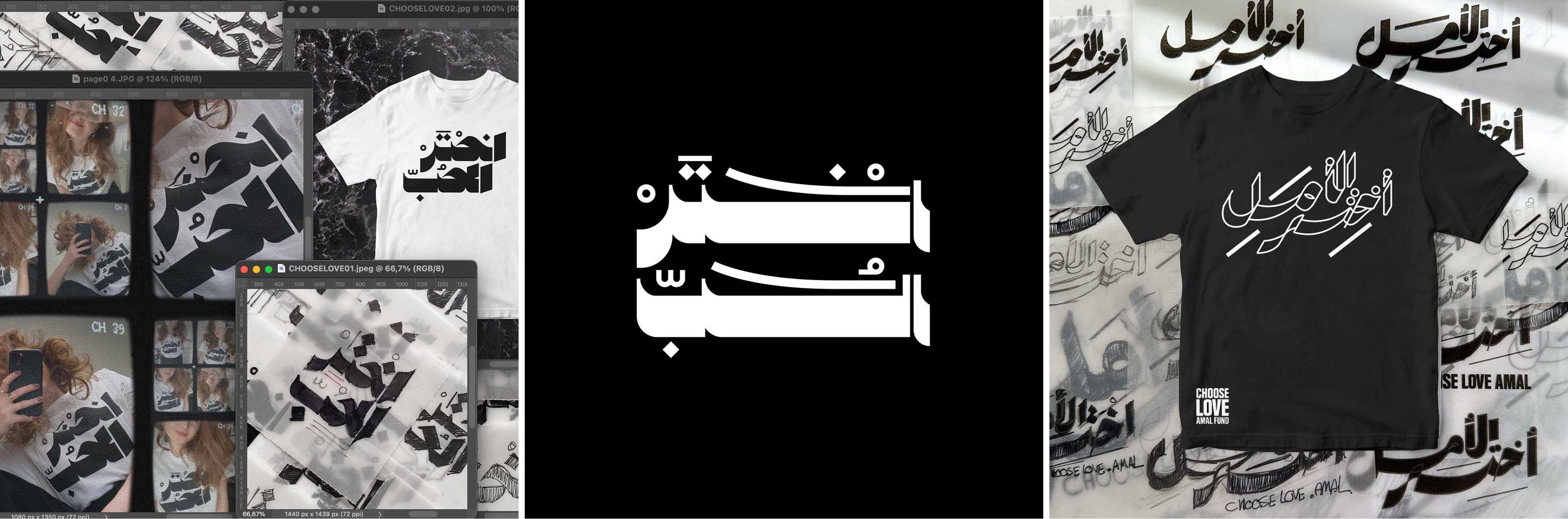
In a very different way, the collaboration with Choose Love for The Swimmers pushed me as well. Designing the “Choose Love” artwork in Arabic for a fundraising T-shirt connected to the story of Yusra and Sara Mardini reminded me that design can also be gentle and practical a way to translate visibility into concrete support for Syrian refugees. It made me think more about circulation, accessibility and how design can move beyond cultural spaces into everyday acts of solidarity.
So while every project challenges me in a different way, these reminded me that creative growth doesn’t only come from difficulty, it also comes from responsibility, trust and being invited to contribute to stories that matter beyond the design world.
How has living in Brussels shaped your perspective on global design?
Every place influences you through people and experiences. Brussels didn’t radically change my perspective compared to other places in Europe, but it gave me a practical base, more mobility, access and ease of connection. My outlook on global design comes more from living between cultures than from one city.
In your opinion, what makes Middle Eastern graphic design distinct?
Let’s call it SWANA region design. What makes it distinct isn’t one single style, but the context it’s created within. It’s shaped by layered histories, political realities, multilingual environments and rich visual traditions that designers constantly negotiate. There’s often a tension between the weight of heritage and the urgency of the present, which creates visual languages that are emotionally charged, resourceful and deeply contextual.
Another distinctive aspect is how designers work with constraint. Limited access to resources, censorship, displacement and unstable infrastructures have historically shaped how design is produced and circulated. This has led to practices that are adaptive, inventive and often concept-driven rather than purely trend-driven. Arabic typography plays a particularly central role, not just as form but as meaning, identity and sometimes resistance.
I think it’s important not to essentialise SWANA region design as one thing. There are many local scenes, aesthetics and approaches. What connects them is less a visual style and more a shared condition: designing within complex social and political realities, and constantly negotiating visibility, representation and voice.
What’s a misconception about design that you wish more people understood?
I think things are slowly getting better, but one misconception that still exists is the idea that design is somehow “better” or more professional when it’s done in Latin scripts. There’s this unspoken standard that associates quality, modernity or global relevance with Latin typography, as if other scripts are automatically less refined or less contemporary.I strongly disagree with that. High-quality design isn’t tied to one language or script. Arabic, for example, can carry the same level of conceptual depth, precision and contemporary expression as any Latin-based design. The question shouldn’t be “Is it in Latin?” but rather “Is it well designed?” Who decided that Latin should be the default benchmark of quality?
Design standards can exist in any language. What matters is the thinking, care and intention behind the work, not the script it’s written in.
Your Instagram reflects both process and passion. How intentional is the storytelling there?
I’ve honestly never thought about it as intentional storytelling. It’s more instinctive than planned. I use Instagram to share my process, what I’m thinking about, how I work and what interests me at a given moment. It feels more like a visual diary or an evolving online portfolio than a carefully constructed narrative.Over time, the way I share has changed as well. What I post now reflects how I understand my practice differently than before. So in that sense, there is a story being told, but it isn’t a fixed one, it’s shaped by where I am at that moment. The account becomes a trace of my growth, shifts in thinking and evolving interests, rather than a polished or intentionally structured storyline.
What piece of advice would you give to younger designers just starting out?
The most important thing I would say is: don’t compare yourself to others. Everyone has their own story, struggles and timing. Social media only shows the highlights, the perfect moments and achievements but behind every project there’s usually a big mess, doubt and many failed attempts. You’re only seeing the polished outcome, not the process, so comparing yourself to that isn’t fair to you.
Another thing I’m still learning myself is to embrace imperfection, the idea of wabi-sabi, finding beauty in what’s unfinished or imperfect. Try to enjoy what you’re doing instead of chasing perfection, because perfection doesn’t really exist. It’s okay to share work even when it feels “not ready”. Some of the projects I was most unsure about ended up leading to opportunities I never expected, including collaborations that later felt like dream projects for me.
I’d also say: ask for feedback and stay open to learning. Social media can be overwhelming, but it also gives you access to people all over the world. You can reach out, ask questions and learn from others. The moment you think you know everything is the moment you stop growing as a designer.
Try things outside your comfort zone, experiment and allow yourself to take breaks as well. Growth doesn’t only come from pushing harder, it also comes from giving yourself space to rest, reflect and come back with new energy.
What’s your favourite part of the creative process, from idea to execution?
The moment I enjoy most is right at the beginning, when everything is still open. Sketching on paper with pens is where ideas feel most alive to me. It’s messy, fast and low-pressure, and it allows me to think with my hands before I overthink things with my head. There’s something very honest about that stage: ideas can be bad, strange or unfinished — and that’s exactly what makes it productive.
I also really love the research phase, because it constantly surprises me. It’s the moment when a project starts to shift from “my idea” into a conversation with history, references and unexpected discoveries. I often begin with one direction in mind and end up somewhere completely different because of something I learned along the way.
For me, sketching and research are the most exciting parts because they’re driven by curiosity and discovery. Everything after that feels more like translating that excitement into a final form.
What’s one archive you’d love to see created that hasn’t yet existed?
I’d love to see dedicated design archives for every Arab country. We’re slowly getting there, more people and initiatives are starting to document, collect and share visual histories, which is really encouraging.
But there are still many gaps, many materials at risk of being lost and many designers whose work hasn’t been documented yet.
How do you want people to feel when they encounter your work?
I’ve honestly never thought about this in a fixed way. I don’t think there’s one specific feeling I want people to have across all my work. With every project, it changes. Sometimes I simply hope people notice the research and care behind the work that it’s not only about the final visual, but about the process and thinking that led to it.
There are also projects where I’m more intentional about wanting a reaction. When the work is connected to a specific issue or struggle, I want people to feel something to pause, feel connected or reflect on the topic the work is responding to.
In those moments, the purpose of the work matters more to me than whether it is simply “liked”. So the feeling I hope for depends on the project: sometimes it’s curiosity, sometimes recognition and sometimes a deeper emotional response.
What’s the most meaningful feedback you’ve had from your audience?
I’m not sure if it fits the classic idea of “feedback”, but one moment really stayed with me. Early in my career, there was a designer I deeply admired. Years later, when we became friends, he told me that the first time he saw my work he thought, “This girl is going to take my place.” Of course, I don’t believe anyone takes someone else’s place, there’s room for everyone but hearing that meant a lot to me.
At that time I was full of doubt and didn’t feel confident about what I was doing. For the younger version of me, that moment was very affirming.
It didn’t change how I act, because I already try to encourage younger designers and students whenever I see something beautiful in their work. But hearing that made me more aware of why that encouragement matters. It connected me back to what I think I needed when I was starting out and helped me recognise the value of small, honest gestures of support.
Another meaningful kind of feedback for me is when students reach out for advice or say that something I shared helped them in their process. And when I work on politically or socially engaged projects like my poster for Palestine, seeing people use the work, share it and engage with its purpose feels like more than feedback. It feels like the work is living beyond me, and that’s very meaningful to witness.
Your message for us at CP Magazine.
Thank you for having me and for giving me the space to share my story.