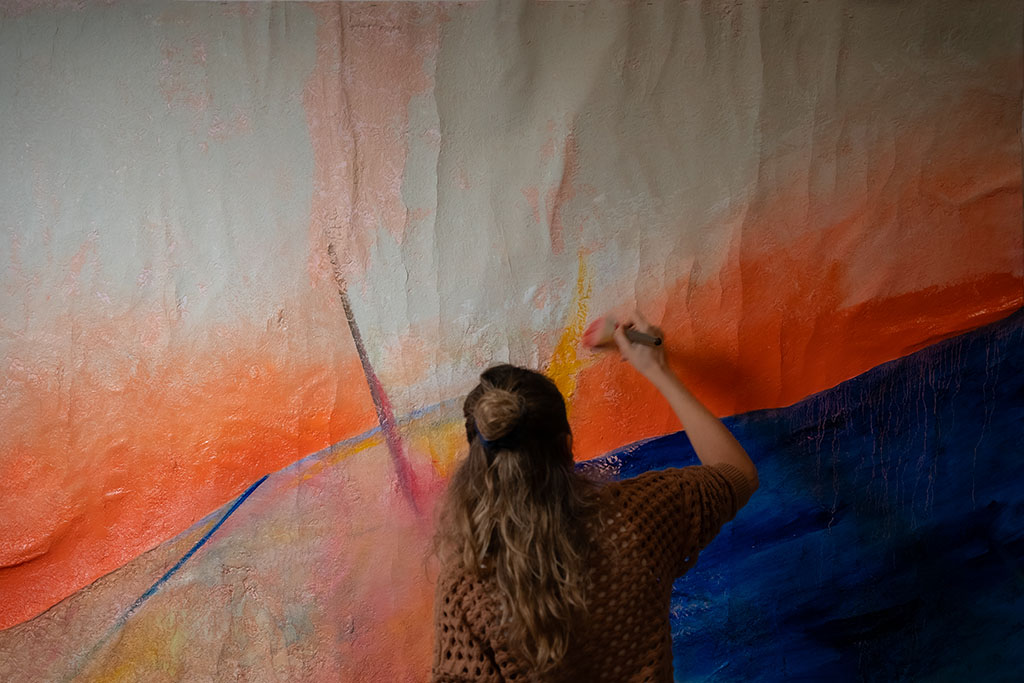

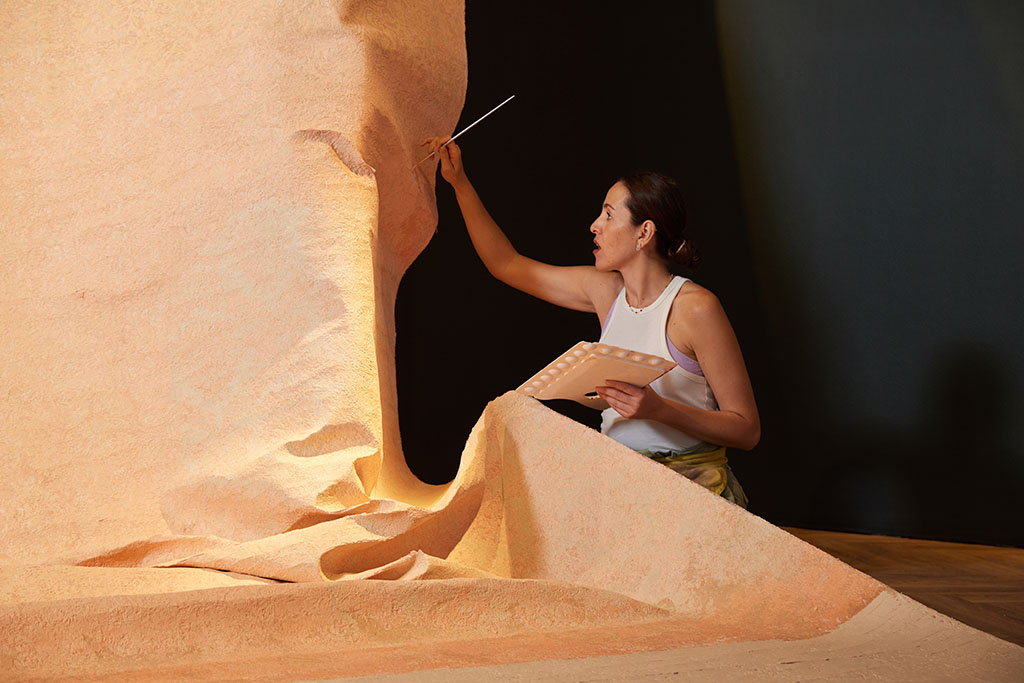
Lebanese artist Chafa Ghaddar paints walls as if they were wounded bodies. Cracked, eroded and marked by humidity, her monumental fresco-inspired surfaces carry the traces of conflict, memory and time with an unsettling physicality. In her hands, architecture becomes flesh: walls breathe, scar, decay and regenerate. Drawing on the visual language of fresco while pushing it into radically contemporary territory, Ghaddar has developed a practice that sits somewhere between painting, installation and spatial archaeology, one that feels as emotionally charged as it is materially seductive.
Much of that sensibility can be traced back to her childhood in Lebanon during the civil war, growing up inside a family home damaged by militia violence and slowly consumed by cracks, moisture and disintegration. Those early encounters with fragile surfaces would later evolve into a wider investigation into the relationship between architecture, trauma and the body. Today, Ghaddar’s works, whether intimate paper studies or immersive site-specific installations, explore how walls absorb history, violence and human presence long after the event itself has passed.
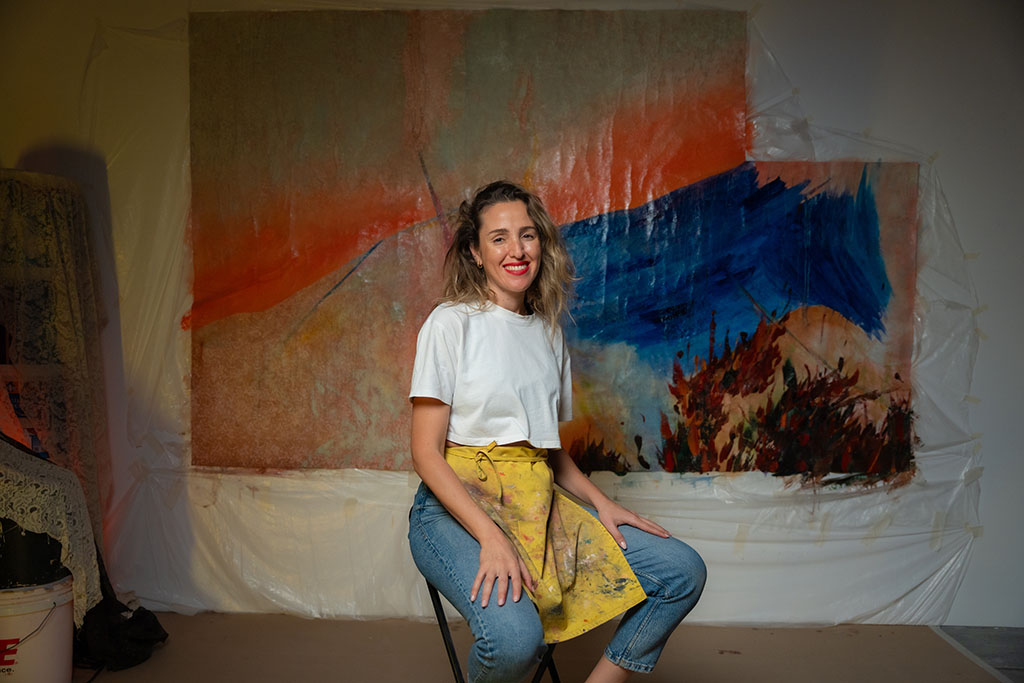
Educated at the Académie Libanaise des Beaux Arts in Beirut and later trained in fresco techniques in Florence, Ghaddar has exhibited internationally across Beirut, Dubai, Brussels, Verona and New York, with recent projects including a major commission for the 16th Lyon Biennale, Manifesto of Fragility. Alongside her studio practice, she has also developed an influential teaching programme focused on tactile experimentation and surface-making. In this conversation, she reflects on the bodily nature of walls, the sensuality of fresco, and why painting, for her, is ultimately about creating spaces where memory and material remain permanently in flux.
Our Lifestyle Editor, José Berrocoso, speaks with Chafa Ghaddar about the wounds and memories that shape her artistic language, her evolving relationship with fresco and architecture, and the projects and ideas currently defining her practice.
You often describe walls not merely as architectural elements but as living surfaces that absorb time, memory and trauma. When did you first begin to see walls in this way, and how did that perception shape your artistic language?
I grew up in a house that got hit during one of the civil war militia conflicts in 1986. It was not destroyed fully but it got “wounded”, meaning the architectural structure remained but its physical state got fully compromised: erosion, cracks and humidity contamination, unhealed surfaces. I witnessed this degradation as a child and grew up with it. I saw these walls altering color, skin and texture. It affected me emotionally but even physically as I had constant allergy from breathing humidity. So, l learned through observation and exposure that walls are bodily and viscerally alive. That wound of my house became a metaphor, a carrier of other inflicted violences that I had to experience just by default of living in a complex place like Lebanon. Since then, I associate wall to body, flesh and skin.
I’m obsessed about these regenerative qualities of a surface. In my work the depth and complexity of a surface is associated to the depth and complexity of walls and violence. Beyond my family house, and looking at the wider landscape of “Lebanese walls”, from archeological ancient ones to more urban architectural and political ones, these walls are naturally palimpsestic and carry layers and layers of traces of time, memory and intergenerational trauma. That’s also a wide field of inspiration to me.
Growing up in Ghaziyeh, overlooking the Mediterranean and surrounded by hills and open landscapes, seems to have given you an early sense of scale and freedom. How do that childhood experiences continue to influence the spatial and sensory qualities of your work today?
My experience of scale came through playing in the hills, witnessing humidity on the walls, observing the Mediterranean Sea facing my home and its marvelous sunsets, and being terrorized by endless wars ravaging my country. Scale is not only a proportional quality of my work. It is its own field of investigation. It is about spread and intimacy and creating fields within fields. When I create at the studio those qualities are shown in the way I work. Multiple surfaces are laid at the same time. Ones on the table and others on the floors and walls. It is an entire ecosystem unfolding at the studio and my paintings start gaining their qualities and aura from those very first moment of production. Even a very small work gives you the impression that it’s coming from something larger than itself. That reference to wall and landscape is always present. Being committed to scale makes the body of the painter aware of its stamina and movement. And the painting holds that overwhelming energy. Therefore, how you create becomes performative and an intrinsic part to the work. I also think of scale as immensity. The immensity of a wall or a rupture or an emotion or color.
The sensorial part is in the invitation to touch. I think my work are very tactile and they require the viewer to be “in touch” with them. Here I remember the fascinating terms by Bachelard: Immense intimacy and intimate immensity.
Your practice places fresco, an ancient technique at the centre of a very contemporary visual language. What draws you to fresco in particular, and how do you negotiate the tension between tradition and experimentation?
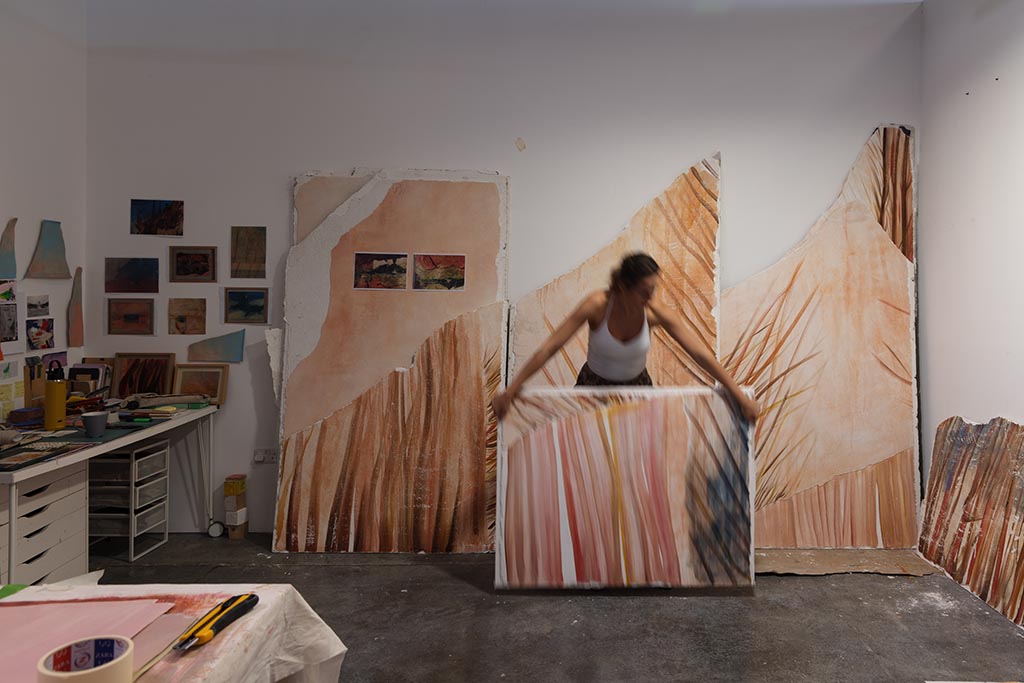
On a physical level, I am initially drawn to the wetness of fresco. You know in this technique you paint on wet. So, it’s very seductive and sensual. It requires you to be in control while building it but then to relinquish that control when unexpected errors occur. So, it humbles the artist and that’s important. But there’s also the idea of creating the surface yourself, the wall onto the wall, that gives me a full sense of agency, for not having to be bound to a limited or defined canvas. The painting starts with the surface and then finishes with color. It is a building act. It’s not 2D but also not 3D. It is very architectural so it has authority. Therefore, fresco and thinking through frescoes allow me to push the boundaries of painting to go beyond itself.
On a conceptual level, the “giornata” which means a “day’s labor” in fresco terms, is the greatest insinuation to the limitation of time and space, and how much you can achieve daily. This itself is a great reminder on how our bodies perform in temporal and spatial states. The fragment itself stands in its autonomy and agency. The fragment can start from the upper left of the wall. So, the idea of western central perspective to access a painting is dismantled here, and that itself is liberating. It has its own logic and as I painter I embody that logic through all the stages of fresco making and thinking, not only visually. Fresco exposes the strength of walls but also their vulnerabilities. They set the promise to defy time yet succumb to the erasure of pigments and traces, through age and environment. The pigments set strongly and keep their vivacity yet can be subject to falling. These paradoxes make frescoes very alive and contemporary. And they echo a lot of concerns that I try to channel through my work. So, the use of fresco to me is a revival of what’s old but also a disruption of the historical, in order to create new environments and encounters that embody contemporary spatial, temporal and bodily philosophies.
Much of your work reflects an acute sensitivity to surfaces: humidity stains, cracks, erosion, and the traces left by time or conflict. Do you think of your paintings as acts of preservation, observation, or transformation?
All of that. They preserve the urgency not the event necessarily. It’s that feeling that something has happened, and we are in the altered body and space, after the visit. The observational aspect is in the commitment to chemical and physical phenomena. The shape and color of wounds, humidity, light and atmosphere, etc. echo that I’ve spent quite some time there, mentally and emotionally. They’re also regenerative cause they destabilize how time feels inside the body of the viewer. In a sense where you can question if this spectacle of scale and material have degraded or about to; if it had just appeared or it has been there. The viewer can’t really lock an answer of whether the work belongs to the past, present or future.
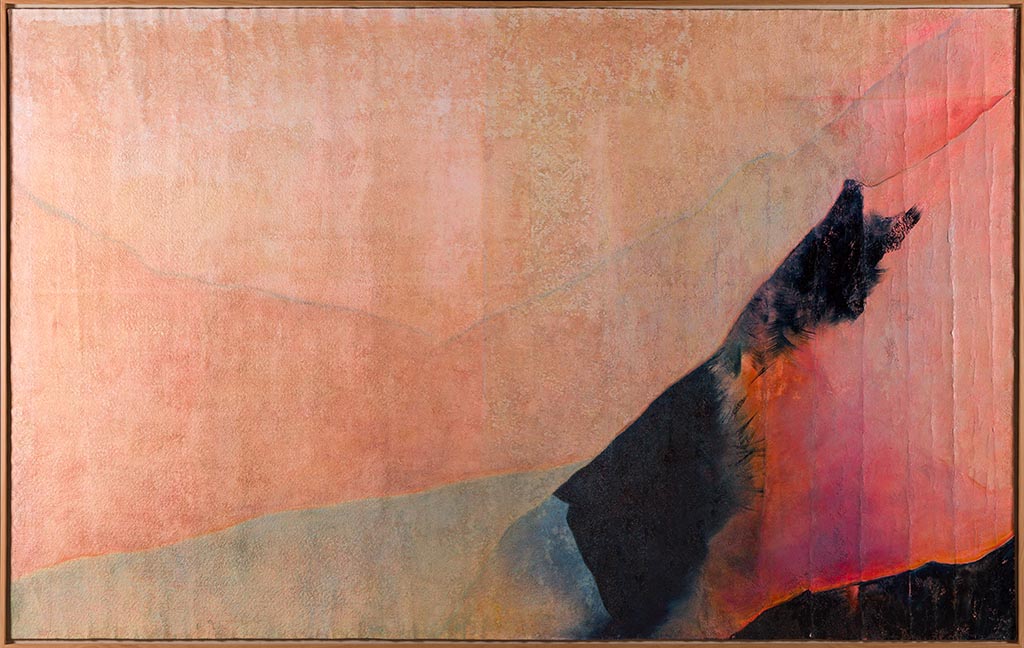
The metaphor of the wall in your work is deeply tied to vulnerability, almost like skin that records experience. In what ways do you see architecture and the human body mirroring one another?
They’re absolutely tied to each other as both are orchestrated by age, environment and chemistry. Fresco softens architecture into bodily and mineral states. My works expose those states as layered, ruptured and unstable, constantly evolving.
Colour plays a central role in your practice, yet it appears in a restrained, atmospheric way rather than as bold statement. How do you approach colour composition, and what emotional or spatial role does it play within your surfaces?
Color to me accelerates the depth of the surface. It forms through its slow emergence from within the layers. It is never a covering, or something that finishes. I sometimes approach color through the lens of haze or atmosphere, that’s what I call accumulative color. And some other times I approach it through the logic of “giornata”. In this case, color presents itself boldly as a standalone fragment, something that doesn’t want to be disturbed, something that has weight.
Your work often exists at the intersection of painting, mural-making and installation. When you approach a wall or architectural surface, how does the process differ from working on canvas or paper?
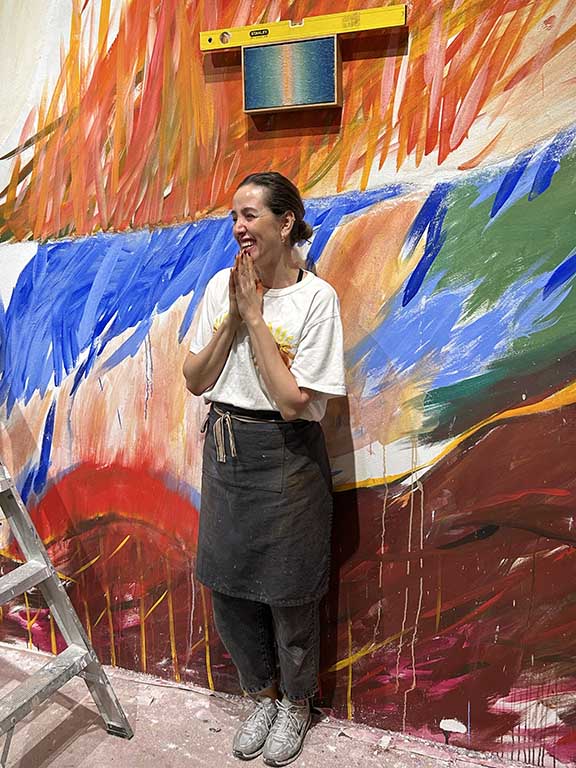
The energy of the wall and architectural surface brings to the forefront the energy of construction sites. Collective work, scale, assistants, systems of production, managing a team, balancing different environmental conditions, scheduling the day ahead, scaffoldings and ladders, among others. The artist holds space for all of that and then spends the “alone and intimate” time at the stage of the pigments. It is a totally different dynamic and a different intimacy from the ones of canvas and papers at the studio. On site you have so many other collaborators and hands, and I am a manager while equally being an artist.
In recent years you have increasingly developed site-specific works and public commissions, including your project for the Lyon Biennale. What interests you about working directly within architectural space and public environments?
It’s the merging of different contexts that I find fascinating. There are more added layers and meanings to the works when they “lean” on other historical or architectural contexts, when they’re “hosted”. Even putting the works in different light conditions is a game changer and brings different readings to my surfaces.
Alongside your artistic practice, teaching appears to be an important part of your life, particularly your tactile workshops exploring unconventional surfaces. How does teaching influence your own studio practice and way of thinking?
Teaching exposes how obsessed I am about every aspect of my practice and how eager I am to share it with everyone. It allows me to refine my language and thoughts and deepen the processes I’m committed too. To believe that something like the simple dotting technique used to transfer drawings in fresco can become a whole poetic and experimental learning experience is fascinating. Every gesture or layer is peeled as knowledge and becomes a tool for critical thinking. Teaching also helps me to push the boundaries of fresco as a contemporary tool and an experimental method of making and thinking. So it doesn’t become stuck in its historical context. Teaching sharpens the thinking but also lubricates it: it brings refreshing new possibilities to the studio.
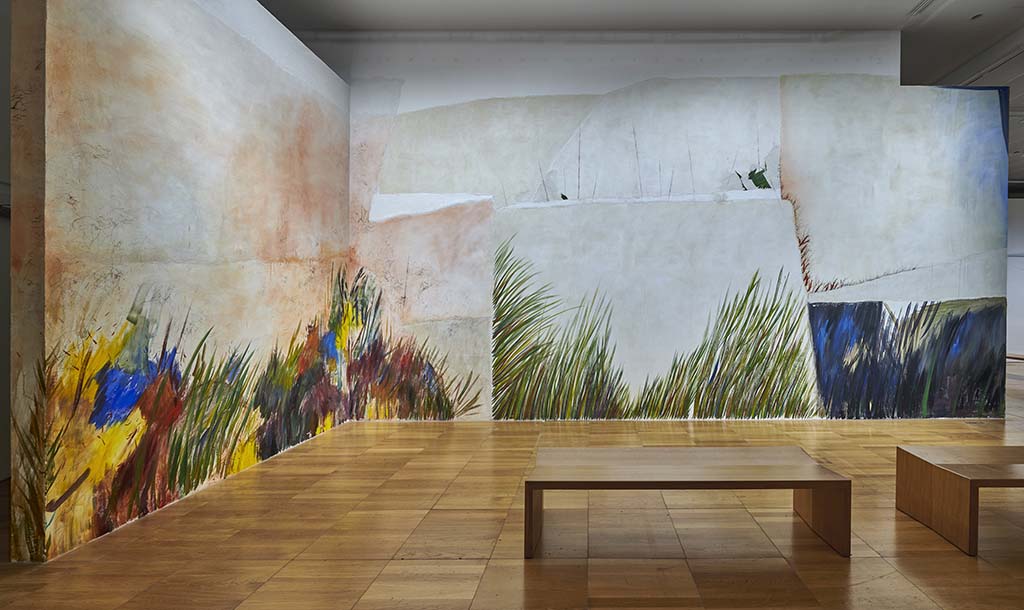
Your recent exhibition Your Sun That Kept Setting suggested a strong dialogue between memory, landscape and emotional geography. Looking ahead, what questions or materials are currently occupying your thoughts in the studio?
I am currently trying to push this idea of “giornata” beyond the fresco mineral body of lime, sand and pigment. How can this fragmentation be investigated on canvas and paper? I am exploring new temporal experiences by developing “portals” onto surfaces of wall fragments and paintings. A lot of emergence energy. And a lot of clashing of oil paint and fresco, wetness and dryness which is quite delicious honestly. My wounds series from 2018 (on paper back then) has made a strong come back during this current war but this time I’m exploring it on canvas and using my lace technique, and on a much larger scale. A lot is going on.
Finally, is there anything else you would like to share about your current practice or any upcoming exhibitions and projects our readers should look out for?
Parallel to the studio practice and teaching, I lead conversation tables and reading groups and I am working on a few at the moment. I will be part of 2 upcoming group shows, one at Concrete, Al Serkal Avenue, called Déjà vu and another one with Tabari Artspace called same “SAME AIR”. I am also working towards a solo show with Tabari Artspace in early 2027.