
A LANGUAGE OF HER OWN
Blending heritage, abstraction, sustainability and instinct into a distinctive creative voice.
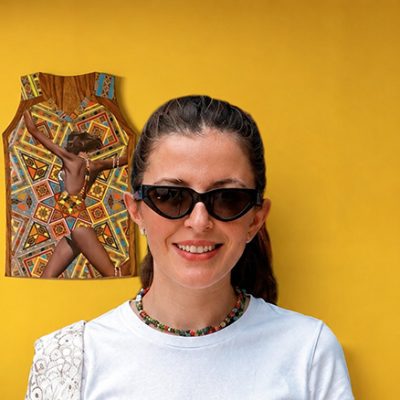
For Sahar Ehsan, art is not simply a creative pursuit; it is a way of making sense of emotion, memory, structure and change. A Kuwait-based visual artist with a strong corporate and academic background, Sahar occupies an intriguing space between analysis and instinct. By day, she works within a world shaped by data, strategy and patterns; through art, she transforms those same ideas into colour, texture, symmetry and reflection.
Her artistic journey began in 2020 during a deeply personal period of grief. With no studio and only a few unconventional materials at hand, Sahar created her first piece using coffee, black ink and nail art brushes. What began as an emotional outlet soon developed into a serious creative practice and, eventually, a distinct body of work.
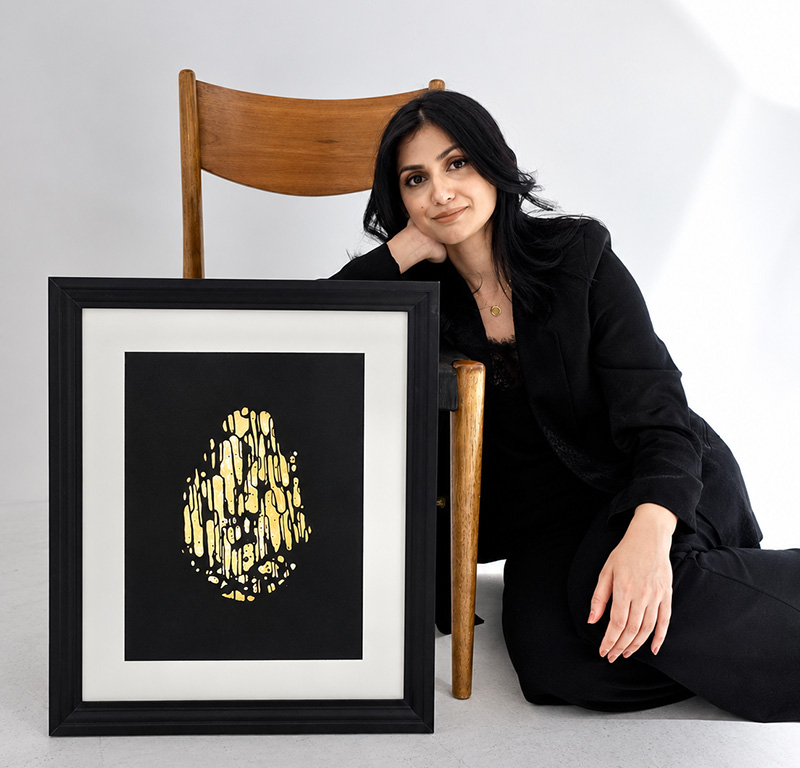
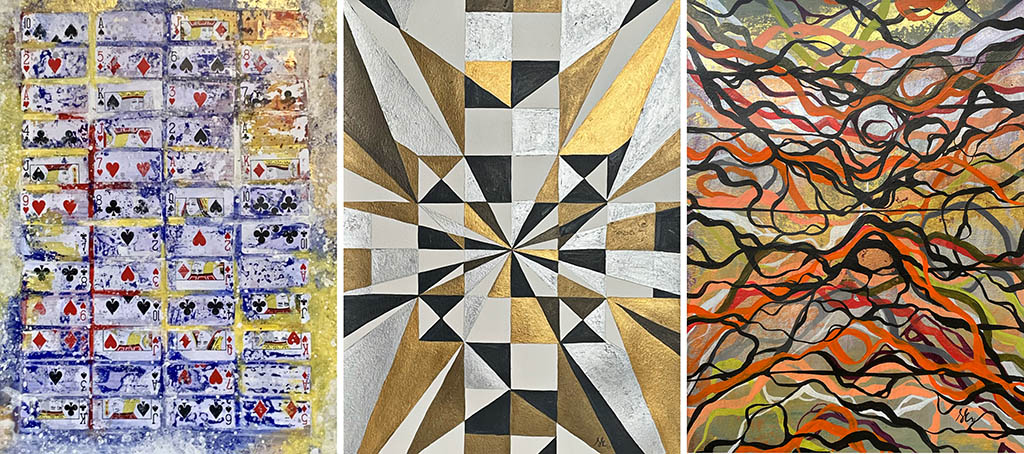
Since then, Sahar has resisted being confined to a single visual language. Her portfolio moves confidently between abstract painting, geometric compositions, floral works, contemporary Arabic calligraphy and sustainable art created from repurposed materials. Across these varied forms, recurring themes of balance, layering, repetition and transformation give her work a recognisable identity.
Sustainability has also become central to her practice, from incorporating dried flowers and recycled plastics into artworks to transforming discarded coffee stirrers into large-scale installations and involving the public in live eco-art experiences.
In this conversation with CP Magazine, Sahar reflects on the personal beginnings of her art, the relationship between logic and creativity, artistic freedom, sustainability and her belief that beauty can emerge from the most unexpected places.
You are a Kuwait-based Pakistani artist, but your story clearly extends far beyond the studio. For readers discovering you for the first time, who is Sahar Ehsan beyond the title of visual artist?
I would describe myself as curious, analytical and creative. I tend to observe things quite closely, think deeply about them and constantly look for connections and patterns.
I also have quite a few different sides to me. I have a corporate career, an academic side, my art and an interest in sustainability. Moreover, I genuinely enjoy people, food and experiences.
I don’t really see myself as someone who fits neatly into one box. At my core, I am someone who is always observing, thinking, questioning and creating, sometimes without even realising it.
What was your childhood like, and where did creativity first appear in your life? Were you always drawn to colours, patterns and making things, or did that side of you emerge much later?
It was always there. I was naturally drawn to colours, patterns and making things, and thankfully, my family was very supportive of that side of me.
I actually wanted to pursue art as a career at one point. But then the practical side of my brain won. I also genuinely loved economics, finance and business, so I chose a more conventional career path.
Looking back, I don’t think I ever really chose between the two. The analytical side became my profession, while the creative side eventually found its way back to me through art.
Your academic journey includes Kinnaird College and, more recently, IE University, while much of your professional life has been rooted in business, strategy and analytics. How has that very different educational background shaped the way you approach creativity and problem-solving as an artist?
It has shaped me quite a lot. My academic and professional background has trained me to look for patterns, relationships and structure, and I naturally bring that into my art.
You can see it in the symmetry, geometry, repetition and patterns that appear throughout my work.
But art has also taught me the opposite. Not everything needs to be solved before you start. I usually begin with some structure, but then I allow the painting to evolve and respond to what is happening on the canvas.
So, my process is really a combination of analysis and instinct.
Alongside your artistic practice, you have built a substantial corporate career at Zain Kuwait, including work in Customer Value Management. What does your professional world demand from you that is completely different from art, and where do the two unexpectedly meet?
My corporate world is very structured. It requires discipline, accountability, deadlines and decisions based on data. Art is much more personal and unpredictable. But there is one very clear connection: patterns.
In my professional life, I look at data and behaviour to detect patterns and trends. In my art, I create patterns, repetition and symmetry.
So, in one world I am detecting patterns, and in the other I am creating them.
Your portfolio dates the beginning of your creative journey to 2020. What happened at that particular point in your life that made you move from simply appreciating creativity to seriously identifying yourself as an artist?
2020 was a very significant year for me, although it started from a very difficult place.
During the pandemic and lockdowns, my manager suddenly passed away. I was dealing with a lot of grief and emotion, and I didn’t really have an outlet for them. I have always believed that people need a medium through which they can express what they feel. For me, that became art.
I had no studio and barely any art supplies. I had coffee, black ink and a few nail art brushes. I made my first piece with those, almost instinctively. When I finished it, I felt better. That was the moment I realised art wasn’t just something I enjoyed. It was something I needed.
Many artists spend years trying to develop one recognisable style, yet your work deliberately moves between abstraction, geometry, floral compositions, calligraphy, reflective surfaces and sustainable art. Have you ever felt pressured to choose one visual identity, or is refusing to be confined to one style part of your identity as an artist?
I have definitely been told that I should choose one style. Quite a few times. But honestly, who decided creativity should be restricted to one style?
If I force myself to make only one kind of art because that is what people expect from me, I would eventually start suppressing my creativity. That defeats the purpose of creating in the first place.
And if you look closely, my work is not completely disconnected. Symmetry, structure, patterns, layers, colour, texture, reflection and balance appear in different ways across the work.
I want to become a great artist, of course, but my bigger goal is also to spread art, colour and beauty into people’s lives. I don’t want to limit the ways in which that can happen.
You describe every piece as “a reflection of who I am in that moment”. How much does your emotional state determine what you create, and can you look back at a work and immediately remember the version of yourself who made it?
Very much.
My emotional state influences the colours I am drawn to, the amount of detail I want, my patience and even when I decide something is finished.
My process is also quite long. I will step away from a painting, come back to it, look at it from different distances, zoom in on details and then reassess the whole composition.
That is probably why even paintings from the same collection can look quite different. Each one has gone through its own journey.
And yes, when I look at certain works, I can immediately remember where I was emotionally when I made them. In that sense, my paintings become a kind of visual record of different versions of me.
Texture and reflection appear repeatedly throughout your practice, particularly through metallic pigments, organic elements and unconventional tools. What attracts you to surfaces that physically react to light rather than remaining visually static?
There is something almost magical about reflection. Think about sunlight on water, or the way a diamond catches the light and suddenly looks different. I love that quality.
Metallics make a painting change depending on the light and where the viewer is standing. They add movement without the artwork actually moving.
I also love that little element of discovery. You notice something from one angle and then something else from another.
You speak about finding beauty in details that people often overlook. What are some of the ordinary things, moments or materials that have unexpectedly triggered an idea for you?
I am very drawn to layers. People are layered. Emotions are layered. Situations are layered. What we see on the surface is rarely the whole story.
That idea finds its way into my paintings through the multiple layers I build into them.
Materials also trigger ideas for me. A piece of plastic, a coffee stirrer or a dried flower can become interesting once I stop seeing it for what it was originally meant to be.
I start thinking about its shape, texture, imperfections and potential. That shift from seeing something as ordinary or discarded to seeing what it could become is something I really enjoy.
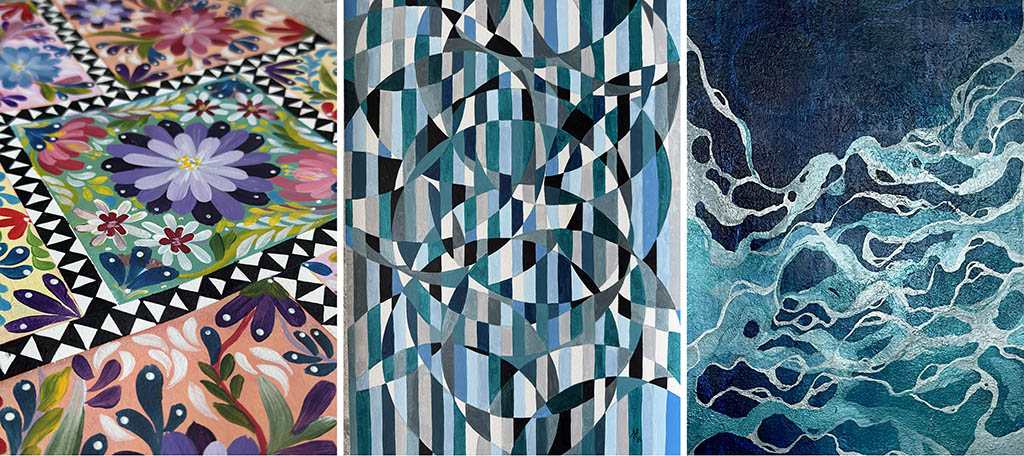
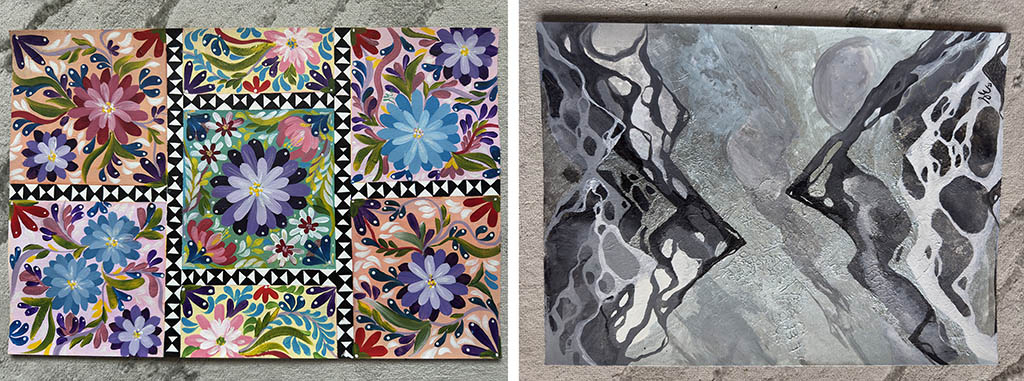
Your Abstract Medley works explore irregular yet symmetrical lines and the idea of balance within abstraction. When you begin a piece like this, how much is carefully planned and how much is allowed to develop instinctively?
I like to have a starting point, but I don’t like knowing exactly where I will end up.
I may begin with a colour palette or a general structure, but once I start painting, I go with the flow.
I constantly move between the details and the overall composition, looking at what is working and what isn’t. Sometimes an unexpected detail becomes the most interesting part, and I follow it.
Ultimately, the work has to look beautiful and feel resolved to me. That is usually my final test.
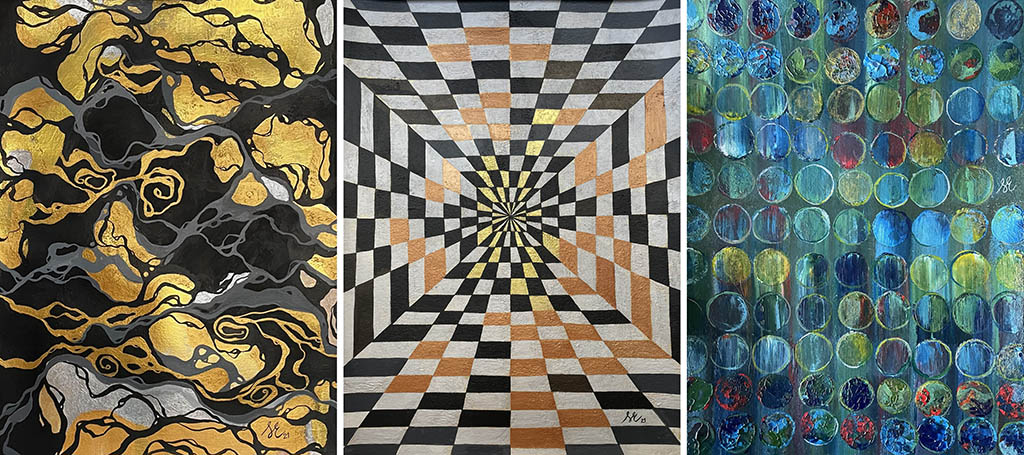
Chromatic Geometry introduces stronger structure, optical movement and repeated geometric forms. Are you fascinated by the tension between mathematical order and artistic freedom, particularly considering the analytical side of your professional life?
Definitely.
I love the combination of something organised with something that can still surprise you.
Symmetry and structure are naturally soothing to me, but I don’t want the result to feel completely predictable. With Chromatic Geometry, I particularly enjoy the optical movement and the way colour combinations can completely change how the geometry feels.
So, in a way, it reflects my personality too: a little organised, a little expected, but still a little unexpected.
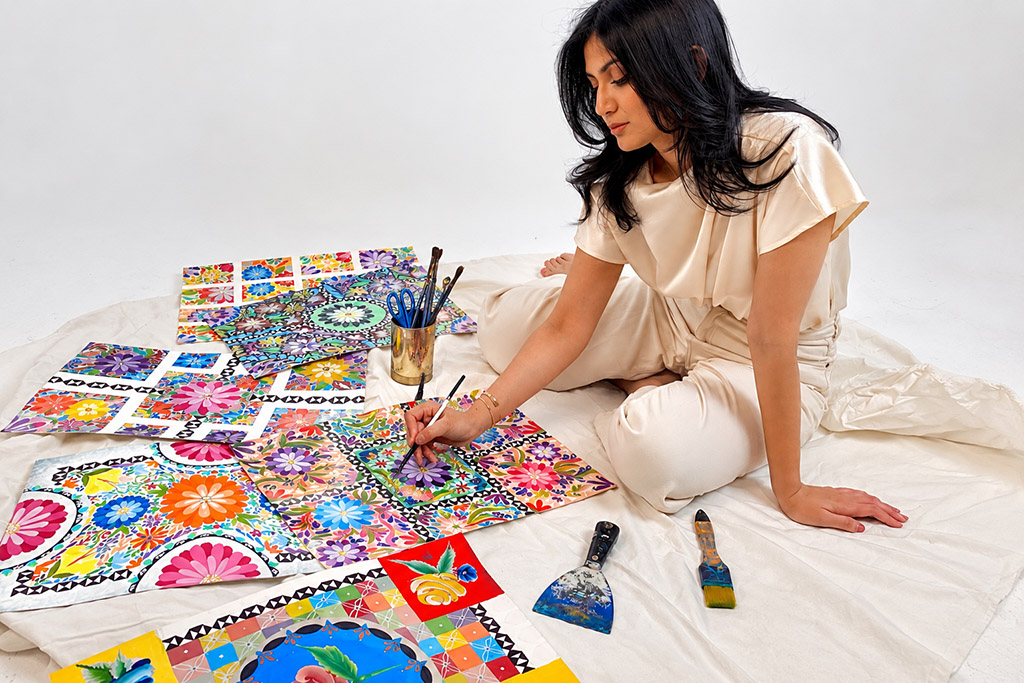
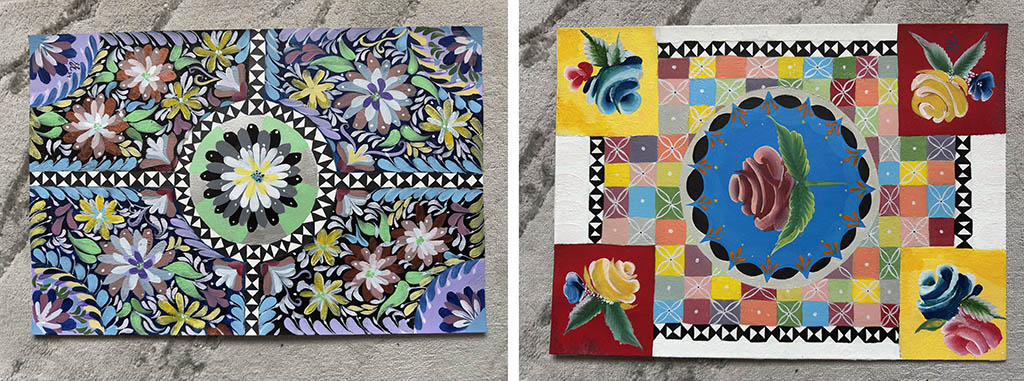
Your Floral Highways collection draws directly from the extraordinary visual language of Pakistani truck art. What does that tradition mean to you personally, and how did you approach transforming such a culturally recognisable art form into something distinctly your own?
Pakistani truck art makes me happy. It is colourful, detailed, decorative and unapologetically maximalist.
There are flowers, borders, patterns and so many details happening at once, yet somehow it all comes together.
As a Pakistani artist, there is naturally a personal connection to it. But I didn’t want to simply reproduce truck art. I wanted to take the elements I love and reinterpret them through my own approach to symmetry, structure, colour and detail.
So, Floral Highways is inspired by that tradition, but it is ultimately my interpretation of it.
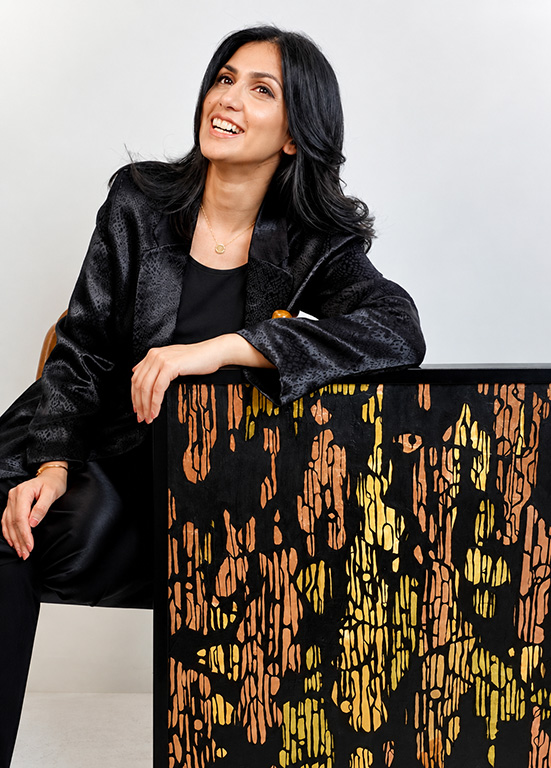
Your signature calligraphy takes elements of traditional Arabic calligraphy and reconstructs them through a personal, contemporary visual language. How did you develop that style, and what were you trying to express that conventional typography or calligraphy could not?
Traditional Arabic calligraphy is beautiful, but it already has an established visual language. I wanted to explore what it could look like through my own eyes.
I started treating the letters almost as visual forms rather than simply written language and began reconstructing them into contemporary compositions.
I wasn’t trying to replace traditional calligraphy. I wanted to give it my own sense, my own hand and my own visual language.
Essentially, I wanted to be able to look at it and say, “This is Arabic calligraphy as I see it.”
Sustainability has become a significant part of your practice. Was there a particular moment when you stopped seeing discarded objects simply as waste and began seeing them as potential artistic material?
Not really. I see it all the time.
I will look at something that is about to be thrown away and immediately think, “There has to be something else this can become.”
Working with discarded materials has actually made me more creative because of the limitations. You have to work with the material’s shape, texture, flexibility and imperfections rather than starting with something designed specifically for art.
For me, the idea is simple: if something can have another life, why should its story end in a landfill?
In Material Transformations, you have incorporated elements such as dried rose petals and recycled plastics into abstract work. Do materials carry memories and emotional associations for you before they even enter the composition?
Absolutely.
The dried flowers especially carry a lot of emotion for me because flowers are usually connected to moments when someone is being celebrated or appreciated.
A birthday, an achievement, a special occasion, or simply someone wanting to make you feel special.
When I preserve those flowers in a painting, I am also preserving a memory.
So, those works feel particularly happy to me. Something that was temporary becomes part of something permanent.
Your 2025 Eco-Stir Project with Caribou Coffee transformed used stirrers into a large-scale artwork displayed in its Kuwait outlets. What was the biggest creative or technical challenge in turning something so disposable and ordinary into something people were meant to stop and look at?
The material itself
Waste materials don’t behave like conventional art materials. Coffee-related materials can bleed, plastics can bubble or warp, paper cups don’t always sit properly, and some materials simply refuse to cooperate!
So, the challenge was learning how to work with those limitations instead of fighting them.
You also have to rethink composition because you aren’t starting with a blank canvas. You are starting with whatever materials already exist.
But that was also what made it exciting. The limitations forced me to problem-solve creatively.
At the 2026 KISR Sustainability and Beach Clean-Up Campaign, you created eco-art live while visitors participated in the process. How did allowing the public into the act of making change your relationship with the finished artwork?
It made me realise how much people can connect with an idea when they are actually part of it.
Instead of simply telling people that discarded materials can become something meaningful, they were able to participate in that transformation themselves.
It also showed me that people can come together around a cause when the message is explained in a way they understand and when they feel they have a role in it.
By the end, the artwork didn’t feel completely like mine anymore. It represented a collective experience, and I really liked that.
Sustainability is now widely used in art, fashion and branding, sometimes meaningfully and sometimes simply as a marketing language. What, for you, separates genuinely sustainable artistic practice from using sustainability as a trend?
For me, it comes down to what you are actually doing, not what you are calling it.
Calling something sustainable doesn’t automatically make it sustainable. There needs to be a genuine change in how you think about materials, waste, consumption or the life of an object.
It also doesn’t have to be perfect. I don’t think any creative process can claim to have zero impact.
But the material transformation has to be genuine. I don’t want discarded material to simply be a prop for an eco-friendly campaign. I want it to actually become part of the artistic idea.
For me, sustainability is not an aesthetic. It is a way of thinking about what we do with what already exists.
Your work has moved beyond framed pieces through projects involving kaftans, limited-edition tote bags, luxury automotive collaborations and other design applications. What excites you about seeing art leave the gallery wall and enter fashion, objects and everyday spaces?
I love the idea of art becoming part of people’s everyday lives.
A gallery is an important space for art, but it doesn’t have to stop there. Someone might wear a piece of my artwork, carry it, live with it or encounter it somewhere completely unexpected.
I also enjoy the challenge of translating an artwork into a different medium without losing what makes it mine.
Ultimately, it comes back to my bigger goal: I want to spread art. I want colour, creativity and beauty to reach people in as many meaningful ways as possible.
In 2022, your work received both a Bronze Award in the Abstracts with Blue juried competition and an Honourable Mention from Art Show International Gallery. At such an early stage in your artistic journey, did external recognition give you confidence, or did it create a new pressure to prove yourself?
It gave me confidence.
When you are starting out, most of the people appreciating your work are your friends and family. You appreciate it, of course, but there is always a little voice asking whether they genuinely think the work is good or whether they are simply being supportive.
The awards gave me a different kind of validation.
They made me think, “Okay, maybe there really is something here.”
It changed how I saw myself, from someone whose art was appreciated by friends and family to someone who could actually have a place as an artist.
And rather than making me feel I had to prove myself with every painting, it made me want to take the practice more seriously.
What are some of your other hobbies and interests?
I love eating out, especially in Kuwait. We are honestly spoilt for choice when it comes to food. I enjoy trying new restaurants, discovering different cuisines and, of course, going back to the places I already love.
I also enjoy volunteering and helping out when there is an opportunity that genuinely means something to me.
Beyond that, I like good company, travelling, discovering new places and experiences, and generally keeping myself busy. I am naturally curious, so I tend to get interested in all sorts of things.
Your message for us at CP Magazine.
I would say: keep going.
What I really appreciate about CP Magazine is the consistency, quality and variety. It is not easy to keep producing content regularly while maintaining a strong standard, and I think that combination is what makes a publication valuable.
I also appreciate the range of people and stories you give a platform to, especially creatives who are trying to reach new audiences.
So, my message is simple: keep the consistency, keep the quality and keep creating space for different voices and perspectives.