
FOLLOWING THE UNEXPECTED
How chance, resilience and curiosity can reshape a creative journey.
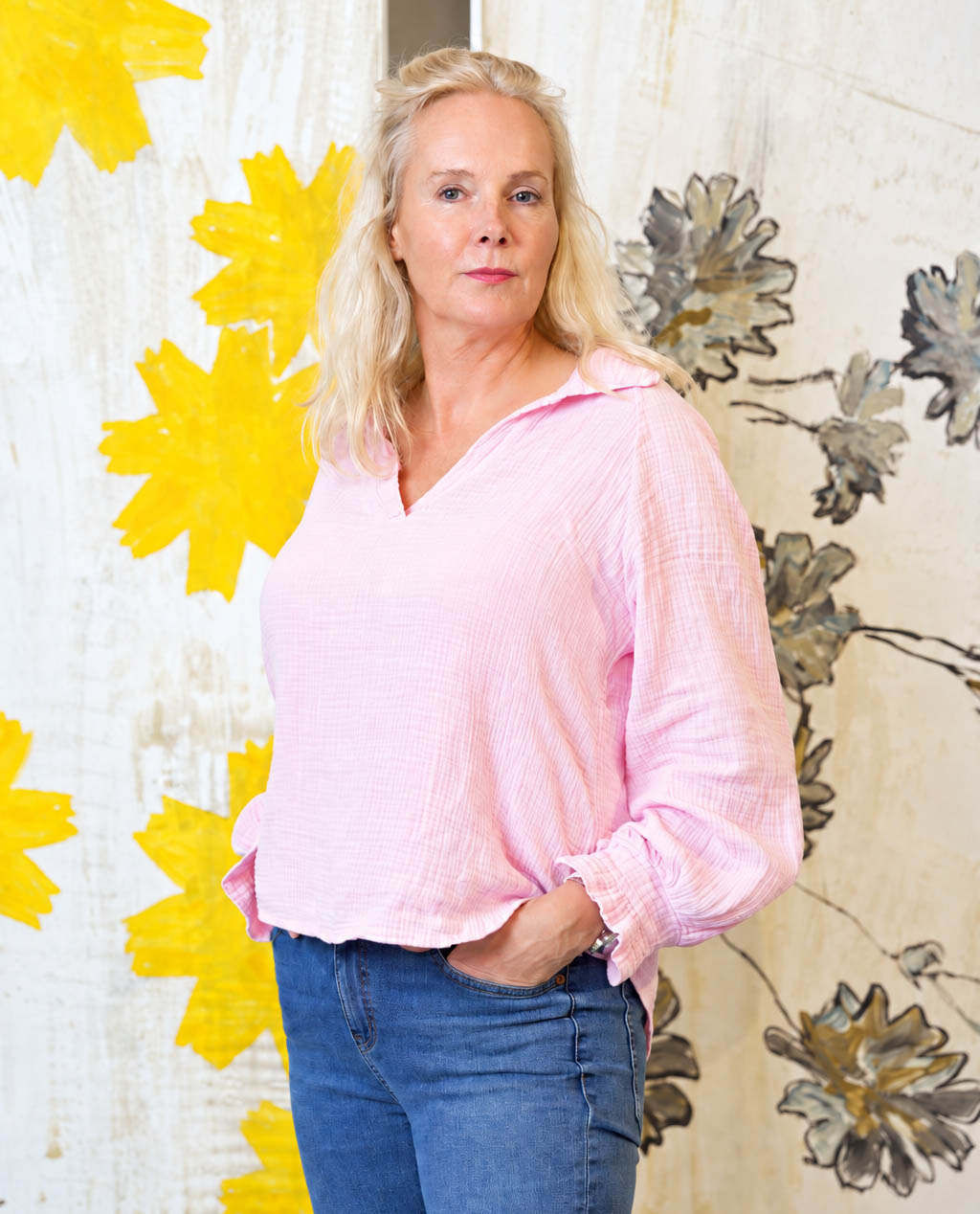
For Elle Ford-Andringa, art is not simply about making objects; it is about tracing what remains after change. A Dutch-born multidisciplinary artist shaped by years of living across the Middle East, Far Eastern Russia, Southeast Asia and Borneo, her practice moves through memory, material, place and transformation. Working across sculpture, installation, painting and found matter, she is drawn to fragments, residue, ash and objects that already carry a history, allowing process and uncertainty to become part of the work itself.
Her current residency at Contemporary Art Platform (CAP) in Kuwait began in an almost cinematic way. A small yellow flower, picked up almost casually during a visit, turned out to be the Arfaj, Kuwait’s national flower. Its resilience in harsh desert conditions immediately connected with themes already present in her ongoing series, The Other Side, which explores strength, renewal and the possibility of moving forward after difficult periods.
What followed was an unexpected residency, a new body of work and a growing exchange with Kuwait, its people and its creative community. Her journey also reveals how openness to chance can transform a passing encounter into an experience capable of reshaping an artist. In this conversation with CP Magazine, Ford-Andringa reflects on movement, artistic freedom, uncertainty, resilience and the beauty of allowing an unplanned moment to redirect both life and practice.
For someone discovering your work for the first time, who is Elle Ford-Andringa?
I am a Dutch-born multidisciplinary artist whose life and practice have been shaped by movement, place and change. I have spent much of my life living outside the Netherlands, moving between very different parts of the world, from the Middle East and Far Eastern Russia to Southeast Asia and Borneo.
As an artist, I am interested in transformation, memory and what remains: the traces we leave behind, the histories carried by objects and materials, and the ways in which something can take on another existence after its original purpose has disappeared.
My work often begins with materials that have already lived a life, ash, fragments, residue or found matter and I allow the process of making to reveal something I may not have anticipated.
I think that sense of uncertainty is important to me. Perhaps living in so many places has taught me to be comfortable with not entirely knowing where something will lead.
You were born in the Netherlands but have lived across remarkably different cultures, landscapes and climates. How have those experiences shaped the artist you became?
Living in such different environments has probably shaped me more deeply than I consciously realised at the time. Every place has its own visual language, its architecture, landscape, light, materials, traditions and rhythms but there is also the experience of arriving somewhere as an outsider and slowly learning how to look.
Moving repeatedly teaches you that very little is fixed. Home changes. Your surroundings change. Things disappear, are left behind or acquire a different meaning in another context. I think that has naturally entered my work.
Rather than trying to reproduce a particular landscape or culture, I am interested in what a place leaves with me. Sometimes that might be a material, an architectural form or a fragment of history; at other times, it is simply a feeling that stays with me and emerges much later in the studio.
Before pursuing fine art, you studied interior architecture. What eventually pulled you towards becoming an artist?
Interior architecture gave me a strong awareness of space, proportion, material and the relationship between an object and the environment around it. Those concerns have never really left me and are still present in the way I approach sculpture and installation.
But art offered me something different. There was greater freedom to ask questions without necessarily having to resolve them. I became increasingly interested not simply in designing a space or solving a problem, but in exploring ideas, materials and processes whose outcomes I did not already know.
You returned to formal art education later in life. What did that experience give you that years of living, travelling and creating on your own could not?
Returning to formal education later in life meant that I arrived with a great deal of lived experience behind me. I already had memories, places, materials and questions that had accumulated over many years. What education gave me was a framework in which to examine them more critically.
It challenged me to ask why I was making something, rather than only how I wanted to make it. Being surrounded by other artists and engaging in critique also forced me to articulate ideas that had previously been much more instinctive.
At the same time, I do not think formal education replaced experience. The two became complementary. My life had given me the material; education gave me another way of interrogating it.
You later completed an MFA with distinction. Did that experience change the way you understood your own practice or perhaps give you a new language for something you were already doing instinctively?
Yes, I think much of it was about recognising connections that were already there. Ideas around transformation, absence, memory, place and material had appeared in different forms throughout my work, but the MFA gave me the opportunity to examine those threads more deeply and understand how they belonged together.
It also made me more conscious of process itself as part of the work. I became increasingly interested in what happens when a material is altered, burned, reduced, fragmented or transformed and in the tension between destruction and creation.
There is something fascinating about taking a material beyond the state in which we normally recognise it. It may appear to have been destroyed, but it has actually become something else. That transformation opened up an important territory in my practice.
But I actually hated some aspects of my MFA. There was far too much theory, while all I wanted was the freedom to play, experiment and follow my instincts. Perhaps, though, it taught me one important thing: what I did not want from my practice.
You have lived and worked everywhere from the Middle East to Far Eastern Russia and Borneo. Which place has unsettled you most creatively in a good way and why?
That is difficult to answer because each place has unsettled me differently.
Moving between such dramatically different environments continually changes the way I look. Far Eastern Russia, the Middle East and Borneo could hardly be more different in climate, culture, landscape and materiality. Each requires a kind of recalibration.
Perhaps creative discomfort comes from being somewhere you do not completely understand. You have to observe more closely. Familiar assumptions no longer work, and that can make you receptive to details you might otherwise overlook.
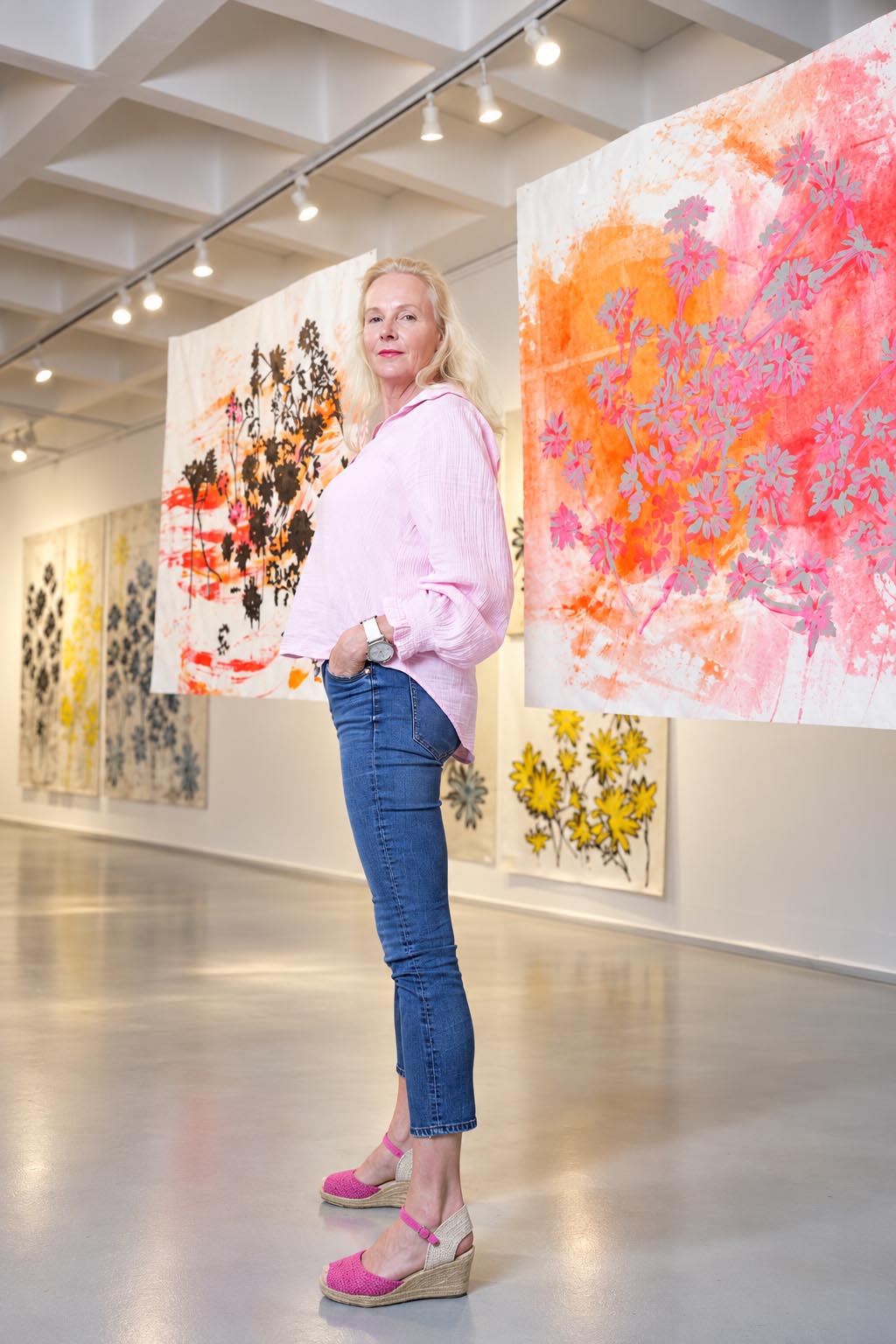
The story of how you came to undertake this residency at CAP is rather unexpected. Take us back to the beginning, how did it all happen?
When I first walked into CAP, I noticed a small yellow flower. I liked it, put it in my bag and did not think much more about it.
When I got home, I finally read what was written on the card. The flower was the Arfaj, Kuwait’s national flower. It survives the harsh desert conditions and, to me, spoke of strength and resilience.
I got goosebumps.
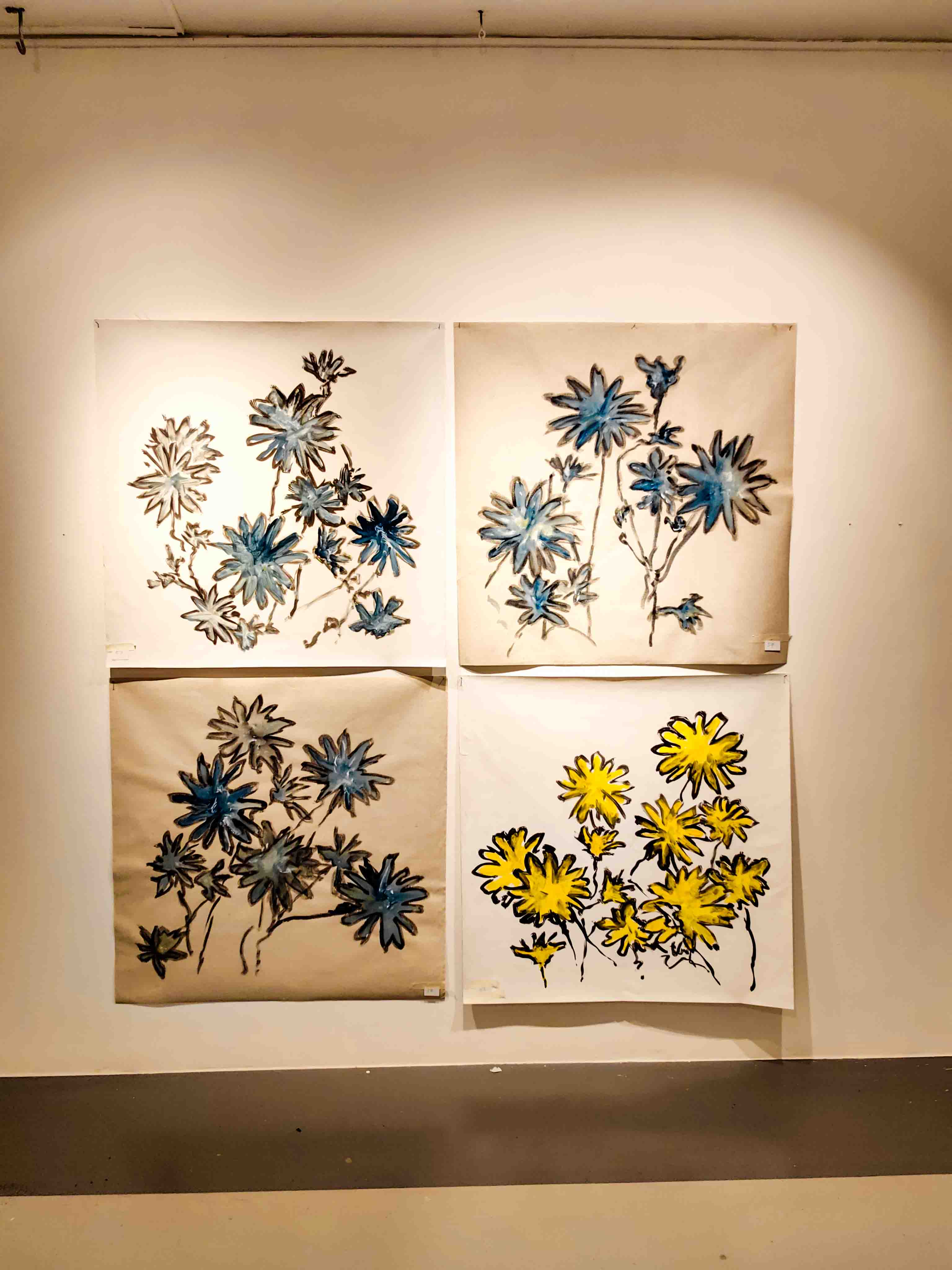
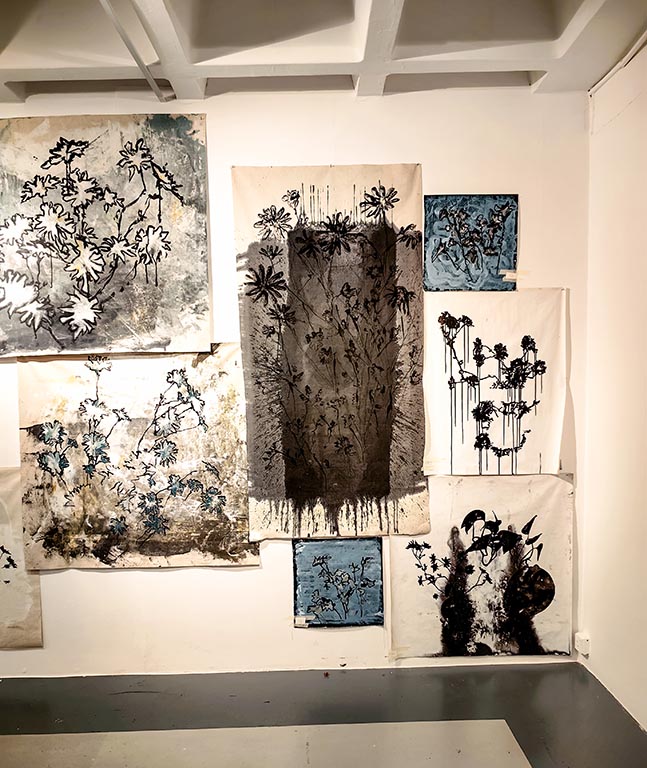
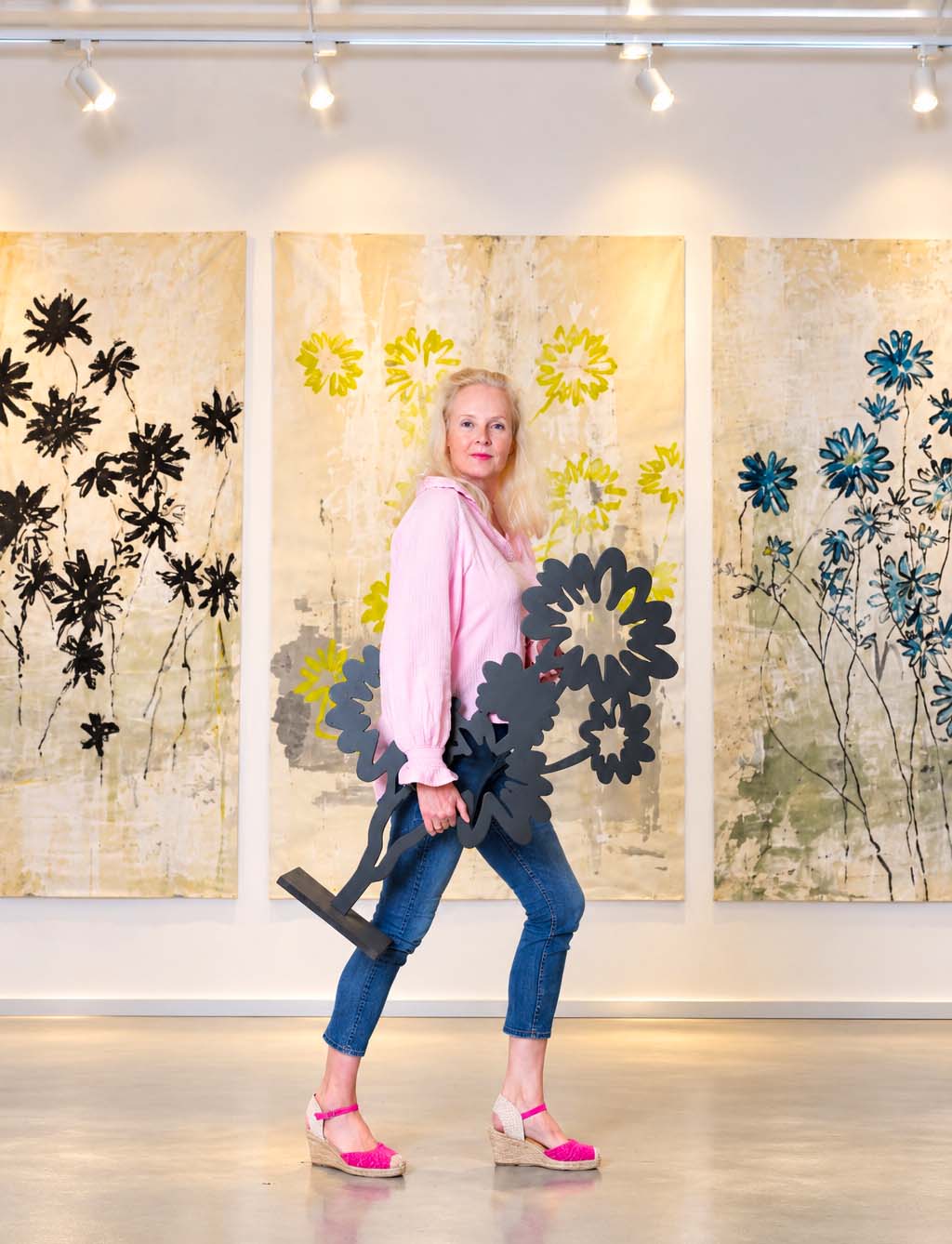
My series The Other Side had begun from exactly that place. I started painting flowers while finding my way out of a darker period in my life. They became about strength, resilience, moving forward and finding light again. Some of these works were created elsewhere, and others here in Kuwait.
The connection with the Arfaj felt too strong to ignore.
So I went back to CAP and told Ophelia the story. Her response was simply, “We need to do something together. Why don’t you do a residency here and see where the work takes you?”
And that is exactly what we did.
There was no big plan. The residency grew from a small yellow flower, an unexpected connection and a willingness to see what might unfold.
Now the journey will end with a show at CAP – although, knowing The Other Side, perhaps it is not really an ending at all.
What has surprised you most about Kuwait since arriving here?
How people dress! It is unbelievable. Everyone looks fabulous, and they smell fabulous too. Then I look at myself and think, “OK, I really need to do something here!”
I can learn a lot from people in Kuwait about how to present myself. They really have something to teach me.
What are you exploring or creating during your time at CAP that you could not have made elsewhere?
I had already started drawing flowers in the Netherlands, and then I came to Kuwait and discovered this amazing connection with the Arfaj. The work was made in different countries, but somehow it carried the same meaning strength and resilience.
Now I have this open studio space where I can simply play and see what happens. People walk in, we talk, and somehow everyone gives me something, a story, an idea, something from Kuwait and that finds its way into my work.
I really do not know yet where it is going, and I like that.
Has anything distinctly Kuwaiti, its light, landscape, architecture, people or materials, already found its way into the work?
Yes, but perhaps not in the most literal sense. My work had already begun to explore flowers before I arrived in Kuwait, so the Arfaj has not directly changed the visual language of the work. What it did was create an unexpected connection with what was already there.
When I encountered the Arfaj, Kuwait’s national flower, I was struck by what it represents: resilience, endurance and the ability to grow in extremely difficult conditions. Those ideas were already at the heart of The Other Side. I had begun painting the shadows of flowers as I was emerging from a period of darkness, and they had come to represent the return of light, growth and the possibility of beginning again.
So, rather than the Arfaj entering the work, it feels as though it came alongside it. There is a kind of parallel between the flower and the paintings, two different expressions of the same idea.
For me, that has created a very natural connection between The Other Side and this chapter of the work in Kuwait.
Carbonisation has been central to your practice. What first made destruction and transformation creatively fascinating to you?
Carbonisation actually came to me rather than being something I consciously went looking for. When my children were small, life was busy and chaotic in the way it often is with young children. I would be cooking while playing with them, get distracted for five minutes and inevitably something would burn. It happened so often that eventually I began to wonder whether I should stop seeing it as an accident and start paying attention to it.
There was one particular moment when I had left a pot of apple sauce inside an old AGA. The door was so thick that I did not smell anything, and I only discovered it the following morning. When I opened it, the apple sauce was completely black and carbonised, but it was still bubbling slightly.
There was something strangely alive about it. It felt almost as though the material was speaking to me, and I remember thinking, “OK, I need to use this.”
That was really the beginning. From then on, I started carbonising objects deliberately and exploring what happens when something familiar is taken through a process of destruction and becomes something entirely different. What began as an accident became a process I could control, while still allowing transformation and unpredictability to remain part of it.
I still use carbonisation in my work today. I think what continues to fascinate me is that destruction does not necessarily mean an ending. It can be the beginning of another form, another material, another life.
There are also different stages of carbonisation, and I am very interested in that fine line between transformation and disappearance. If you do not burn something enough, it remains too close to what it was; if you take it too far, it becomes ash and there is almost nothing left to hold on to.
There is a particular point where the object is completely transformed but still holds its form, so fragile that it can begin to deteriorate in your hands. For me, that fragility has a very human quality. It reflects something about life itself: how delicate the balance can be between holding on and letting go, between what remains and what simply slips through our fingers.
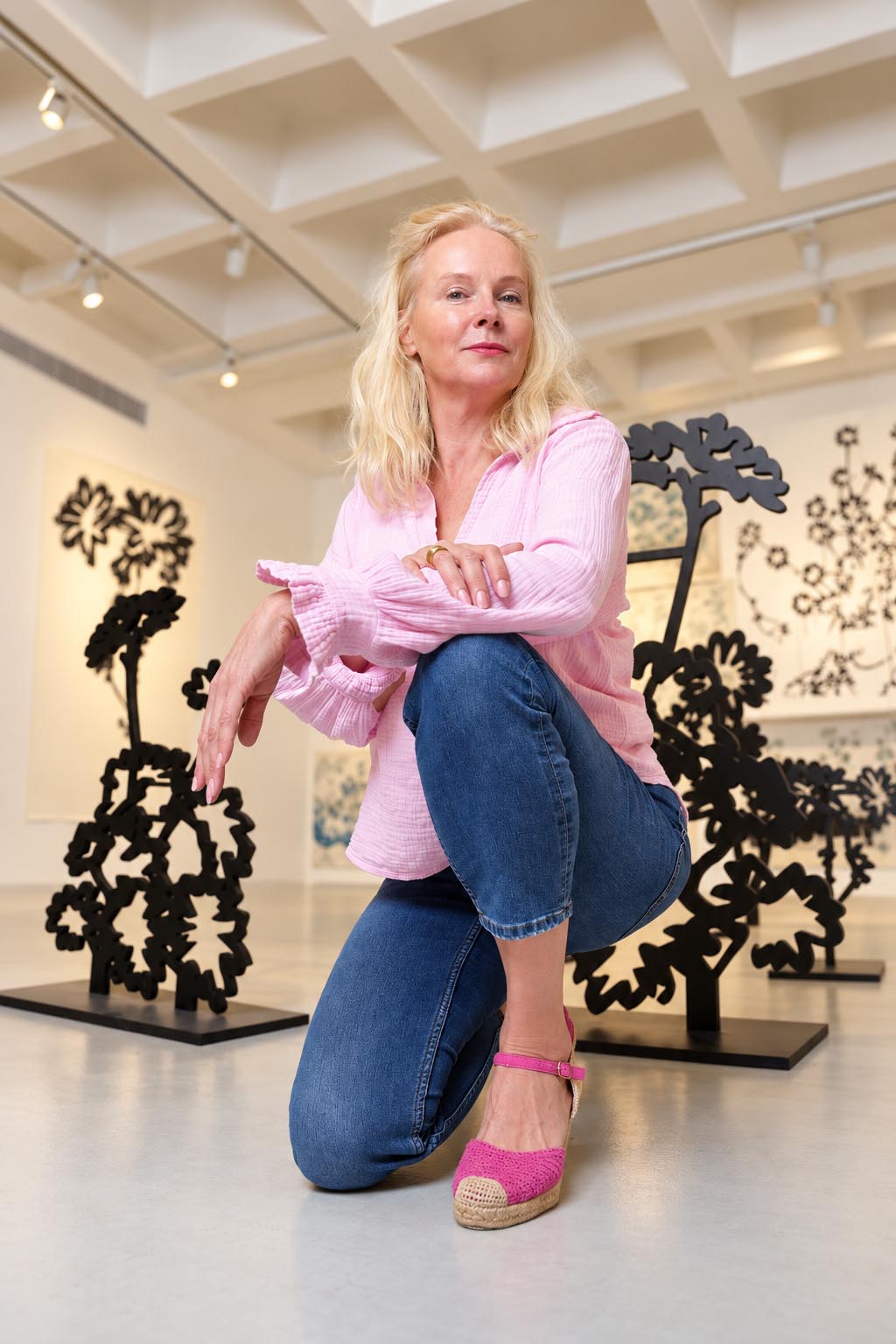
Why are you drawn to ash, residue, fragments and materials that have already had another life?
I think I am drawn to these materials because, for me, they are not simply the remains of something that has disappeared. They still carry something of what they once were.
I use ash made from fruits, plants and other organic matter, and then use that ash as a material to create paintings.
There is something very beautiful to me about taking something that has already lived, transforming it through fire and then allowing it to become something new. What might normally be considered residue or something to be discarded becomes the starting point for another work.
It connects very naturally to the ideas that run throughout my practice, transformation, fragility, endings and new beginnings. The material has already had one life, but through the work it is given another.
You deliberately leave room for uncertainty in your work. Why is not knowing sometimes more powerful than understanding?
I think uncertainty is very much a part of life. We never really know what tomorrow will bring, and I approach my work in the same way. I do not begin a painting knowing exactly where it will go or what it will become.
For me, that not knowing creates a sense of freedom. It allows the work to unfold in ways I could not have planned or anticipated, and often those unexpected moments are what give the painting a deeper meaning.
If I understood everything from the beginning, I think I would lose something essential, the possibility of discovery.
So uncertainty is not something I try to resolve. I try to remain open to it. That openness is where I find the greatest freedom in my work.
Your current series, The Other Side, treats each day as part of an unfolding journey. What does “the other side” mean to you personally?
For me, The Other Side is a new beginning. It came after quite a dark time, and it really is an unfolding journey.
I try to make one painting every day, Day 1, Day 2, Day 3 and every day something different happens.
It is about moving forward, one day at a time, and being open to whatever comes next.
When you eventually leave Kuwait, what do you hope this residency will have changed in your work and in you?
This residency at CAP has already given me so much. I have met so many wonderful people, and I feel that my work has become much freer. I have also discovered that I can create under pressure and actually grow from it.
It feels like another part of this unfolding journey, where things change, new possibilities appear and each painting becomes part of a bigger story.
For me, The Other Side continues this journey of transformation. It reminds me that growth often begins when I am willing to let go of what no longer serves me and remain open to what lies ahead.
It is an invitation to embrace what is unfolding, even before its destination is known.
Finally, what message would you like to share with our readers at CP Magazine?
I think my message would simply be to stay open to the unexpected.
I came to Kuwait not knowing where any of this would take me, and one small yellow flower somehow led to a residency, new work and so many wonderful people.
Sometimes you just have to follow what comes your way and see where it takes you.