
The Colour of Desire
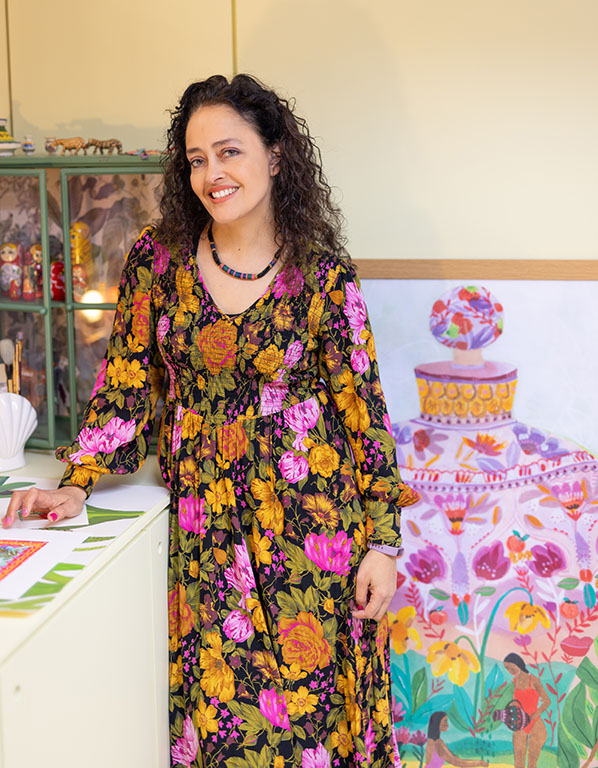
There is a particular kind of warmth in Roeqiya Fris’s paintings. Her worlds are filled with radiant colour, women, palms, flowers, patterned interiors and sun-drenched architecture, yet beneath their visual exuberance lies something more intimate: a search for beauty, belonging and home. The Dutch-Egyptian artist has created a visual language that feels both familiar and imagined, somewhere between memory and reverie.
Born and raised in the Netherlands to a Dutch father and Egyptian mother, Fris grew up between two cultural sensibilities that would eventually become central to her work. Her childhood was steeped in museums, concerts, colour and creativity, while home brought the textures, music, food and visual richness of her Egyptian heritage. After graduating from Rotterdam’s Willem de Kooning Academy of Visual Arts in 2005 and spending several years teaching fine art and running her own creative workshop company, she eventually chose to devote herself entirely to painting.
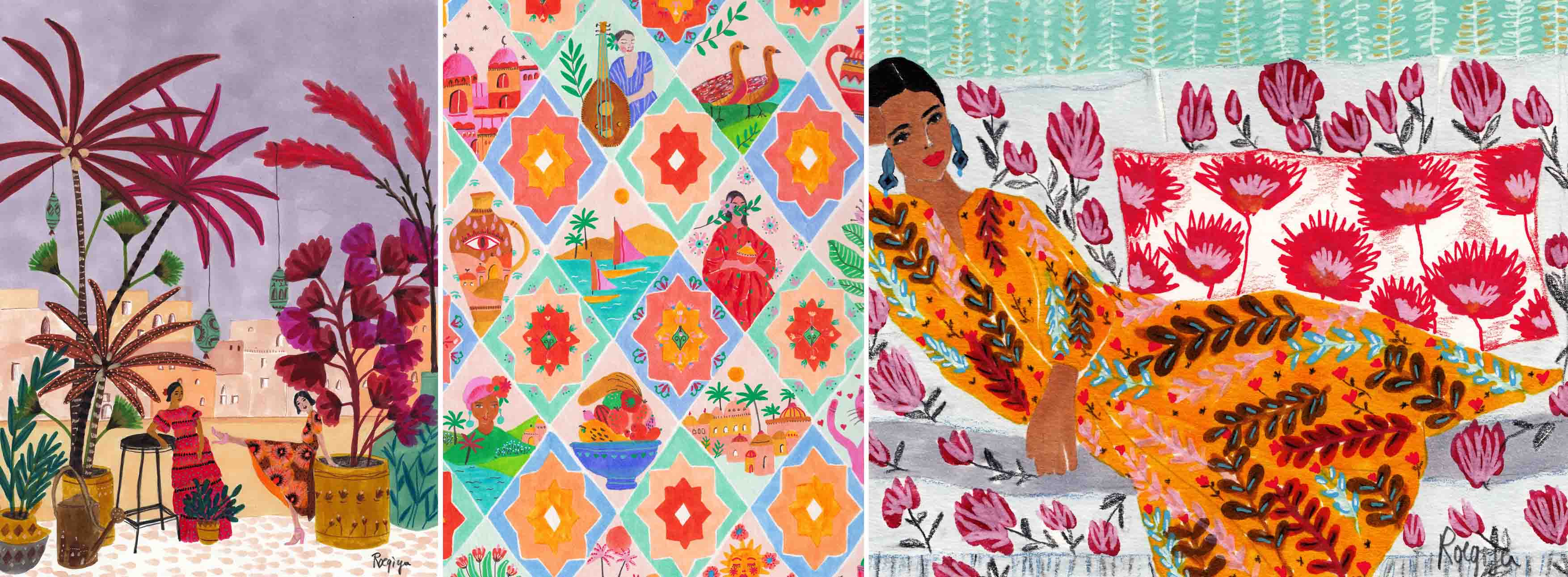
Today, Fris’s compositions often begin with fragments of everyday life: a colour combination glimpsed on a street, flowers in a garden, an outfit, a scene from a film or a piece of architecture that catches her eye. She gathers these impressions almost instinctively, allowing them to resurface in paintings where reality and imagination freely overlap. Egypt is present, but rarely as a literal depiction; instead, it emerges through memory, atmosphere and the artist’s own imagined version of a place that has remained deeply connected to her sense of identity.
Women occupy the centre of this world. Sometimes alone, sometimes gathered in quiet moments of sisterhood, Fris’s female figures embody a kind of strength that does not need to announce itself. Softness, intuition, creativity and connection are equally powerful forms of femininity in her work. Her art has since travelled far beyond the canvas, finding its way into fashion, books, homeware and collaborations with international brands, but at its heart remains the same instinctive desire: to create places of colour, warmth and freedom that invite us to step inside, even if only for a moment.
José Berrocoso, our Lifestyle Editor, chats with Roeqiya Fris about identity, femininity, colour and the memories that shape her dreamlike artistic world.
Your work is immediately recognisable: intensely colourful, full of women, patterns, architecture and a sense of movement. When you look at your work as a whole, what do you think it says about you?
I think it probably says that I am someone who is always looking for beauty, warmth and connection. I am very sensitive to colour, atmosphere and small details around me. I also think there is a lot of femininity in my work. I like women to feel strong, but not necessarily in an obvious or forceful way. For me, softness, sensitivity, creativity and care can also be forms of strength. There is probably an optimistic side to my work too. Life is not always beautiful or easy, of course, but I naturally tend to notice the things that bring warmth or joy, and painting allows me to give those things more space.
You are Dutch-Egyptian, and both cultures seem to have a place in your visual language. How has growing up between these two worlds shaped the way you see colour, beauty, family and place?
RF: I grew up mainly in the Netherlands, with a Dutch father and an Egyptian mother, so both cultures have always been part of me. My mother brought a lot of Egypt into our home through food, music, language, colourful clothes, fabrics and family life. Our house was definitely not minimal! If I simplify it, I sometimes feel that the Dutch side of me is quite practical and structured, while the Egyptian side is more emotional and expressive. I think both appear in my work. I can be very particular about the composition of an image, but at the same time I want it to feel warm, colourful and alive. As I became older, I also realised how deeply connected I am to my Egyptian side. Painting somehow gave me a way to rediscover that part of myself.
Egypt appears in your work through palm trees, architecture, gatherings and everyday moments. How much of what we see is based on actual memories, and how much comes from an imagined version of Egypt?
It is really a mixture of both. I have very strong childhood memories of travelling to Egypt with my family: the heat, the Nile, palm trees, music, food, the colours of the streets and especially the feeling of being surrounded by family. For many years I wasn’t able to return to Egypt very often, so those memories started mixing with imagination and with impressions from other places I travelled to, particularly Morocco and other Mediterranean countries. I don’t try to paint Egypt in a documentary way. I take elements from memory and combine them with other places, dreams and things I find beautiful. So the Egypt in my paintings is real, but it is also very much my own version of it.
You have spoken about being raised by a creative mother alongside four sisters, all of whom went on to study art. How has that female environment influenced the women who appear so often in your work?
I actually grew up with three sisters. My three sisters and I all went to art school at some point, so there was definitely a lot of creativity around us. My mother was also very visual and loved colour, clothes, textiles and interiors. Being surrounded by women has certainly influenced my work. My mother, my sisters and later my female friends have all shaped the way I see women. The women in my paintings are rarely portraits of one particular person, but they often contain something of the women around me. I like portraying women as independent, elegant, intuitive, soft and strong at the same time. Female friendships, sisterhood and that feeling of women being together come back very naturally in my work.
Colour is perhaps the first thing people notice in your paintings. Do you choose your palette consciously, or does colour arrive intuitively as part of the drawing?
Mostly intuitively. I don’t usually begin with a carefully planned colour palette. I might have one or two colours in mind and then the rest develops while I am working. Colour is something I notice constantly in everyday life. It can be two cars parked next to each other, flowers in a garden, someone’s clothes, an interior or a colour combination in a film. Those things stay somewhere in my mind. I think my love of colour also comes from my mother. There was always a lot of colour around us growing up. For me, colour is very connected to warmth, emotion and joy, so using it feels quite instinctive.
There is an almost dreamlike quality to your scenes, Mediterranean landscapes, beautiful women, patterned interiors, palms and endless summer light. Are you trying to recreate a particular feeling or place when you paint?
Yes, but it is more a feeling than one actual place. I often create somewhere that doesn’t exist exactly as I paint it. I bring together things I love: warm sunlight, water, flowers, plants, beautiful architecture, patterns and sometimes people. It is made from pieces of Egypt, other Arab and Mediterranean countries, places I have travelled to, memories and imagination. I think what I am really trying to create is a feeling of home, not necessarily a home belonging to one country, but a place of warmth, beauty, freedom and belonging. Sometimes it is also a form of escape. I like the idea that someone can look at one of my paintings and travel somewhere else for a moment.
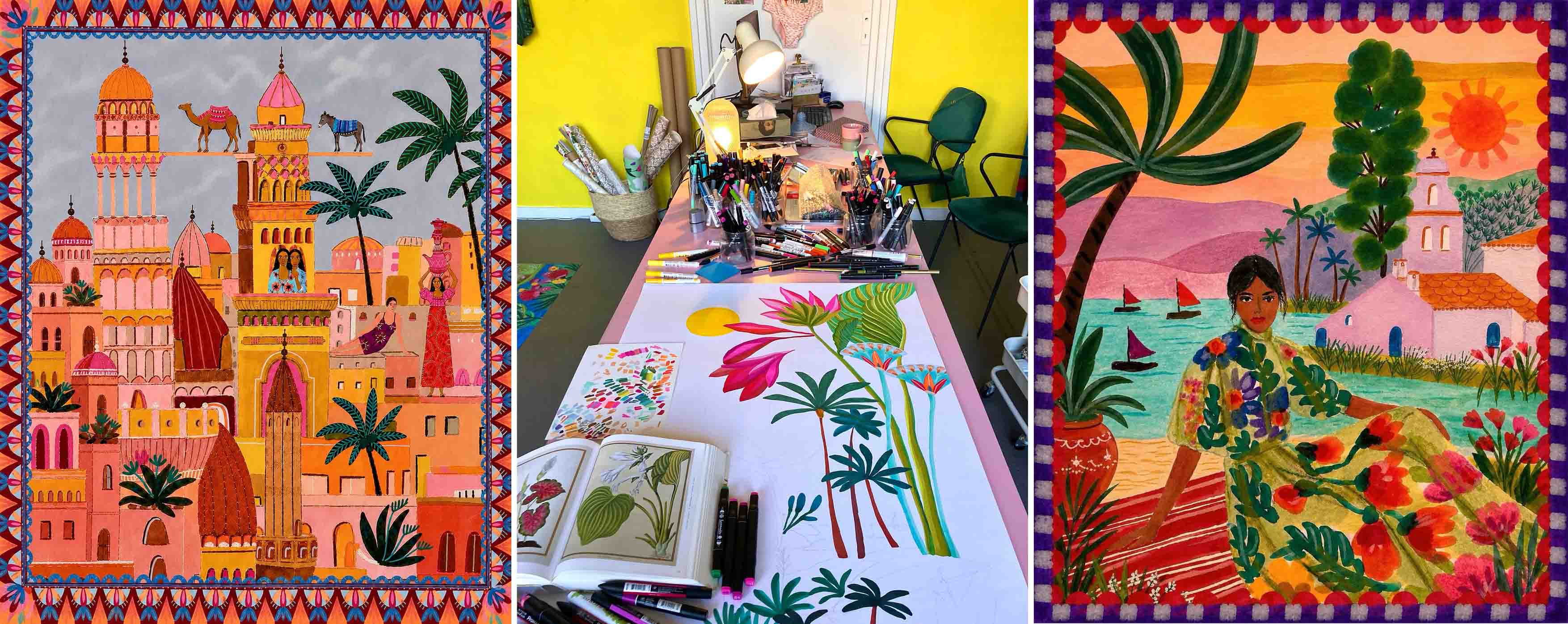
Your process is surprisingly spontaneous: you often create an entire original in one sitting, at the kitchen table, sometimes in just a few hours. What happens during that first take, and do you ever find yourself wanting to go back and change something?
I think working quite quickly helps me not to overthink. Before I start, I often collect lots of different images and impressions, architecture, women, plants, landscapes, patterns or colours but once I begin drawing, I try to work quite intuitively. I use traditional materials such as coloured ink, markers, gouache and pencils, often all in the same piece. Because I work on paper, I can’t endlessly undo or correct things. Of course, sometimes afterwards I see something I might have done differently, but I usually try to accept it. Those little imperfections and unexpected moments are actually important to me. If I keep correcting an image, I think it can lose some of its energy.
You have said that you draw intuitively, without overthinking the image. Do you think that instinct has become more important as your career has developed?
Yes, definitely. I think I trust my intuition much more now.Earlier in my life I spent a lot of time wondering what kind of artist I should be and what kind of work I should make. Now I understand that the things I create instinctively are usually the things that feel most like me.
Even when I start with an idea, I don’t want to know exactly what the finished painting will look like. My favourite moment is when something unexpected appears and surprises me. Working professionally can sometimes make you think about clients, audiences or what performs well on social media, so protecting that intuitive part has actually become even more important to me.
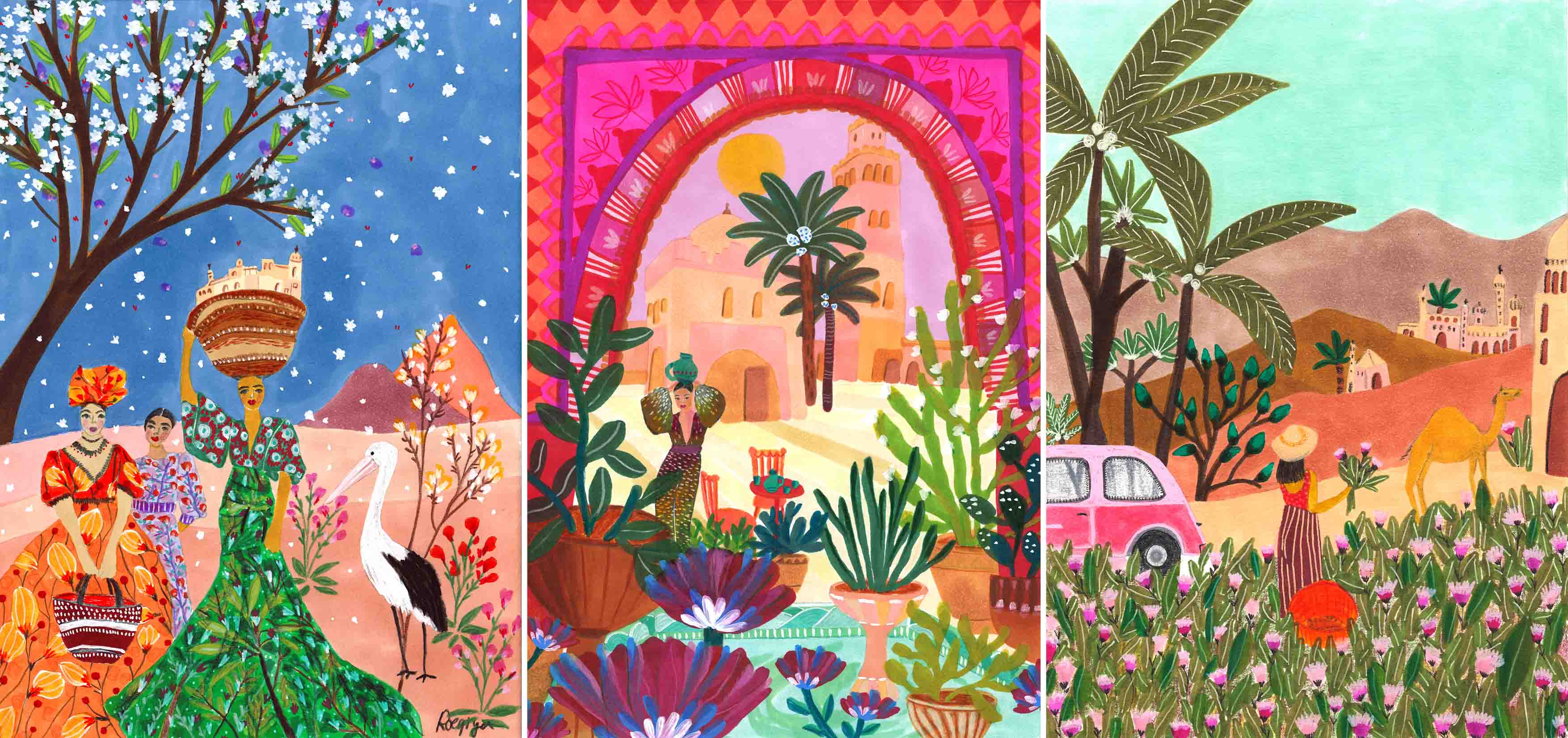
Your work has moved beyond the gallery or print into fashion, books, magazine covers, homeware and even puzzles. What do you enjoy about seeing your art translated into objects and spaces that people live with?
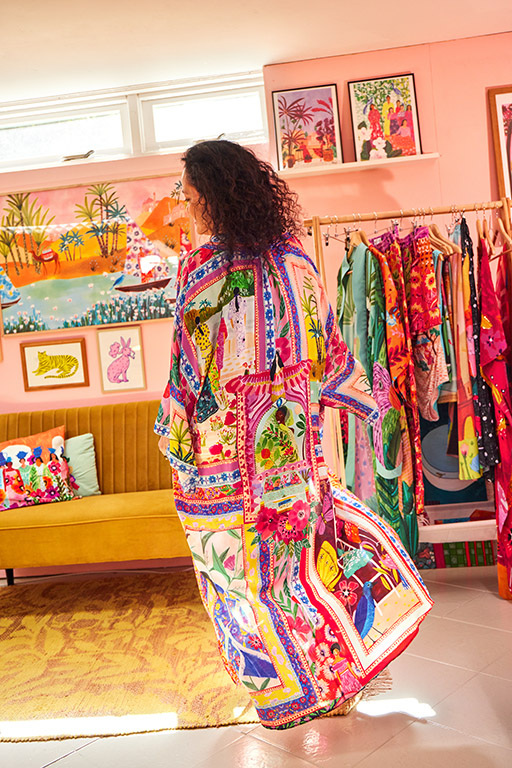
I love it. There is something very special about seeing an image leave the piece of paper where I originally created it and become something completely different. For example, it was amazing to see my illustrations translated into silk clothing for the Australian fashion brand Camilla. With books, puzzles or objects, people can hold and interact with the work. I also love knowing that people have my prints in their homes all over the world. Art can become part of someone’s everyday surroundings.
One of your projects was an illustrated book about the Netherlands’ history of slavery. How did working on a subject with such a complex and painful history affect the way you approached the work?
RF: It was very different from making my autonomous work because the subject carries such an important and painful history. I felt a much greater responsibility towards the story and the people represented in it. With a project like that, the illustration cannot simply be beautiful. It has to support the story and communicate something honestly without making a difficult history feel too decorative or light.
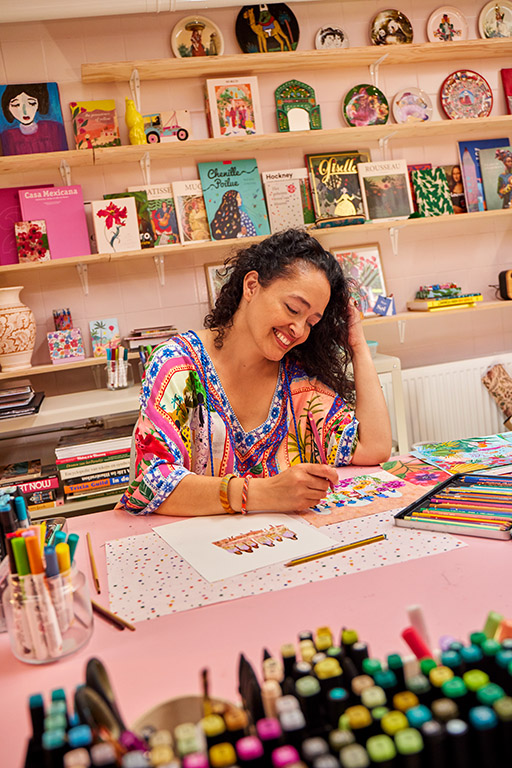
You have worked with brands such as Jungalow and HEMA, as well as fashion and interiors labels. Is there a difference between creating something entirely for yourself and creating work that has to live within someone else’s world?
Yes, there is definitely a difference. When I make work for myself, I have complete freedom. I can follow an idea without knowing where it will end up, and that freedom is very important because my personal work is where my style keeps developing. In a collaboration there are usually more boundaries: a particular product, format, colour direction or audience. But I actually enjoy that too. It can make me think differently and sometimes leads to things I would never have created on my own. For me, the most successful collaborations are the ones where a brand comes to me because they already love my visual world.
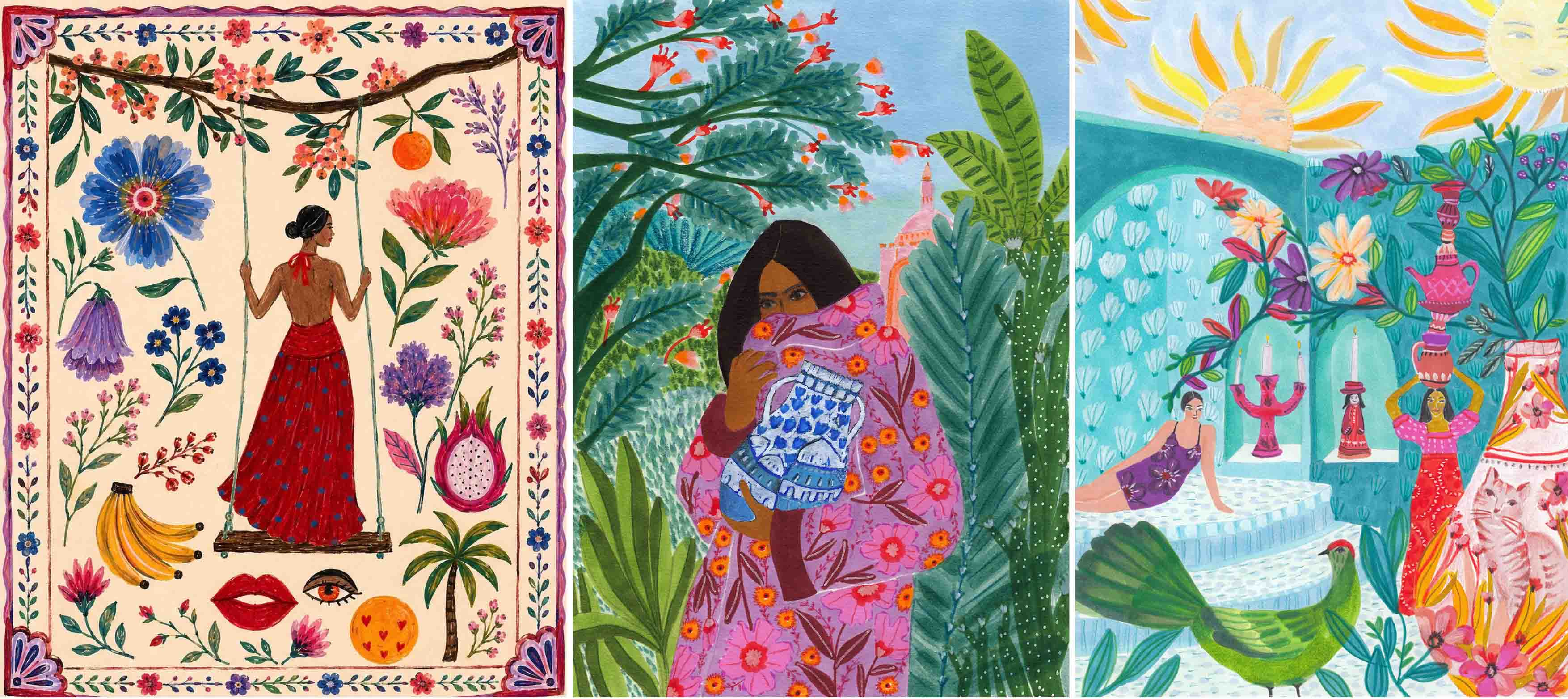
You have mentioned dreams of creating your own wallpaper or seeing your work transformed into a large-scale mural. If you could take one of your paintings off the page and place it anywhere in the world, where would you put it and what would you want people to feel when they stood in front of it?
I don’t think I have one exact location in mind, although creating something large-scale in Egypt would be very special to me. What excites me most is the idea of scale itself. I usually work quite small, on paper, so I would love to see what happens when one of those worlds becomes big enough to physically stand in front of. I would love people to feel surrounded by colour and warmth, as if they could step into the world of the painting for a moment.