
Exploring the space between intuition and form through deeply atmospheric art.
In an era where digital imagery is both instantaneous and abundant, few artists manage to create work that lingers quietly, powerfully, beyond the screen. Feryal Bayram is one such voice. With a distinctive visual language rooted in emotion, atmosphere, and introspection, her work transcends the conventional boundaries of digital art, inviting viewers into deeply personal yet universally resonant spaces.
At the heart of her practice lies an exploration of aesthetics not merely as visual pleasure, but as a profound human necessity. Her compositions, often surreal, layered, and delicately expressive seek to reconnect audiences with something increasingly overlooked in the rhythm of contemporary life: the inner self. Through her nuanced use of light, texture, and gaze, she constructs a silent dialogue between artwork and observer, one that speaks without words yet resonates with striking clarity.
Beyond the surface, Feryal’s work reflects a careful balance between intuition and intention. Each piece becomes a site of emotional translation, where fleeting thoughts and subconscious impressions are shaped into visual form. It is this ability to merge the personal with the collective that defines her artistic identity.
In this exclusive conversation with CP Magazine, we delve into the philosophy, process, and inner world behind her creations. From her reflections on beauty and meaning to her evolving relationship with art in a digital age, Feryal offers a compelling insight into a practice that is as thoughtful as it is visually arresting.
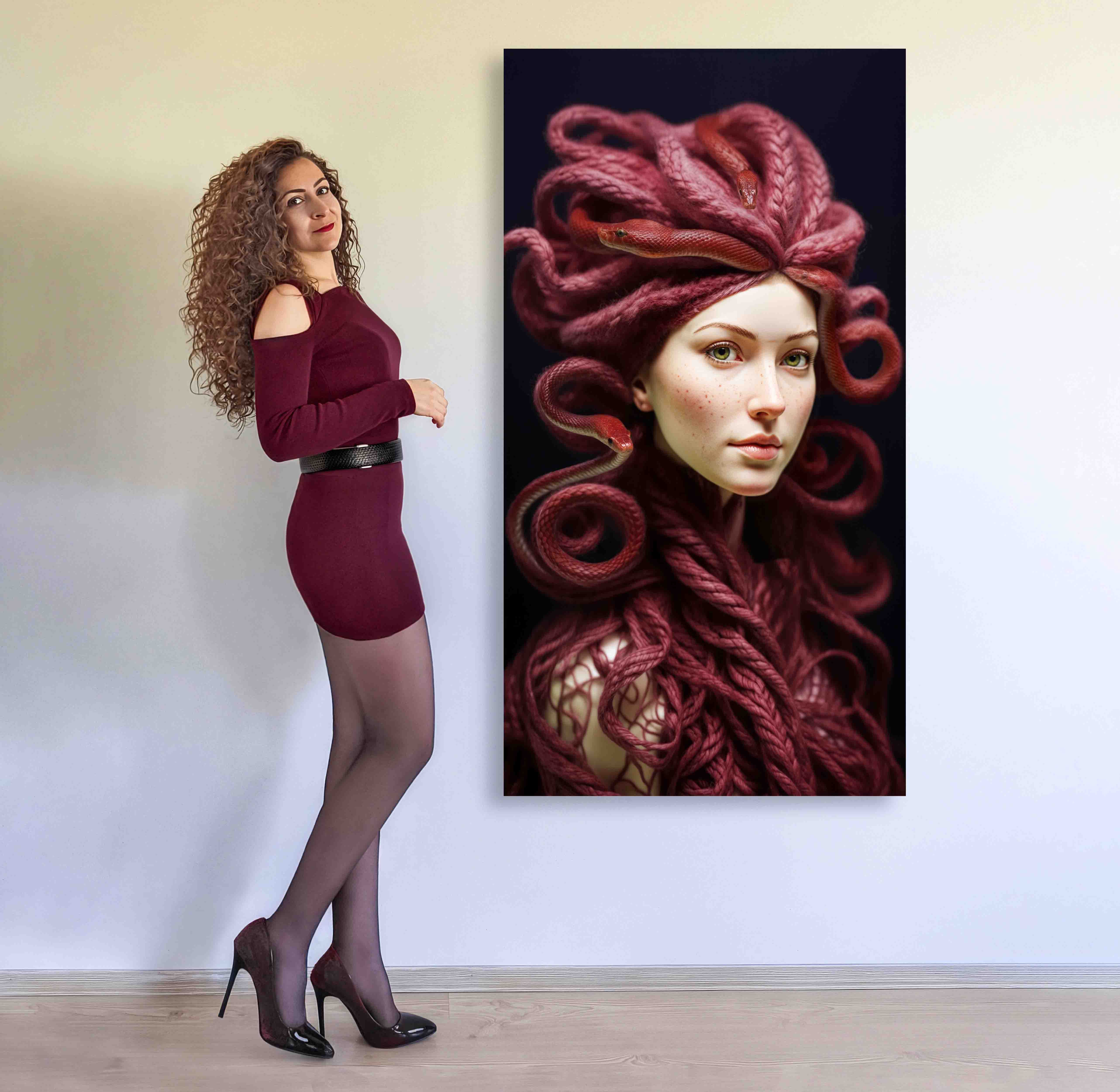
You describe yourself as a digital artist with an “aesthetic narrative”, what’s the story you’re trying to tell most consistently across your work, and why does it matter to you?
It’s a fact that when something lacks aesthetics, it inevitably has a deficiency. The basic human drive is to transform the boring into the interesting. Our happiness in the presence of things we find aesthetically pleasing stems from our coded knowledge. In this sense, aesthetics is an inevitable beauty in our lives. As Kant said, “like an unpostponable milestone…” For this reason, aesthetics is the most important subject for me. I prefer to use aesthetics in favour of nature and humanity, due to my love of nature and my emotional perspective. On the other hand, beyond aesthetics, I love connecting with people through art, conveying our inner voices—our emotions—to each other without speaking. Every work of mine reflects a part of myself, and I find it important to present this as a whole. In this silent communication, I am always present in every work that reflects a part of myself, spiritually and physically. That’s my story.
When you begin a new piece, what usually comes first: an emotion, a character, a colour palette, a phrase, or an image in your head?
I don’t think art can be impressive without emotion. That’s why emotion comes first for me. When I start a piece, I first observe the portrait in front of me for five to ten minutes. I believe eyes are the most special gateway to revealing a person’s character. Through the eyes, I identify and extract the person’s traits, reconstructing them according to my own vision. Then, in the next stage, I use my imagination to determine what the other details should resemble.
Your captions often move between Turkish and English, how does language shape the way you think, feel, and create?
Art inherently possesses a beautiful ability to transform emotions. While working, I find myself alone, allowing me to explore my depths. I create certain images, and then they begin to speak to me, creating a dialogue between us. It’s a dialogue detached from all egoistic aspects, seeking the good, the beautiful, and the aesthetic. Ultimately, this dialogue, through art, transforms into something tangible. I believe that what emerges from this dialogue doesn’t have a special language of its own. When we speak of art, we all use a common language.
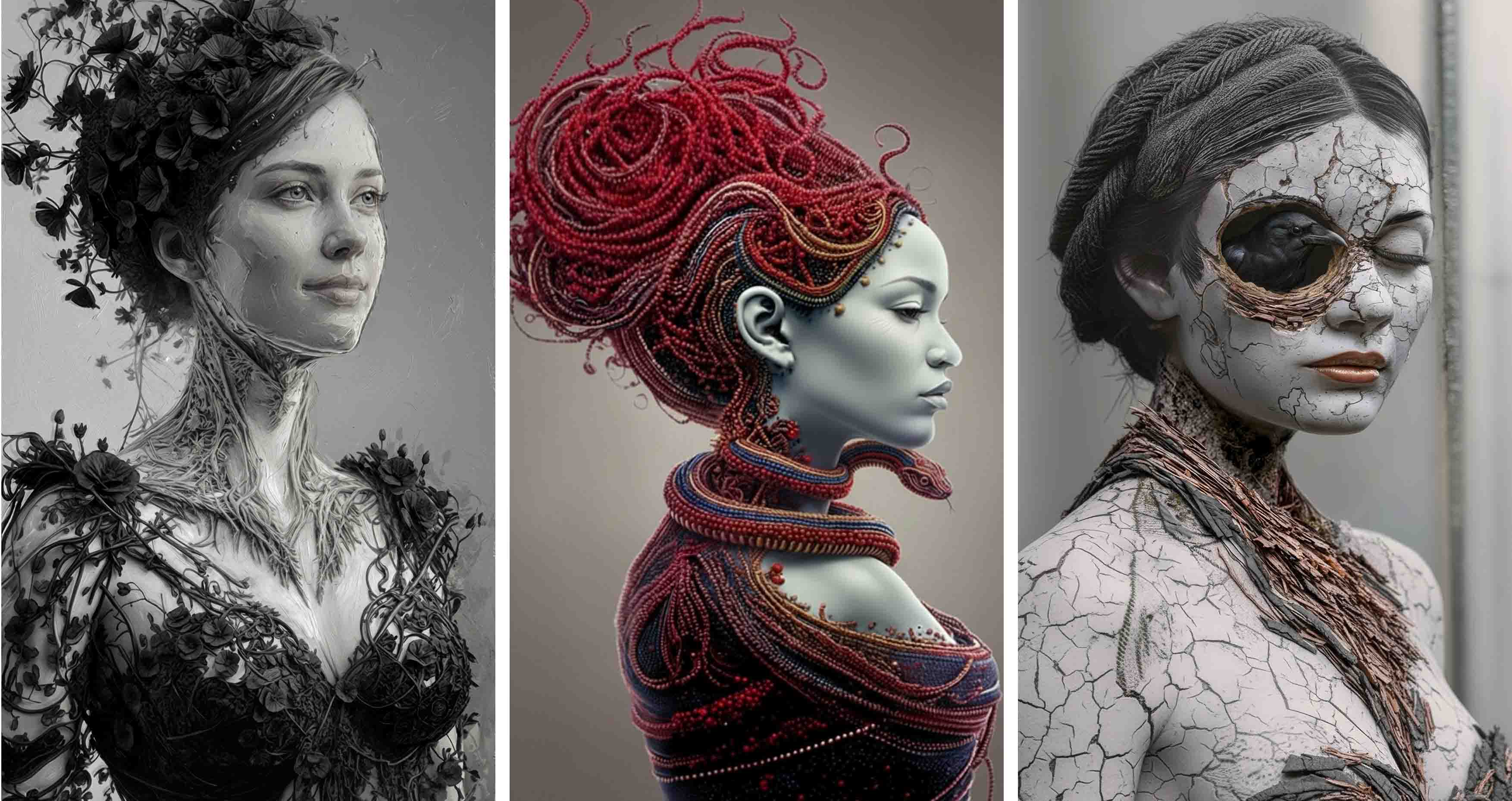
What does “beauty” mean to you as an artist and what do you think people get wrong about beauty in contemporary visual culture?
I believe beauty is a flow, a connection between the viewer and the object of that view. When I see something beautiful, I ask myself: what elements come together to make it beautiful to me?
In my opinion, the answer to this question should include nobility, an attitude towards life, and also grace. People’s definitions of beauty have changed significantly since we became a consumer society. I think many people don’t choose what they find beautiful; they simply follow that flow. They define beauty as whatever the system dictates to them at that moment. I don’t think it’s right to confine beauty to such a mould. Beauty should be something to be questioned, not something to be accepted.
What do you want someone to feel in the first three seconds of seeing one of your artworks on a screen? And what do you hope they discover if they stay longer?
Art is not really about what you feel, but about what you make the other person feel. Unfortunately, we humans are going through times when we are somewhat neglecting our own development by being swept away by the irresistible urge of scientific progress. In this sense, art intervenes in our tendency to forget, reminding us that we have emotions. This is one of the things I love most about art. It is the reason for human existence. No matter which work of art we look at, we first look for pieces of ourselves in it. We love a work of art as much as we find ourselves in it. This might be one of the things I love most about my job. In each of my works, different perceptions and emotions arise, and there are people who say they find themselves in it. Every person who has gone through different filters in life looks at it with a different eye and extracts a different meaning from every detail.
To answer your question, I want people to realise that it is a surreal work in the first three seconds. I hope that when they stay longer, they find a piece of themselves in it.
Which themes do you find yourself returning to again and again (belonging, distance, memory, womanhood, calm, disruption) and what in your life keeps pulling you back there?
In my work, I’ve created my own ecosystem. It’s an ecosystem that evokes many different emotions in me, encompassing elements like family, friendship, and love. Every event I see, hear, and feel within this ecosystem helps me grow and transforms into a need to release my soul like an avalanche. I need art to “leave a trace” of what I’ve experienced within myself. I derive great pleasure from my soul working alongside my hands. That’s why I never stick to just one theme. I express whatever is affecting me within that ecosystem at that moment. However, there are two elements that, when always present within me, are inevitably reflected in every piece I create: femininity and serenity.
How do you personally define the line between digital art as a “tool” and digital art as a “medium with its own soul”?
Digital art doesn’t particularly like discipline, but it can’t exist without freely used discipline. It expects originality and flexibility. Instead of choosing between A and B, it asks us to create C. It never tolerates being forced. Forcing it makes it mechanical. On the other hand, it shouldn’t be left to its own devices either. It’s potential energy. To transform it into kinetic energy, it absolutely needs a source, and that source must be emotion. It compels us to broaden our horizons. Only then does it accept being nourished sustainably.
What does your creative process look like on a practical day, the rituals, the mess, the soundtrack, the timing, and what’s non-negotiable for you?
A long time ago, when I was young, I escaped the chaotic city and built myself a home in a quiet place surrounded by nature. Over the years, this tranquillity and simplicity have become indispensable in my creative process. Because I live in a place with plenty of oxygen, I always wake up around 5 am. I dedicate at least four hours to myself. I engage in hobbies that I enjoy, where my hands and soul work together. I never skip my exercise. After these golden hours calm my body and soul, I turn on my computer and start working. Music is essential while I work. I play music that matches the rhythm of my work. In this way, my work flows smoothly without me even realising it while I listen.
How do you know when a piece is finished, especially when you could technically keep refining it forever?
Here, I trust my intuition and my eyes more. I think they’re great teammates. After I think I’ve finished a piece, I let it rest for a day. The next day, when I open it and look at it as a completely different Feryal, I ask myself that famous question about beauty and aesthetics: why does this piece seem beautiful to me? Or which parts detract from its aesthetic appeal? Based on the answer my intuition gives me, I complete the missing parts that day and definitely finish the piece, never to change it again. I think it’s necessary to apply this determination to the mind; otherwise, this cycle will never end.
What role does intuition play in your work compared with planning and have you learned to trust your instincts more over time?
I believe the world isn’t seen, it’s created, because the world can only exist from where we see it within ourselves—our intuition. It’s drawn within us according to where we look. This is the lens of survival. Our world map, therefore, is a dynamic map that changes depending on where we stand within ourselves. If we stand within plans, we are in order and see everything that isn’t in its place. If we stand in intuition, we see people, opportunities, meaning, and horizons. If we stand within both, we feel richer, more capable, clearer, and we want to give back to the world that gives so much. Although I’ve learned to trust my instincts, and my intuition is more supportive during the production phase, I don’t disregard the existence of planning.
You’ve shared work that feels intensely atmospheric (rain, immersion, quiet tension), what are you trying to express through mood rather than narrative?
Art is a very interesting concept. Practising it transforms you into a kind of madman. It gives you a different perspective on life. With art, you can’t be the kind of person who just ‘lives aimlessly’. Instead, you question meanings and discover that extraordinary things can take shape. You gain a kind of perspective on life. You undergo a beautiful deformation, actually. Art contributes to your personality. I hope that through my work, I can provide this contribution both to myself and to others.
How do you approach creating characters or faces, are they self-portraits in disguise, composites of people you’ve met, or entirely imagined beings?
Creating faces is actually a kind of madness. I admit it. But it’s also a very beautiful discovery. Because in a face, especially in the eyes, in those depths, there’s a whole other world. That world shows me what impatient creation looks like and brings me closer to myself. That’s why I’m very happy with this discovery.
Many of the people I use in my work are real people. The faces are real, while the situations I create for them are surreal. Of course, this can sometimes change. Depending on the content of the design, they can also transform into disguised faces.
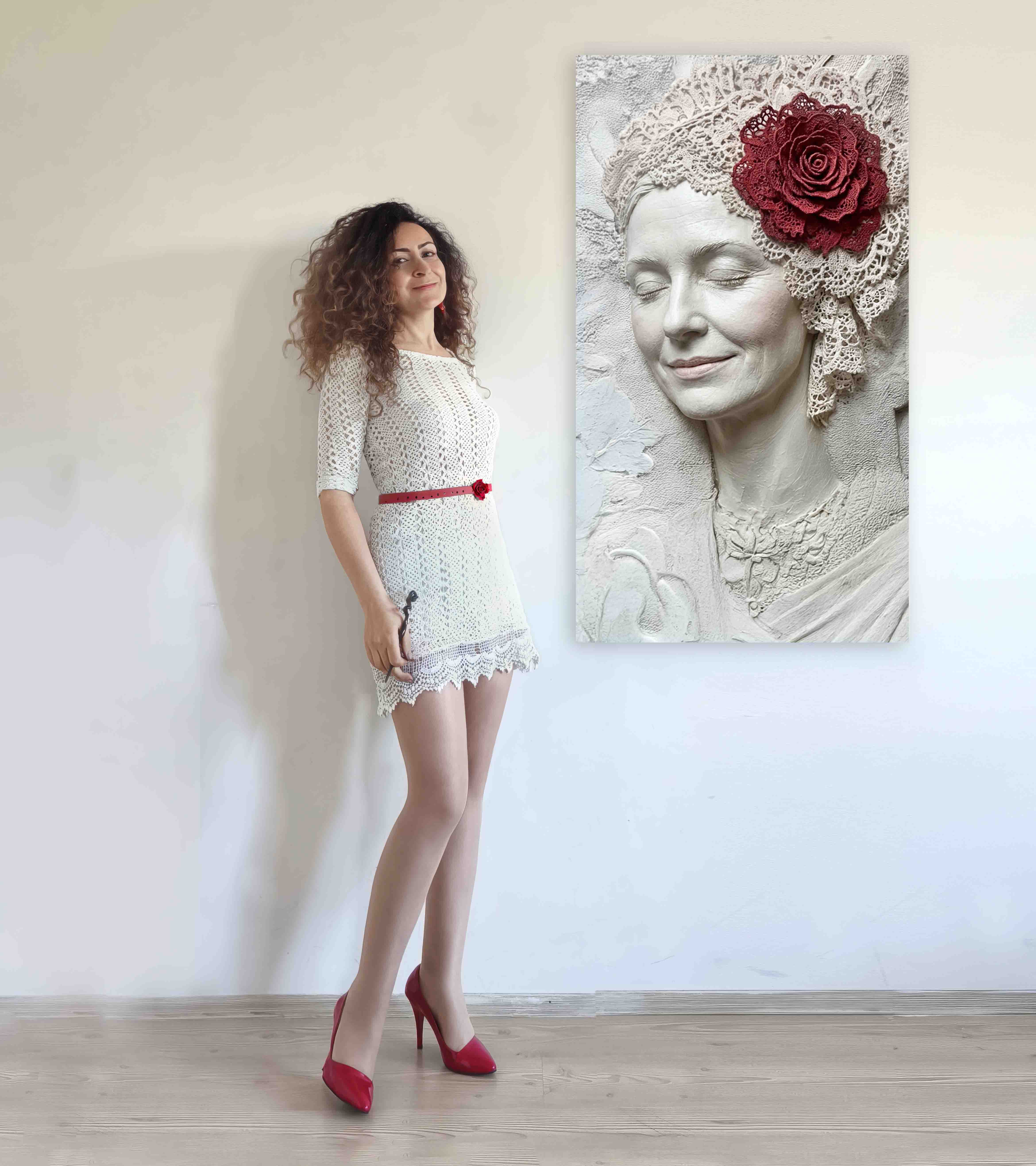
You also run an entrepreneurial venture alongside your art, how do you balance commerce with artistic integrity, and what boundaries have you had to set?
To be honest, I can say that I struggled quite a bit with this until recently, because I could only produce by focusing on my inner self. Of course, this also encompasses the spirit of the times I’m in. In certain situations, during those periods, I can experience different emotions. At those times, I turn to myself and search for a translation of that feeling. Only when I find it can I create the visual language, and that takes time. On the other hand, my entrepreneurial spirit is far removed from this slow-paced state of mind, because you have to be in constant communication with people who are constantly making demands. Although I try to keep the two separate in order to balance them, it becomes impossible after a while. I was able to establish balance by convincing my mind to be a Feryal who doesn’t have to keep up with everything. Now, nothing has to be both rushed and perfect. I’m not a superwoman. I’m not a woman with a special power to run everything alone. That’s why, in the entrepreneurial part, I now work with a good team member and entrust myself to them.
Do you think being an artist today requires being a brand and if so, how do you stay human inside that pressure?
The idea that one day we will no longer live in this world is very strongly present in all of us. In this sense, everything left behind creates an unbreakable bond with this world. On the other hand, I believe art is the only way to most profoundly reveal all the mysteries and secrets of humanity. Most importantly, art allows a person to navigate their journey of self-discovery without being swept away by dangers. I am old enough to understand the value of this very well. For these two reasons, I want to continue creating without ever thinking about becoming a brand. As I am doing now, I stay away from goals that overwhelm me. Becoming a brand is included in this.
Which part of the art-making journey is the hardest for you personally: starting, staying consistent, finishing, or sharing and how do you work through it?
Many of us don’t know the difference between existing and living. To exist, it’s enough to eat, drink, and fulfil the basic needs of the body. But to live, we must also fulfil the needs of our soul and mind, and this is only possible through art. In my opinion, art is essential for living. It heals me deeply. In this sense, the whole process is a separate journey and a pleasure for me. I love the excitement of discovering a new emotion when starting a new piece. Staying consistent also supports my self-confidence and keeps me alive. Sharing my work is the icing on the cake.
What are the biggest misconceptions people have about digital artists (or graphic artists), and what do you wish the public understood about the craft?
If you had asked me this question ten years ago, I could have had a long conversation with you about it. Back then, most people had little knowledge about digital art and held many prejudices. They thought that all the work was done by machines and, because it lacked effort, had no value. The transformation of art was not accepted by conservative circles. Today, thanks to the influence of social media, people have begun to understand and appreciate digital art more closely. Through our own media, we can show that digital art also goes through a labour-intensive process. Now, even the world’s largest auction houses have created sections for digital artists and started selling their work. Recently, they have even had better sales than many emerging artists and have built strong communities.
How has your definition of “success” changed since you first started sharing your work publicly?
To be honest, in the beginning, I considered success to be simply having my work approved and appreciated by people. I created pieces with people’s preferences in mind, striving to produce popular work. As I delved deeper into emotions through my art, I made significant progress in this area.
Now, I define success as feeling the beauty of the rooftops, seasons, trees, and grasses I chase after in search of a drop of meaning, being certain of the solidity of the tower within me, always remembering to generously give back what I receive as a language of love, knowing that beauty is not a goal or a project but the very reality of our nature, nurturing empathy and sympathy for humanity, and being able to translate all of this into my work.
What are some of your other hobbies?
Nature and everything in it is my greatest hobby. I find working with the soil, giving life to a new flower or tree, and growing them from seed very satisfying. I love taking quiet walks in nature for hours, imagining everything I see there as something else in my mind. The way light falls on a surface, the changing states of the sky and clouds throughout the day, the splendour of a flower, the chatter of a bird—I love observing these things. I enjoy creating creative and amusing things with inspiration from nature and materials I gather from it. This includes preparing creative and playful dishes from food.
If CP magazine Kuwait could take you anywhere in Kuwait for a one-day creative residency, where would you go, what would you observe, and what kind of piece would you make from it?
I know Kuwait is a magnificent country, and that people from many different cultures live there. If you were to take me somewhere, my wish would definitely be to see markets where I could see people of every colour at the same time. There, I would witness the most vibrant, authentic, and natural side of the country, feel like a member of that nation, even if only for a short time, and with the light I would receive from their eyes, I could create a work of art that might merge your people with desert lizards or desert ants.
Your message for us at CP magazine.
I’ve given numerous interviews in many places so far. After a while, I started getting the same types of questions, and this was no longer satisfying for me. This interview with you, after a long time, challenged me for the first time because you prepared some truly great questions. You researched me, carefully examined my page, noticed every detail, and prepared your questions with that awareness. I thoroughly enjoyed answering your questions. Thank you very much for that and for the interview invitation. I hope it will be enjoyable and engaging for the readers as well.