
Bridging Past and Present Through the Language of Art
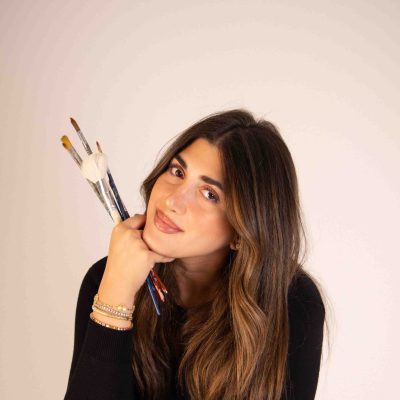
For Turkish artist Buket Akpunar, art is more than a creative expression; it is a journey through emotions, memories and the complexities of human existence. With an instinctive curiosity and a deep appreciation for cultural heritage, she has developed a distinctive artistic voice that transforms ordinary surfaces into extraordinary stories
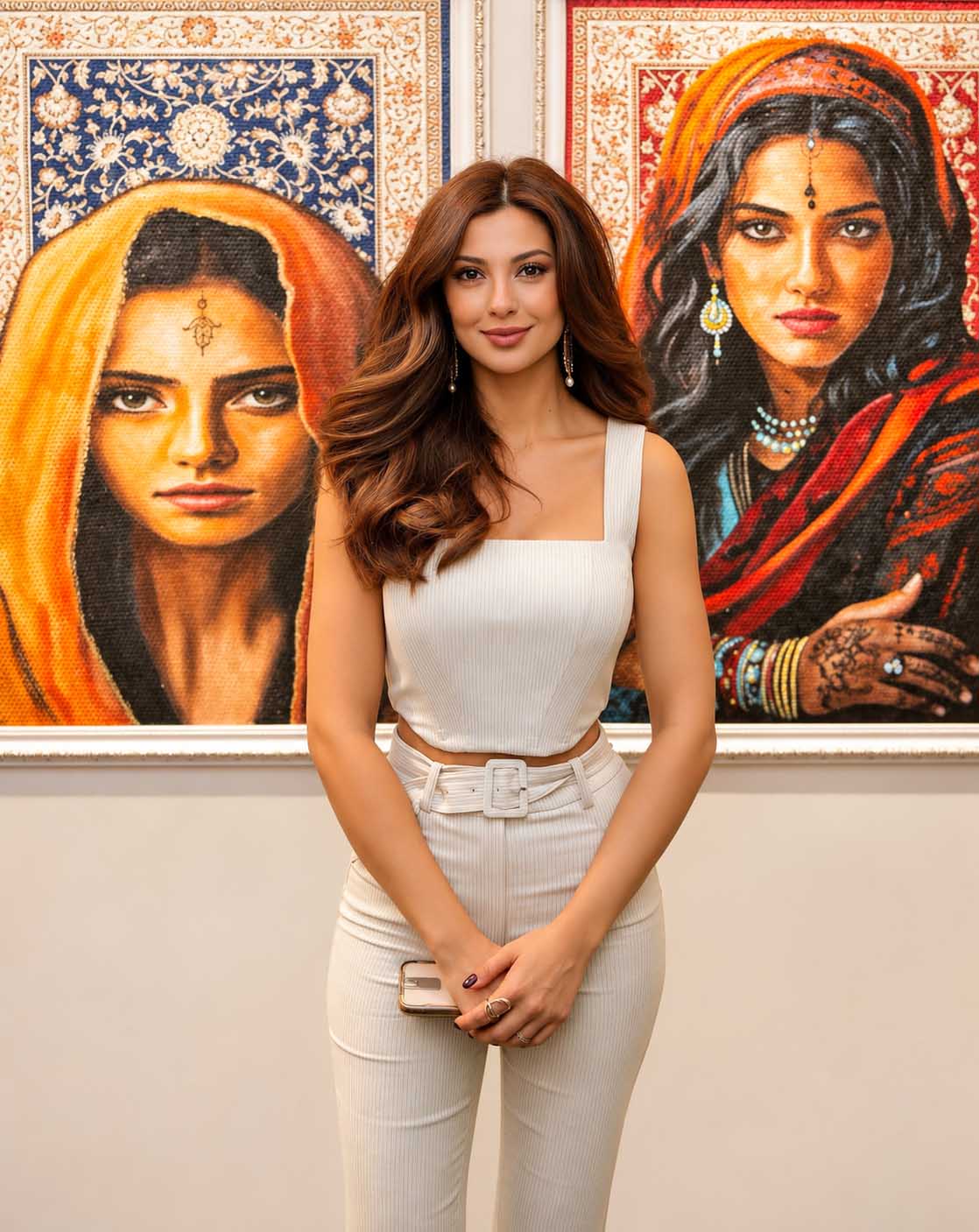
Born in Bursa and now based in Istanbul, Buket discovered her passion for painting at just seven years old. Largely self-taught, she has spent years exploring techniques, colours and forms of expression, with a particular fascination for female portraiture. Her remarkable approach to painting portraits on traditional carpets and kilims beautifully bridges the past and present, breathing contemporary emotions into surfaces rich with history.
Beyond the canvas, her interests in literature, philosophy, theatre and travel continue to shape her creative perspective. Whether exploring the depths of human emotion or encouraging young minds through art workshops, empathy and curiosity remain central to her philosophy.
In this exclusive conversation with CP Magazine, Buket opens up about her artistic evolution, the personal stories behind her paintings, the healing power of creativity and her aspirations to connect cultures through art, revealing an artist determined to make the invisible felt.
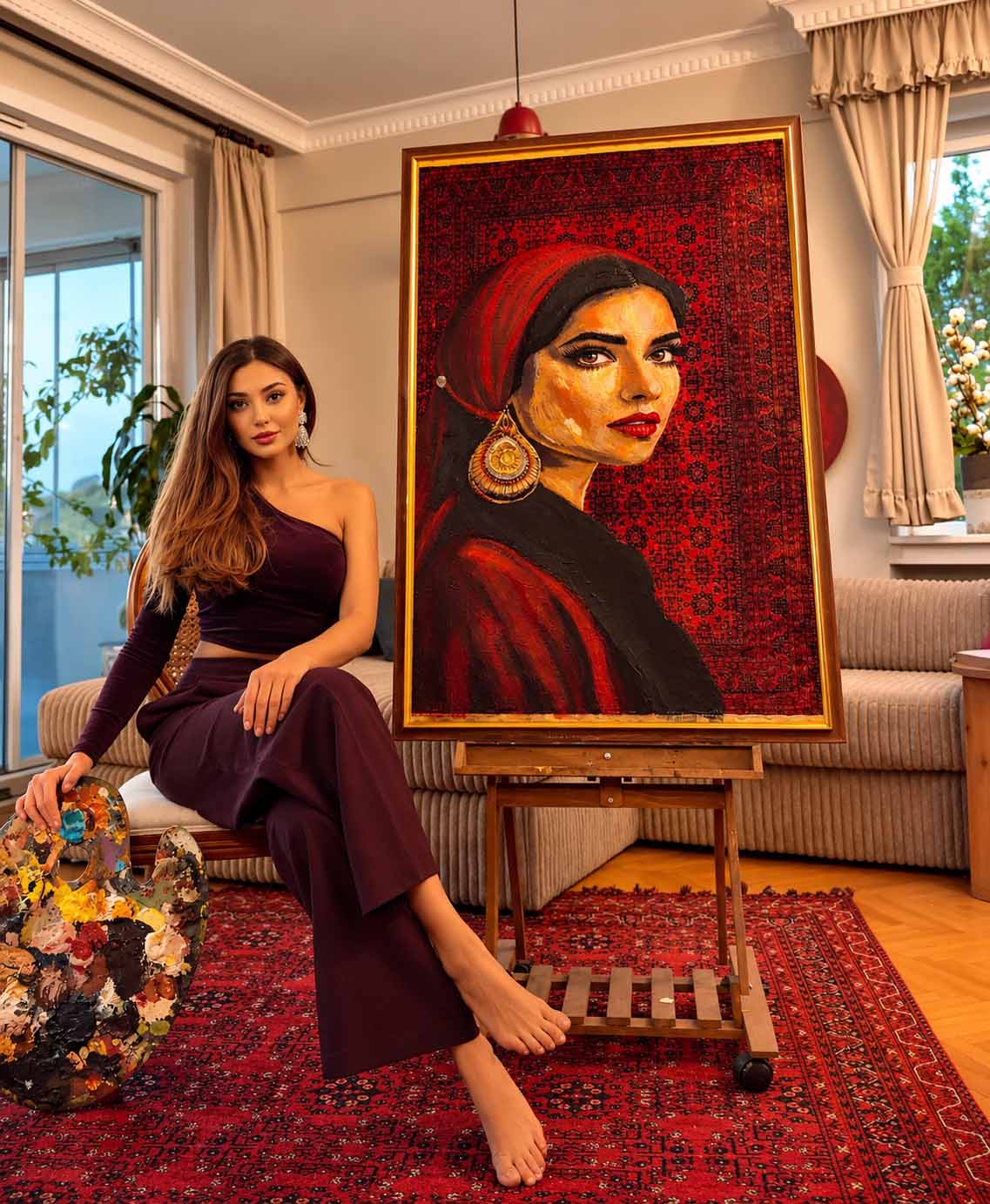
“The foundation belongs to the past, while the story belongs to the present.”
For our readers discovering you for the first time, how would you introduce Buket Akpunar?
I would describe myself as a curious person who loves nature, travelling, every form of art, meeting new people, and learning.
I enjoy exploring life, observing the world around me, and trying to understand it on a deeper level.
Perhaps the best way to describe myself is as someone who has never lost her curiosity or her desire to learn and discover.
Growing up in Bursa, what were your earliest interests, and how did they shape your personality?
My very first interest was art. During my middle school years, I was introduced to theatre and literature, and I actively participated in my school’s theatre and literature clubs.
These experiences had a significant influence on the way I express myself and perceive the world.
Even today, I have a deep interest in literature and philosophy. Understanding human nature, emotions, and life itself remains an endless journey of discovery for me.
You discovered painting at just seven years old. What first attracted you to art?
Actually, the person who first introduced me to painting was my primary school teacher.
It was my very first day of school, during our very first lesson, when our teacher asked us to draw something. There were forty students in our classroom.
She was so impressed by the picture I created with pastels that she displayed it on our classroom board. Her appreciation and excitement left a lasting impression on me.
Perhaps, without even realising it, that was the day I began the longest journey of my life. Because from that moment on, I never stopped painting.
Could you tell us about your educational background and how it influenced your artistic journey?
I did not receive a formal academic education in fine arts. My educational background was primarily focused on the humanities.
My relationship with painting developed naturally over time, through self-learning, experimentation, and exploration.
I worked in different styles, explored various techniques, and continuously challenged myself to improve. Even today, I am still learning with the same curiosity.
I don’t believe in limiting art to a single style or structure. Of course, technical knowledge is important, but for me, creativity is what truly matters. I believe it is valuable to understand artistic techniques, but even more valuable to have the freedom to create beyond their limitations. My artistic philosophy is quite simple: Learn the rules, but never become confined by them. Keep questioning, experimenting, and discovering.
Beyond painting, what other interests and passions are important in your life?
I absolutely love taking long road trips on my own.
Being on the road, discovering new places, and travelling through unfamiliar landscapes give me an incredible sense of freedom.
Every place I visit and every road I travel leaves a certain feeling or memory within me.
Sometimes inspiration comes from a landscape, sometimes from someone I meet along the way, and sometimes simply from my own thoughts during the journey.
Literature also holds a special place in my life. Recently, I have become particularly interested in poetry and novels. I believe words can be just as powerful a form of artistic expression as paintings.
What inspired your move to Istanbul, and how has living there influenced your creativity?
I often compare Istanbul to love. In this city, you experience life with extraordinary intensity.
On one side, there is breathtaking beauty, history, and depth. On the other, there is chaos, overwhelming crowds, and constant movement. Istanbul is a city that makes you experience completely opposite emotions at the same time.
Sometimes it fascinates you, and sometimes it exhausts you. But either way, it always teaches you something. I believe these contrasts are what help us grow. There is something to learn from chaos just as much as from beauty. Living in Istanbul has positively influenced my imagination, my way of thinking, and my creativity. The city’s endless energy continues to inspire me, challenge me, and encourage me to create.
How would you describe your artistic style, and how has it evolved over the years?
I would primarily describe myself as a portrait artist, although I don’t limit myself exclusively to portraiture.
I enjoy experimenting with different styles, techniques, and forms of expression. Since childhood, I have been particularly drawn to painting female portraits because I feel that the human face allows me to express my emotions most powerfully. Over the years, my techniques, colour choices, and artistic language have naturally evolved.
However, one thing has remained constant: my need for freedom when creating. I don’t want to confine myself to a particular artistic identity or style. I believe one of the most beautiful aspects of art is that it allows us to continuously rediscover ourselves.
Your portraits often feature expressive female faces. What draws you towards these subjects?
I would like to answer this question with just one word, a word that carries enormous meaning for me: Empathy.
What emotions or messages do you hope people discover when looking at your paintings?
Above all, I want to awaken their curiosity.
Curiosity carries countless questions within it. When people become curious, they begin to think, question, explore, and understand. I believe curiosity is one of the most powerful emotions that help us grow and learn.
I don’t expect everyone who looks at my paintings to feel the same emotion or discover the same story. On the contrary, I want each person to find something connected to their own experiences, memories, or emotions. If a painting can create a new question in someone’s mind, then, for me, that painting is still telling its story.
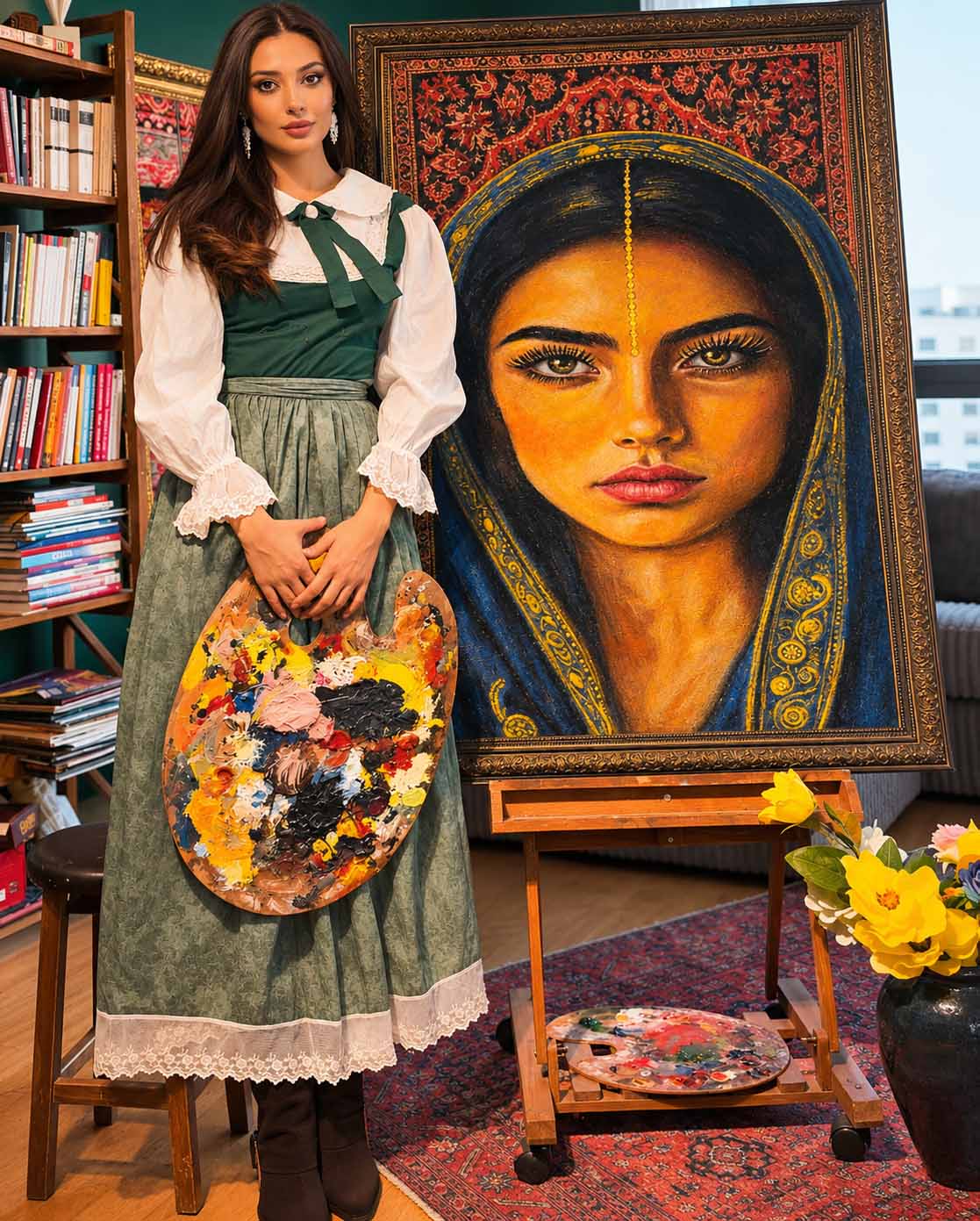
You have experimented with painting portraits on traditional carpets. How did this fascinating idea originate?
I deeply value traditions and cultural heritage. I believe they carry memories and identities that deserve to be preserved and passed on to future generations.
For me, carpets and kilims are not simply decorative objects. They are surfaces that carry traces of the past, human experiences, and cultural memory.
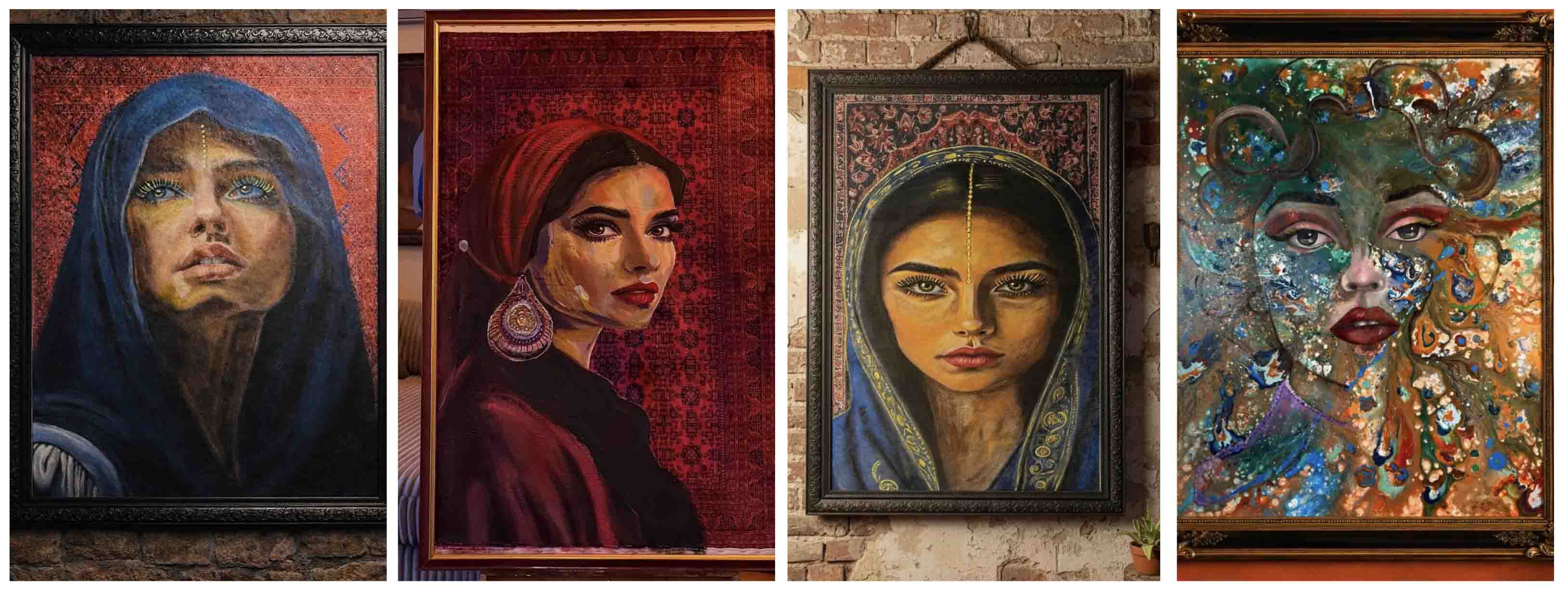
The idea of painting oil portraits on these traditional textiles came from my desire to bring the past and present together. In a way, I am painting the emotions and people of today onto a surface that belongs to the past.
The foundation belongs to the past, while the story belongs to the present. Through this process, two different periods and two different forms of expression come together within a single artwork.
How does working on carpets differ from painting on conventional canvases?
Painting on carpets is considerably more challenging than working on a traditional canvas.
The margin for error is extremely small. The texture, patterns, and surface of the carpet completely change the way the paint behaves. However, these challenges are exactly what make the process so exciting for me. It requires an extraordinary level of concentration, and after a while, that concentration creates an almost hypnotic state.
I gradually disconnect from the outside world and become completely absorbed in what I am creating. Interestingly, although the process demands so much attention and effort, I also find it deeply relaxing.
In a way, it becomes a form of meditation.
Your artwork often explores identity, emotions, and inner struggles. How much of your own story appears in your paintings?
I believe my personal story is reflected in my work to a great extent.
I find it difficult to imagine that someone can truly express an emotion they have never experienced, felt, or somehow encountered. What I find interesting is that, while painting, I am often not fully aware of what I am expressing. My emotions, thoughts, and experiences naturally find their way into the work without me consciously directing them.
Only when the painting is finished and I step back to look at it as a whole do the scattered pieces begin to fall into place. That is when I understand what I have painted and why.
Perhaps painting is sometimes my way of making visible the things I cannot even put into words for myself.
What role do colours play in expressing emotions, and how do you choose your colour palettes?
For me, colours are a reflection of my emotional state.
Periods when I create vibrant, colourful paintings usually coincide with times when I feel energetic and happy. When I find myself using darker, muddier, or more muted colours, it often reflects periods when I am experiencing sadness or stress. I also believe that colours have memories.
Every colour can be connected to a particular moment, person, or period in our lives. For example, the colour burgundy always reminds me of my middle school years because our school uniforms were burgundy. Over time, that colour became deeply associated with education and those memories in my mind. I believe colours are not simply things we see. They are also things we remember and feel.
Do you usually begin a painting with a clear vision, or does the story develop during the creative process?
It varies from one painting to another. Sometimes I begin with a very clear image or a particular emotion I want to express.
However, more often, the story develops naturally throughout the creative process. There are many times when the original idea transforms into something completely different.
And I enjoy that. I like allowing the creative process to surprise me.
Rather than controlling every detail from the beginning, I prefer to give the painting the freedom to discover its own story.
What has been the most emotionally challenging artwork you have created, and why?
The most emotionally challenging artwork I have created is Narya.
I witnessed the heartbreaking final months of my closest friend of twenty years. Within just two months, I watched helplessly as my friend passed away.
It was an extremely painful and difficult period for me, a state of emotional limbo that is almost impossible to describe. There was hope on one side, fear of loss on the other, and the overwhelming helplessness of knowing that I could not change what was happening. Through Narya, I tried to portray that state of being suspended between hope and loss.
The painting took a long time to complete and was emotionally exhausting. While creating it, I was also confronting the grief and pain of losing someone who had been such an important part of my life. Even today, I cannot say that I have completely recovered from that experience. Narya is not simply a painting to me. It is a deeply personal story carrying the traces of love, grief, and loss.
Your work has appeared in exhibitions, including Hazineler. What does presenting your art to a wider audience mean to you?
The Hazineler exhibition was a truly beautiful and meaningful experience for me. Like every artist, I naturally want my work to be seen, understood, and appreciated.
Over time, reaching a wider audience has become an increasingly important goal in my artistic journey. I believe that a work of art does not belong exclusively to the artist.
The moment it meets its audience, it begins to acquire new meanings and stories.
The more people my paintings can emotionally connect with, the more inspiring the experience becomes for me. One of the most powerful aspects of art is its ability to create a connection between people who have never met, without the need for words.
One of your portraits, Nazende, was inspired by a literary character. How do literature and storytelling influence your artwork?
Yes, my painting Nazende was inspired by a book telling the life story of an Iranian woman. It was one of the books that affected me most deeply.
As I read, the character’s experiences, emotions, and personal story created a very powerful image in my mind. I decided to portray her on a traditional Persian carpet.
In doing so, I wanted to create a connection with the culture she belonged to while also bringing literature and visual art together. Literature is an important source of inspiration for me. Sometimes a single sentence, a character, or a life story remains in my imagination for a very long time. And sometimes, eventually, that story becomes a painting.
You have also explored acting. What did that experience teach you about artistic expression?
Acting is a wonderful art form because it is something you experience and live through directly. At the same time, I believe it requires tremendous dedication, discipline, and perseverance.
One of the most valuable aspects of acting is its ability to strengthen empathy. Taking on different characters means trying to understand other people’s thoughts, emotions, and perspectives on life. I believe this experience contributes not only to artistic expression but also to everyday life.
Learning to understand different personalities helps us become more adaptable, compassionate, and open-minded. I also see a strong connection between acting and painting.
Both are different ways of exploring human nature and understanding emotions.
You have been involved in teaching art to children and conducting workshops. What do you enjoy most about sharing your knowledge?
Working with children is something I genuinely enjoy. I believe their imagination and creativity are often much freer than those of adults.
As we grow older, we develop rules, habits, and limitations. Children, however, have not yet built many of those boundaries.
They are much more courageous when choosing colours, drawing shapes, or inventing stories. That is why I never see these workshops as simply an opportunity for me to teach children something. In fact, I learn a great deal from them.
Seeing the world through their eyes reminds me of art in its purest form and of how valuable it is to create without fear or limitations.
What new artistic directions, collaborations, or international opportunities would you like to explore, particularly in the Middle East?
One of my dreams is to hold an exhibition in the Middle East, creating artworks that incorporate the region’s cultural heritage and history into the very surfaces I paint on.
The idea of bringing different cultures, traditions, and human stories together through art is incredibly exciting to me. However, before creating such a project, I believe I need to explore the region’s history more deeply and develop a closer understanding of its culture.
I would particularly love to meet people who live there, listen to their stories, and understand their ways of life. For me, art is not simply about visual creation. It is also an attempt to understand people and cultures.
My dream is to bring the cultural traces of the past together with the human stories of today, on the same artistic surface.
Finally, what would you like people to remember about Buket Akpunar and the stories she tells through her art?
More than being remembered for a particular style, technique, or even for the paintings themselves, I would like people to remember the emotions my work leaves within them.
Because for me, art is not simply about showing something. It is about making the invisible felt.
I believe that behind every face, every gaze, every silence, and every human story, there is an entire world waiting to be discovered. Through my paintings, I try to get a little closer to that world. Throughout my life, I have valued curiosity, learning, and the desire to understand.
I hope my art will always remain a reflection of that search. If one day someone stands in front of one of my paintings and discovers a feeling, a memory, or a question connected to their own life, that would mean a great deal to me. Because I don’t want my paintings simply to be seen. I want them to be felt.
And perhaps, above all, I would like to be remembered as an artist who tried to understand people and who never lost her curiosity or her freedom.
Your message for us at CP Magazine.
I believe life itself is one of the greatest sources of inspiration.
Sometimes we discover a part of ourselves during a journey, sometimes in the story of someone we have never met, and sometimes in a single sentence from a book.
What truly matters, I think, is never losing the curiosity and sensitivity that allow us to notice these moments.
I don’t believe art exists only in museums, galleries, or on canvases.
Art is everywhere.
It exists in nature, in people, in history, in memories, and sometimes in the most ordinary moments of everyday life.
If there is one message I would like to share, it is this: Never stop being curious, never stop learning, and never stop feeling.
I believe that trying to understand our differences, practising empathy, and learning to see the world through different perspectives enrich us both as individuals and as a society.
Because as long as we remain curious, we continue to learn. As long as we allow ourselves to feel, we begin to understand. And as long as we try to understand, we grow closer to one another.
To me, that is one of the most beautiful things art can achieve.
I would like to thank CP Magazine for giving me the opportunity to share my story and my artistic journey.