

Redefining Luxury Through Craft and Culture
After careers at Chanel, Louis Vuitton, Alexander McQueen and Burberry, French-Moroccan creative Sophia Kacimi left the world of luxury fashion to build Zoubida, a multidisciplinary practice where craftsmanship, memory and cultural identity become the foundation of contemporary art and design. As a growing number of designers return to local traditions in search of authenticity and meaning, Kacimi’s work is helping redefine what luxury looks like today: slower, more human and deeply connected to place.
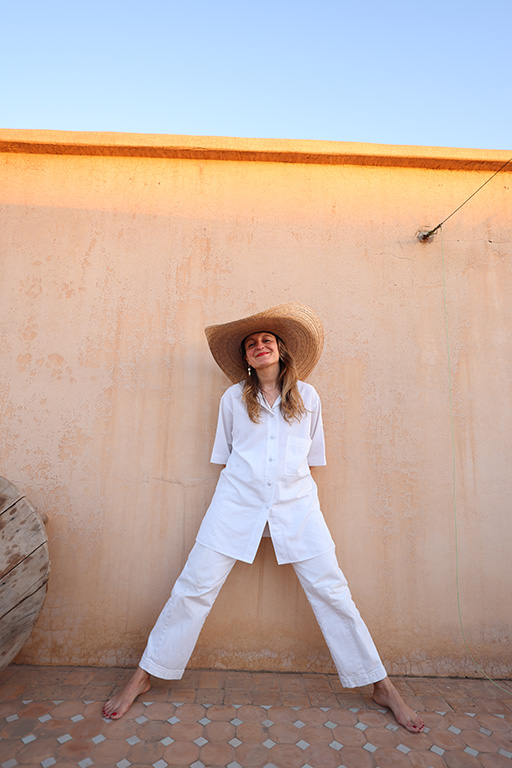
Some creative projects begin with a business plan. Zoubida began with a question: what happens when craftsmanship is no longer valued? That question led French-Moroccan creative Sophia Kacimi to leave a successful career at luxury houses including Chanel, Louis Vuitton, Alexander McQueen and Burberry in search of a slower, more meaningful way of creating. Rather than chasing the industry’s relentless cycle of novelty, she chose to return to her Amazigh roots and explore the cultural heritage of Morocco through a contemporary lens.
Today, Zoubida has evolved into a multidisciplinary creative platform where art, collectible design, interiors and fashion intersect through the work of Moroccan artisans. Here, traditional craftsmanship is not preserved as a relic of the past but reimagined as a living, evolving practice, where every object carries a story of identity, collaboration and cultural memory. At a time when the global creative industry is increasingly looking towards authenticity and local heritage as the new language of luxury, Kacimi’s work feels both deeply personal and remarkably relevant. We spoke to her about craftsmanship, collective creation, cultural identity and why looking back may sometimes be the most progressive way to move forward.
After working with some of the world’s most influential luxury houses, what was the moment when you realised that craftsmanship and cultural heritage could become the centre of your own artistic language?
My role in luxury was to be the chief conductor of a product’s journey from concept to shelf, one foot in creativity, one in strategy.
As I started to feel burned out by the rhythm of that industry, I began organising art retreats in Morocco, where my father is from, outside of fashion weeks. I could feel that my friends and I needed to slow down, reconnect with our hands. And that’s where craft came as an evidence.
Coming back with my luxury industry lens, I started paying real attention to the maîtres around me. What struck me was that the guardians of these traditions were mostly older men, incredibly skilled, financially under-rewarded, socially invisible. And the younger generations had completely turned away from this world.
That contrast was striking, because in my previous work (haute couture, fine leather goods, high jewellery…) métiers d’art are the centrepiece. They are the future. The spotlight, commercially and culturally, is moving exactly there.
So I felt a duty to change the dynamic I was witnessing in Morocco. Not to preserve craft as a relic – but to make it desirable, cool, alive. To make young people see what I saw: that these hands hold something irreplaceable, and that irreplaceable things have enormous power.
Zoubida sits somewhere between art, design, fashion and collectible objects. Do you see these disciplines as separate territories, or as different expressions of the same creative practice?
Honestly, I have a lot of fun navigating between them, and I think that freedom is intentional! The creative world has evolved so much, including the way we consume it, that these disciplines naturally feed each other. The boundaries feel less and less relevant to me. And I feel this is something that I learnt from living in London.
What ties everything together at Zoubida isn’t the category, it’s the approach. The same people, the same golden rules: local materials, Moroccan craft, and a playful instinct to turn things upside down. I am always asking myself the same questions regardless of what we’re making, how does the public interact with this object? What’s the narrative behind it? Where’s the unexpected entry point?
Whether it ends up on a gallery wall, in a living room, or on a body, that’s almost a consequence of the process, not the starting point.
Your work is deeply rooted in Moroccan textiles. Beyond their aesthetic qualities, what do these fabrics reveal about memory, identity and the way cultures preserve their stories?
The fabrics I work with are not just any fabrics. They are the centrepiece of a Moroccan home – the place where every family milestone happens, is marked, is celebrated. For anyone who grew up in Morocco, they are a real “Madeleine de Proust”. They carry memories in their weave, texture, colour.
For me, bringing them outside of that intimate domestic space isn’t a rupture, it’s an evolution. It extends their role, gives them a new life without erasing the old one.
What I find fascinating is the split in my audience. Around forty percent of the people who collect our work understand exactly what they’re holding. But a good sixty percent have been to Morocco without ever having been invited into someone’s home. They’ve never encountered these textiles in their original context. So the work becomes an introduction, an opening.
Most of these pieces have already had a life or they’re antique rolls produced years ago. Most of the factories that made them have closed. They couldn’t survive the faster, cheaper imports. What I love is that even the artisans who work with me have that moment of surprise “this reminds me of my childhood, we don’t find this quality anymore.” That reaction tells me everything.
So bringing these materials into contemporary contexts isn’t nostalgia, it’s a form of resistance. Keeping something alive by refusing to let it become a relic.
And I’ll say it openly, I started a real trend in Morocco! Five years ago, nobody was using these fabrics in this way. Now I can see how many people have been inspired by it, and I feel genuinely proud of that. Not just as a creative achievement, but because it shifted something deeper: the way people perceive their own culture.
You often describe Zoubida as a human-scale project. In a world increasingly driven by speed and mass production, what does “human scale” mean to you today?
Without a doubt and given the direction the world is moving, if I start a project, it has to be a meaningful one. I truly believe that art can create an ecosystem. That it can elevate not just the audience, but also the hands behind the work. A solo practice would make no sense to me. What keeps me genuinely aligned with what I’m doing is that it brings people with me, it provides work to people who deserve the spotlight.
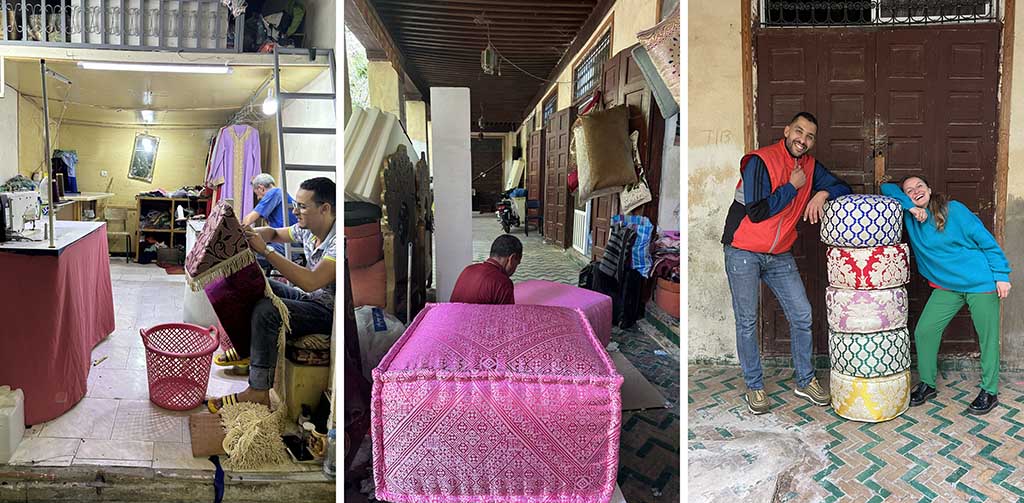
And i say it out loud: Zoubida is tiny. It’s me and my father on the day-to-day, and then a handful of artisans we’ve been working with for five years, slowly growing together. The idea has always been exactly that, to grow together. And I’m proud to be the main source of income for many of the people we work with. More recently, I decided to give the project a new dimension by involving schools of the second chance in Fès. So that new generations can see there is a future in this – that these skills are not a dead end but an opening.
When I say human scale, I also mean going against every rule the industry sets. No collections, no seasons, nothing designed to go out of date. We produce step by step, mostly on order. It’s slower, yes – but it’s more honest, more manageable, and more sustainable for everyone involved.
Having lived between London and Morocco, how has the experience of moving between cultures shaped your understanding of beauty, craftsmanship and belonging?
I’ve been living in London for about ten years. I came for my role at Alexander McQueen, straight from New York. London was immediately a catalyst. The patchwork of cultures, the collision of styles, references, prints, it gave me a visual and intellectual permission I don’t think I would have found anywhere else. It taught me that contrast is generative.
Morocco has been a constant since childhood, family visits, summers. But it’s really as an adult, after leaving the corporate world, that I felt a genuine desire to engage differently with my roots. To discover parts of the culture I had moved too fast to see.
Today I hop between the two constantly, luckily it’s only a two-and-a-half-hour flight. And I make the most of both. London feeds Zoubida in ways that are hard to overstate the exhibition culture, the richness of references, the density of opportunity. It shapes what we make and how we position it. Morocco is where the Zouzou gang is, the raw materials are, where things get made, and where I remember why.
What inspires me most isn’t just the craft, it’s the way society operates. Built on taking the time, understanding the other, trust. The complete opposite of the fast, transactional logic I’d come from. The relationship with time is different, and that difference changed how I work, how I make things, how I measure value. Between these two places, my understanding of beauty shifted. London showed me that belonging doesn’t require sameness that identity can be a collage. Morocco showed me that beauty is often slow, often humble, and always relational. Zoubida lives somewhere in that tension.
Many contemporary artists are revisiting traditional craft techniques. What responsibility do you believe artists have when working with cultural heritage and artisanal knowledge?
It makes me genuinely happy to see how many of us are moving in this direction, returning to these practices, finding new ways into them.
But the responsibility is real. As artists working with cultural heritage, we are here to make it feel relevant today. Not dusty, not museified, but alive. That means a triple duty: to sustain it, to document it, and to let it evolve. Because what doesn’t evolve, disappears.
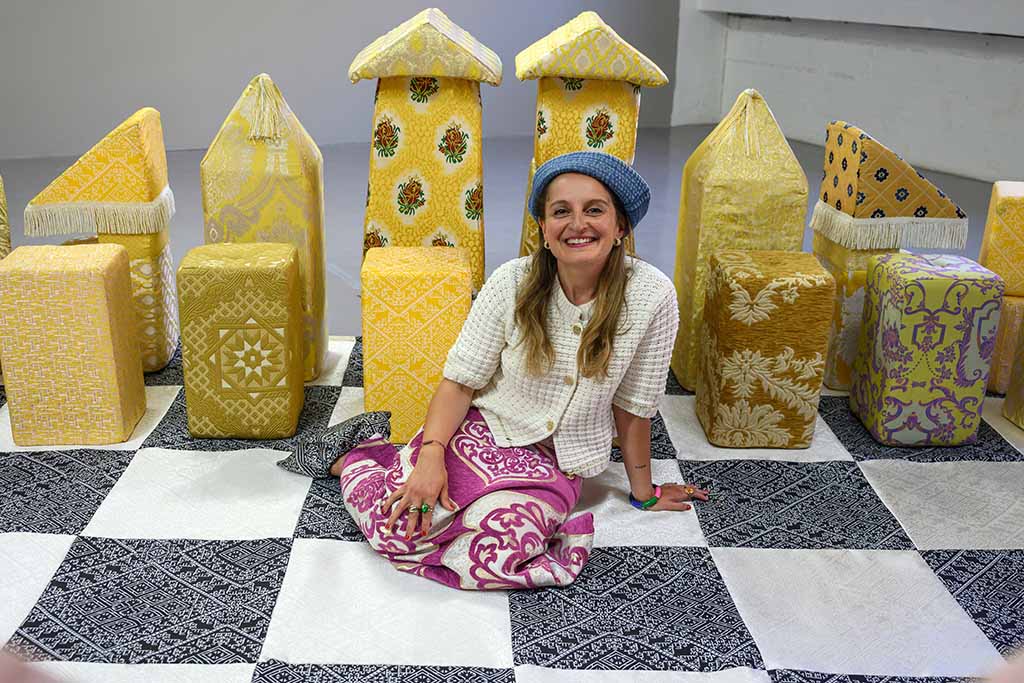
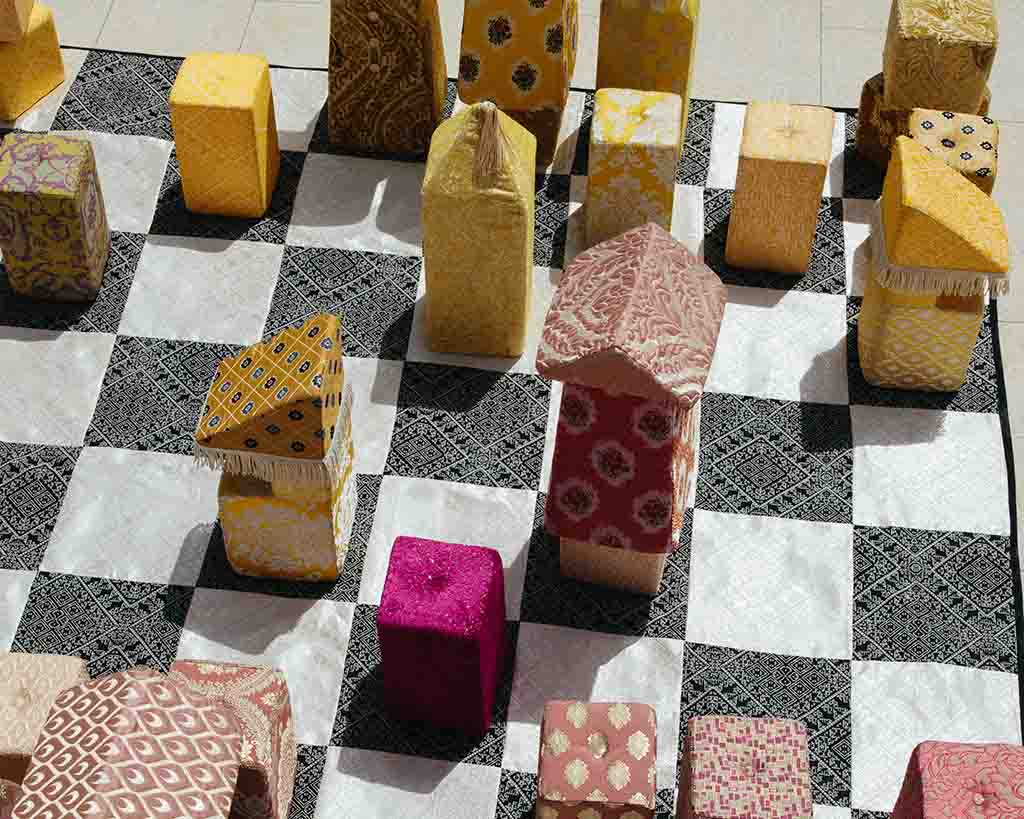
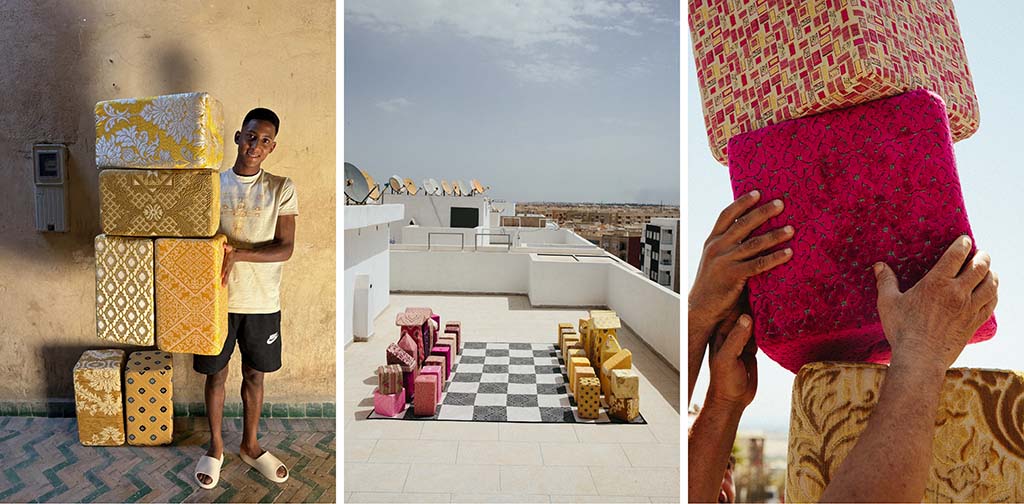
That’s exactly what I tried to show with my art piece “Play on Craft”: a giant chess set made from antique fabrics using traditional upholstery techniques. I treated the sofa-making as sculpture. Brought the craft into a completely different context, one that nobody expected. And what stayed with me most was the reaction of the artisans who worked on it. When they saw the result, they said: “I’m an artist too, actually”.
That moment said everything. When you shift the context, you shift the perception of the object, of the technique, and of the person who made it. That to me is what the responsibility looks like in practice.
The relationship between creator and artisan is central to your practice. How do you navigate authorship when a work emerges from a collective process rather than a solitary vision?
It was a deliberate choice to build this under a name that isn’t mine. My name is Sophia – but Zoubida, which is a wonderfully old Moroccan name that never fails to make people laugh, is all of us. It was important to me that the name embody the collective from the start.
The way we work is actually quite simple. The spark, the initial idea, always comes from my mind. That part I own. But then the best part of the process begins: the back-and-forth with the artisans who hold the technical knowledge. How do we do this? Which technique would work? What does the material allow?
I have learned to never arrive attached to my first idea. I adapt, I listen, I let the knowledge in the room reshape the vision. Then I come back as the one making the final decisions on materials, the colours, the fabrics, the proportions. I wear many hats in bringing these things to life. In some ways it’s not so different from what I did in luxury orchestrating a product from vision to reality. But with more freedom, more humanity, and a lot more fun.
Your installation A Chess by Zoubida transforms a familiar game into a meditation on community and collaboration. Why did chess feel like the right language to tell this story?
The idea came from a very personal place, I relearned to play chess with my father, and from that came the desire to make a giant one. There’s something about scale that changes the relationship to an object entirely.
But chess also felt right because it’s one of the rare games that crosses every culture and every generation. It needed no explanation, no translation. It was already a shared language.
And then there’s the message I chose to carry with it. In chess, the king is the centrepiece, if the king falls, the game is over. And yet the king is the piece that can make the fewest, least interesting moves of all. Without the pieces around him protecting him, he is nothing. That is exactly the message I want to share through my practice. Like the king, I am no one without the artisans around me. The spark might come from me, but the magic comes from the collective. Everything is a co-creation. I find it quite a beautiful metaphor for the power of the collective.
Chess has fascinated artists from the Surrealists to Marcel Duchamp and the Fluxus movement. What conversations were you hoping to enter by revisiting this iconic game through Moroccan craftsmanship?
Honestly, I discovered the full depth of that conversation after the piece was finished. While writing the text for it, I came across an extraordinary book (called ‘Chess design’ from Romain Morandi) documenting every artist’s version of chess ever made. It was fascinating – and it made me understand immediately why artists are so drawn to this object.
Because chess comes with rules you cannot escape. Two teams, thirty-two pieces, a strict proportionality so the hierarchy reads clearly. And I’ll tell you something: creating within constraints is one of the most exciting things you can do! It focuses the brain. It narrows the field in a way that paradoxically sets you free.
My version happened almost instinctively. An Alice in Wonderland world built on Moroccan references, it came as an obvious choice in the moment. I didn’t question it. I had a vision and I followed it.
It’s only now, a year later, looking at the piece, that I think, I must have been a little crazy to have brought this into existence. And you need craziness to give birth to such art pieces!
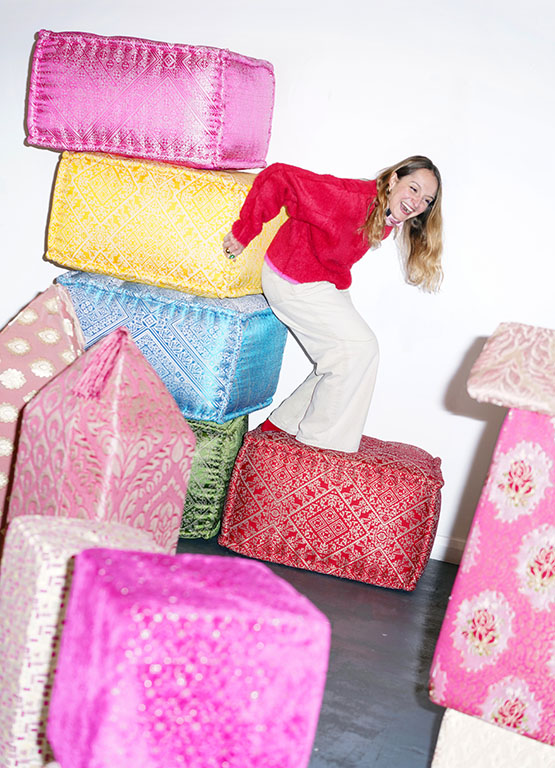
The pieces are soft, tactile and almost playful, yet they carry strong symbolic meaning. How important is playfulness in your artistic practice?
I’ve always found the way art is typically exhibited so disconnected from what art actually is: feeling, tactility, life. A white wall, a do-not-touch sign, a distance between the object and the body. I wanted to go against that completely.
I wanted to create pieces that people could touch, engage with, get close enough to understand how they were made. Nothing fragile, nothing untouchable, something that even the youngest visitor could approach and discover. Something that invited hands.
And I realised that passing a message through play has an extraordinary resonance. It creates social connection in a way that a static, silent object rarely does. So it felt like a natural extension of the making itself as many hands as it took to create these pieces, I wanted that same energy to continue when people encountered them. Hands making, hands experiencing.
Playfulness, for me, isn’t the opposite of seriousness. It’s often the most direct route to meaning.
Looking ahead, do you see Zoubida evolving further into the realm of contemporary art, or is its strength precisely in remaining between categories, resisting definition?
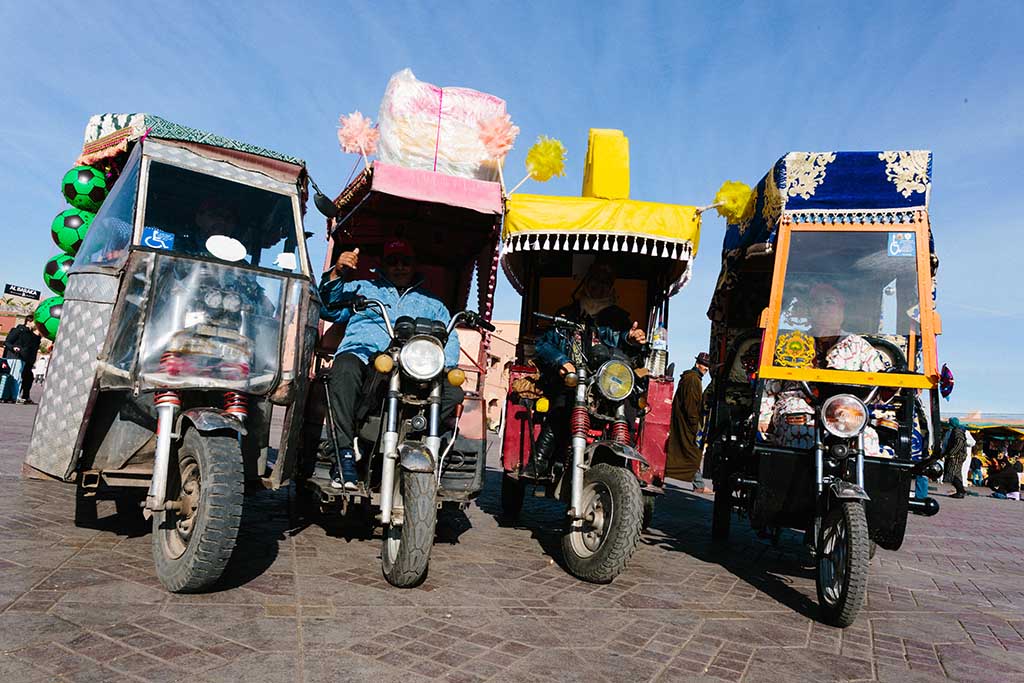
Zoubida will always be an extension of me and for that exact reason, I don’t think it will ever fit in a defined box. I think I created this beast to keep surprising. That’s precisely what a project like Tuk Tuk was involving disabled driver communities in Marrakech, bringing a completely unexpected human story into the work.
Having said that, I feel a real pull toward contemporary art right now. A desire to go head down and push further in that direction. It allows me to work on larger pieces, detached from any commercial rhythm, with more people, at a different scale. And the art audience genuinely responds to what I do, they understand it, they want it.
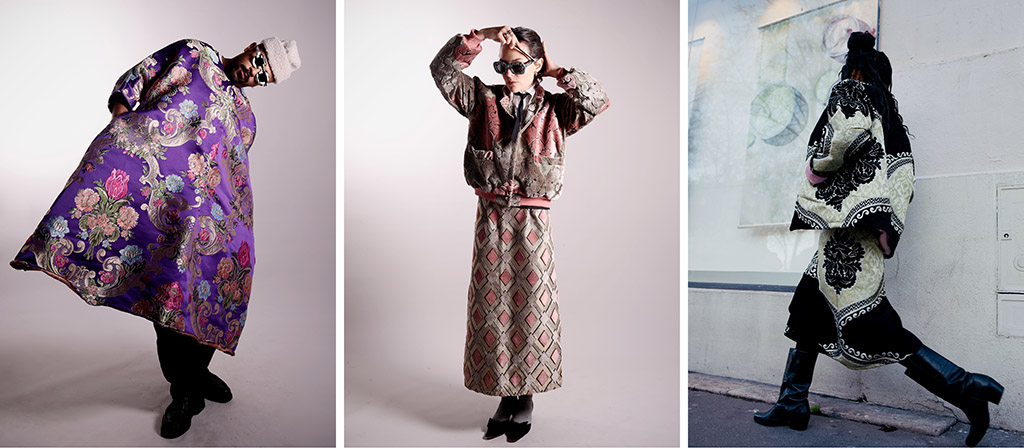
What makes this possible is our art-to-wear line, one-of-a-kind statement pieces, all unisex, that are very much part of the Zoubida world. That’s what funds the art developments today. You can find an existing range on our website (zoubidazoubida.com), but honestly my favourite part is bespoke, sharing my fabric catalogue with someone and co-creating the piece of their dreams together. It’s how we started, and it remains one of the most intimate things we do.
But more than anything, I think people are craving exactly what Zoubida does: more meaning, more colour, more joy. So wherever it goes, that won’t change.